Most teams want to recognize good work, but they struggle to do it. Recognition often appears in bursts: a big push during appreciation week, a few shoutouts when someone remembers, then long stretches where everyday effort goes unnoticed.
That inconsistency matters. Gallup research shows that employees who receive high-quality recognition are 45% less likely to leave their jobs over two years. That kind of stability directly affects retention and improves employee engagement.
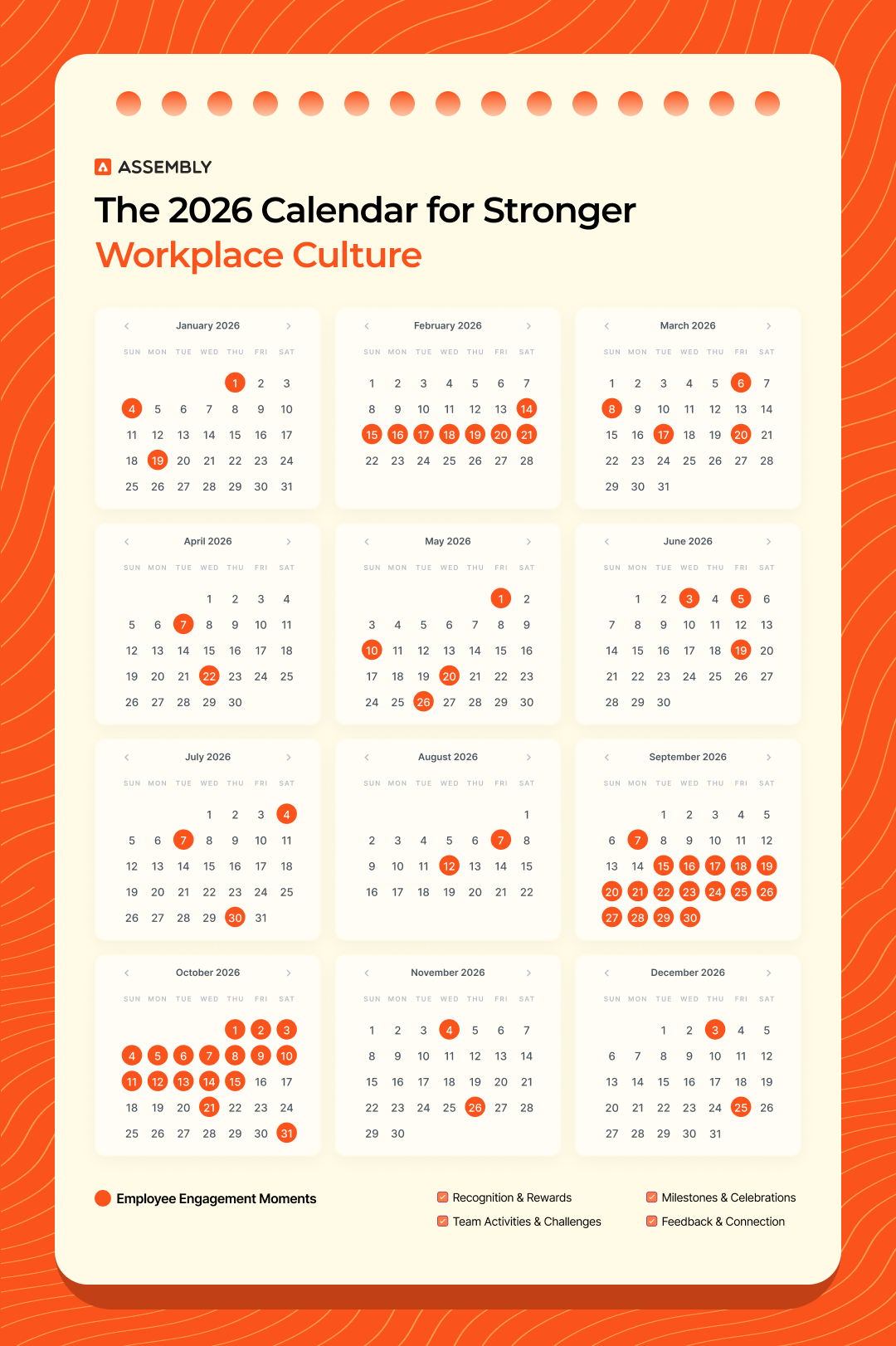
If you’re planning engagement more broadly, this monthly employee recognition guide pairs well with an employee engagement calendar to help you map moments across the year. Instead of scrambling for ideas each month, you’ll get practical themes and prompts you can use year-round, from birthdays and anniversaries to peer wins, team momentum, and behind-the-scenes effort.
Employee Recognition: What It Means and How to Do It Well
Employee recognition helps employees understand which contributions truly matter.
At its core, recognition is feedback. It tells employees, “This behavior mattered,” or “This effort moved us forward.” When recognition is vague or rare, employees are left guessing what success really means. When it’s specific and consistent, it becomes one of the strongest drivers of performance and retention.
The biggest mistake teams make is recognizing only outcomes like deals closed, deadlines met, and launches shipped, while missing the everyday work behind them.
Best employee recognitions also highlight:
The teammate who unblocked others quietly.
The person who kept customers calm during a tough week.
The manager who protected focus time and prevented burnout.
The employee who showed up consistently, not just impressively.
To build recognition that truly sticks, focus on three core pillars.
1. Make Recognition Timely - Timely recognition connects effort to appreciation while the context is still fresh. A quick callout after a helpful action or a tough week lands far better than praise delivered weeks later.
2. Make Recognition Specific - Specific recognition creates clarity. Calling out what someone did and why it mattered helps reinforce the behaviors you want repeated and makes appreciation feel genuine, not performative.
3. Make Recognition Repeatable - Consistency matters more than intensity. If recognition relies on memory or extra effort, it will fade during busy periods. Simple systems, recurring prompts, and automated reminders help teams recognize people regularly without adding work.
Assembly helps you put recognition into practice. It prompts key moments like birthdays and anniversaries, gives teams a place to share peer shoutouts, and keeps recognition visible instead of forgotten.
How to Use This 2026 Month-by-Month Employee Recognition Guide
One of the hardest parts of employee recognition is same things keep getting recognized. Without a clear lens, teams tend to recognize the same types of wins, while other meaningful contributions go unnoticed.
This guide is designed to change that. It helps you decide what to recognize and when.
Each month shifts your attention to a different kind of contribution. Some months focus on progress and momentum. Others bring support, collaboration, reliability, or behind-the-scenes effort into view. That shift is intentional. It keeps recognition from becoming repetitive or centered on the same roles or outcomes.
You don’t need to plan the entire year at once. At the start of each month, look only at that month’s section and ask one simple question: What kind of work should we be paying more attention to right now? Then recognize what you see.
You don’t need to follow all the listed ideas exactly. Use them as cues for what to call out in a meeting, what to highlight in a post, or what to acknowledge in a peer shoutout. If an idea doesn’t fit your team, skip it. The value is in the focus, not the format.
Over time, this approach leads to more balanced recognition. Different people get recognized. Different kinds of effort get noticed. Recognition starts to reflect how work actually happens, not just how results show up.
So here are 36 employee recognition ideas to help you recognize the right moments, month by month, all year long.
Monthly Employee Recognition Ideas to Run All Year
Before the month-by-month themes, these are the recognition moments that should always be running in the background, month after month.
1. Birthday Celebrations
Birthdays work best when they feel intentional, not automated. A single “Happy Birthday!” message rarely lands unless it’s paired with context.
You can pair every birthday with one specific callout from the past year. It could be a project they led, a teammate they supported, or a habit they consistently show up with. This turns a personal milestone into a recognition moment without making it uncomfortable.
You can use Assembly to handle the reminder so no one is missed and the message stays personal.
If your team needs inspiration for what to write, our guide to birthday wishes for coworkers has 120+ messages organised by tone from funny to heartfelt to professional.
2. Work Anniversaries
Work anniversaries recognize commitment, growth, and continuity.
Instead of celebrating how long someone has been at the company, highlight what’s changed because they’ve been there. New skills, expanded ownership, or the impact they’ve had on others.
You can invite short peer or manager notes for milestone anniversaries. Even two or three sentences add depth and signal that the employee’s journey is noticed.
Instead of rewarding only top performers, rotate the focus. Some months can highlight results. Others can recognize collaboration, reliability, or leadership behaviors. This prevents recognition from feeling repetitive or competitive.
Be transparent about why someone is chosen. When the criteria are clear, the recognition feels fair and aspirational rather than subjective.
Encourage regular shoutouts for small wins, support moments, or everyday effort. A weekly or monthly “wins” thread helps normalize appreciation and keeps recognition from being reserved only for big achievements.
When peers recognize each other consistently, appreciation feels more authentic, and culture becomes something employees actively participate in, not something handed down from the top.
January Employee Recognition Ideas
January sets the tone for the year ahead. Use this month to acknowledge recent effort, reset recognition habits, and start the year with appreciation that feels intentional.
5. New Year Kickoff Recognition
Instead of jumping straight into new goals, start the new year by acknowledging the wins that closed out the previous year.
You can spotlight individuals or teams who maintained momentum and follow-through as the year wrapped up. Calling out specific contributions helps employees see how their past efforts still matter as the year begins.
6. Recognition for Year-End Support
The end of the year often looks quieter than it actually is. While some people are out, others are keeping things running.
January is a good time to acknowledge employees who covered shifts, handled customer needs, or stepped in to support teammates during holiday downtime. This kind of work is easy to overlook because it happens without fanfare.
You can simply call out what they stepped in to do and how it helped the team. You can use Assembly to track these moments so they don’t get forgotten once the year picks up speed.
February Employee Recognition Ideas
After the rush of the new year, this month creates space to reinforce connection, belonging, and how people show up for each other.
7. Peer-to-Peer Appreciation Moments
February works well for encouraging employees to recognize each other directly.
Run a simple “gratitude chain” where each person calls out one teammate and shares why their support mattered. Keep it lightweight and specific so it feels genuine, not forced. The value comes from hearing appreciation in the words of peers, not from polished messages.
You can highlight moments where teams worked across functions, shared context, or helped each other move faster. Calling out how collaboration reduced friction or made work smoother reinforces that teamwork itself is worth recognizing, not just the result.
9. Culture Builder Shoutouts
Culture is shaped by everyday actions, not statements. Recognize employees who helped others feel included, supported new teammates, or created space for collaboration. Highlighting these moments makes cultural contributions visible and encourages others to show up in the same way.
March Employee Recognition Ideas
Use March to recognize effort, learning, and forward movement, not just finished results.
10. Employee Appreciation Day
Employee Appreciation Day is more than a thank-you message. Start with personal notes from managers. A short, specific message about what the employee did and why it mattered lands far better than a generic “great job.”
Pair those notes with a tangible reward, whether that’s points, a gift card, or a small experience that fits your culture and employee incentive program.
Assembly makes this easier by letting managers send personal recognition, attach rewards, and share stories in one place. Instead of juggling messages and spreadsheets, you create a single moment of appreciation that feels coordinated and genuine.
11. Learning & Growth Recognition
March is the perfect time to recognize growth that is still in progress. Not every win is finished or measurable yet, and employees need to know that learning and effort are valued, too.
Recognize teammates who are:
Building new skills.
Taking on stretch projects.
Mentoring others.
Making steady progress toward a longer-term goal.
Acknowledge the initiative to learn something new or the persistence to keep improving, even when the outcome is not final.
April Employee Recognition Ideas
By April, energy can start to dip. The year is no longer new, and workloads are steady. Recognition in April should reinforce sustainable performance, healthy habits, and the leaders who make balance possible.
12. Wellness-Focused Recognition
Wellness recognition is about appreciating behaviors that help work stay healthy and sustainable.
Recognize employees who model good habits, like setting boundaries, taking time off when needed, or encouraging teammates to disconnect after hours. Call out peers who support others during busy weeks or help redistribute work before stress spikes.
Make recognition specific so it feels earned, not performative. A short note explaining how someone protected team wellbeing goes a long way.
13. First Quarter Milestone Recognition
April is the perfect time to pause and recognize progress from Q1. Even if goals are not fully complete, milestones matter.
Celebrate teams and individuals who:
Hit key checkpoints.
Shipped meaningful improvements.
Made steady progress on long-term initiatives.
May Employee Recognition Ideas
By May, a lot of teams are in a steady rhythm. The work isn’t new anymore, but it’s not slowing down either. This is where recognition can quietly make a big difference.
14. Reliability Recognition
Every team has people who just show up.
Use reliability recognition to recognize those employees who consistently follow through, meet deadlines, and keep work moving without needing escalation or reminders.
A simple recognition for showing up consistently goes a long way. It tells the team that reliability isn’t invisible here and that steady, dependable work is worth celebrating.
15. Customer Love Shoutouts
Customer feedback is one of the easiest ways to make recognition feel real.
Highlight employees who are mentioned in reviews, support tickets, or direct messages. Share what the customer appreciated and connect it back to the behavior behind it.
This helps employees see how their work shows up outside the organization and reinforces customer-focused habits across teams.
June Employee Recognition Ideas
By June, you’ve got real momentum. Work is moving, teams are collaborating, and progress is happening across the board. This is a great moment to pause and recognize what’s already working.
16. Mid-Year Wins Celebration
June is a natural checkpoint.
Instead of waiting for year-end, take time to recognize what’s already been accomplished. Call out projects that shipped, problems that were solved, or goals that moved forward. Focus on progress, not perfection.
Sharing these wins reminds employees that their effort is adding up and how much their work matters in the organisation.
17. Team Awards
You can spotlight teams that worked well together, handled a tough stretch, or supported others while still delivering their own work. Recognizing teams reinforces collaboration and shows that success isn’t always individual.
Team recognition might look like a simple team shoutout, a short story shared company-wide, or a small collective reward that everyone on the team shares.
You can invite teams to publicly thank other teams who shared context, jumped in to help, or removed blockers. This could be as simple as a dedicated “thanks to another team” thread or a few minutes in a meeting to call out cross-team support.
Making these moments visible helps break down silos and reinforces people to support each other. It makes recognition feel shared rather than competitive and helps build trust across teams.
July Employee Recognition Ideas
July is a good month to recognize trust and ownership in people who step up, take responsibility, and solve problems on their own.
19. Ownership and Accountability Recognition
Recognize employees who took initiative, owned a problem end-to-end, or followed through when things could have stalled.
A simple callout that explains what they took ownership of and how it helped is enough. This kind of recognition shows that accountability and follow-through matter.
20. Manager Shoutouts
Use July to recognize managers who supported their teams with trust and clarity. This might be a leader who gave autonomy, removed blockers, or communicated clearly during a busy period. Calling out these behaviors reinforces the kind of leadership employees want to experience.
You can do this through a short public shoutout or a note shared in a team update.
21. Independent Problem-Solving Recognition
Recognize employees who figured things out on their own, made decisions with confidence, or found solutions without escalating everything. Naming what they solved and why it mattered helps reinforce independence and good judgment.
This kind of recognition encourages people to trust themselves and take action when challenges come up.
August Employee Recognition Ideas
August often runs on coverage and support. With people taking time off, the work still gets done because others step in quietly and keep things moving.
22. Recognition for Stepping In and Supporting Others
Notice the people who picked up extra work, covered for teammates, or helped things run smoothly while others were out.
You can recognize this with a short callout that names what they stepped in to handle and why it mattered. Keeping it specific shows that support work is seen and appreciated, not just expected.
23. Behind-the-Scenes Contributions
Some roles make everything else possible without drawing attention to themselves. Recognize operations, enablement, admin, and support roles that keep systems running and teams organized.
Calling out how their work made others’ jobs easier helps everyone see the impact of behind-the-scenes contributions.
24. Mentor Appreciation
Take time to recognize employees who consistently mentor others, formally or informally. Call out the impact they had, such as helping a new hire ramp faster, supporting a career move, or building confidence during a tough project.
With Assembly, you can spotlight mentors through peer nominations and public recognition tied to values like growth and leadership.
September Employee Recognition Ideas
In September, work settles into a steady pace, and this is where thoughtful improvements and real impact start to show.
25. Innovation and Idea-Sharing Recognition
You can recognize employees who suggested a new approach, improved a workflow, or solved a problem in a creative way. Highlight what they improved and why it mattered. This encourages others to share ideas without fear of being ignored.
26. Process Improvement Appreciation
Process improvements are easy to overlook because they quietly remove friction. But those wins often save hours, reduce errors, and improve morale.
Appreciate teammates who streamlined workflows, automated manual tasks, clarified documentation, or simplified handoffs between teams.
27. Customer Impact Highlights
Customer impact is one of the clearest signals of meaningful work. Recognize individuals or teams who improved customer speed, quality, satisfaction, or delivery. Share the metrics when possible, like faster response times, fewer errors, or positive feedback.
This helps employees see how their work connects directly to the customer experience.
October Employee Recognition Ideas
October is a good time to recognize impact and leadership. By now, people have made real decisions, taken ownership, and delivered results that are visible across the business.
28. Leadership & Impact Awards
Use this moment to recognize people who made strong decisions and followed them through. You can highlight employees who took ownership of complex work, made judgment calls under pressure, or drove results that had a clear impact.
When you recognize this, focus on what decision they made, why it mattered, and what changed because of it.
This helps others understand that leadership isn’t just about titles. It’s about responsibility, clarity, and outcomes.
29. Peer Nominated Recognition
Peer nominations add a different kind of credibility to recognition.
Invite the team to nominate colleagues for categories like “most helpful,” “most reliable,” or “best collaborator.” Keep the process simple so participation stays high. A short explanation with each nomination helps recognition feel thoughtful, not popularity-based.
With Assembly, peer nominations are easy to collect, review, and share.
30. Behind-the-Scenes MVP
Ask teams to nominate someone who helped quietly behind the scenes that month. Keep the nominations short and light. It’s an easy way to recognize support without turning it into a formal award.
November Employee Recognition Ideas
November is a natural moment to slow down and acknowledge the people behind the progress.
31. Thanksgiving Gratitude Campaign
November is a great time to let appreciation come from peers, not just leaders. Thanksgiving gives you a natural reason to pause and say thank you.
Use the week around Thanksgiving to run a simple gratitude campaign where employees recognize each other for support, help, or teamwork throughout the year. A short “thank-you notes” moment works well here. Encourage people to name what someone did and why it mattered to them personally.
32. Year-End Push Appreciation
The final stretch of the year often demands extra focus, effort, and resilience. November is a good moment to recognize employees who are carrying momentum forward and setting the team up for a strong finish.
Appreciate teammates who:
Stepped up during tight deadlines or heavy workloads.
Maintained quality and consistency under pressure.
Helped others stay focused and motivated during the push.gm
Recognizing this effort shows that you value how people showed up, not just what made it into the final results.
33. Gratitude Wall or Thread
Create a shared space where people can post quick thank-yous throughout the week. It could be a Slack thread, board, or internal post. No long messages needed. Just short notes calling out help, kindness, or support.
Watching the messages stack up creates momentum and makes appreciation feel collective and easy.
December Employee Recognition Ideas
In December, employees are closing out projects, reflecting on the year, and thinking about what their work added up to. This is the moment to make appreciation feel real and earned.
34. Year-End Contribution Recognition
Instead of broad thank-yous, recognize standout contributions with short stories. Call out what someone worked on, the challenge they handled, or the difference they made over time. Specific examples help employees see that their effort was noticed, not just their final output.
35. Team Wins Recap
Share a “top wins” recap that highlights key projects, milestones, or improvements from the year. Tag the people and teams who made those wins possible so credit feels shared, not abstract.
This recap helps everyone see how their work fits into the bigger picture and ends the year on a note of collective progress.
36. Holiday Gifting & Rewards
When it comes to holiday rewards, flexibility matters.
Instead of guessing what people want, you can give employees the flexibility to choose something that actually fits their lives. Whether it’s food, shopping, travel, or a small treat, digital gift cards make the reward feel useful rather than symbolic.
They’re also easy to send and easy to manage, which matters during a busy time of year. Assembly lets you send digital gift cards alongside a personal message, so the appreciation feels thoughtful without turning gifting into an admin-heavy task.
If you’re exploring other options alongside gift cards, these holiday gift ideas can help you find thoughtful alternatives.
What do You Say When Recognizing an Employee?
Recognition lands best when it’s specific, human, and grounded in real work. You don’t need a long message or perfect phrasing. You just need to explain what the person did and why it mattered.
If you’re ever stuck on what to say, use this simple structure:
What they did
How it helped
Why it mattered
Below are 25 prompts you can use as-is or tweak to sound like you.
Ownership & Accountability Recognition Prompts
“You took ownership of [task or situation] and followed it through to [result]. That made a real difference because [impact].”
“The decision you made around [action] helped the team move forward when [context]. Thanks for stepping up.”
“You didn’t wait for direction on [task]. Taking initiative there helped us avoid [issue or delay].”
“Handling [challenge] the way you did showed strong judgment and accountability.”
Peer-to-Peer Recognition Prompts
“I want to thank you for helping with [specific action]. It made my work easier and kept things moving.”
“You jumped in on [task or moment] when it was needed. I really appreciated that support.”
“Working with you on [project] helped things come together faster because [reason].”
“Your help with [specific thing] didn’t go unnoticed. It made a difference for me.”
Impact & Results Recognition Prompts
“Your work on [project or task] directly led to [result]. This mattered because [impact].”
“Because of how you handled [action], we were able to [outcome].”
“The result we saw with [metric, delivery, or outcome] connects back to the work you did on [task].”
“I want to call out the impact of your work on [area]. It helped us achieve [result].”
Collaboration & Teamwork Recognition Prompts
“You helped bring clarity to [situation] and kept everyone aligned. That made collaboration easier.”
“The way you worked with [team or person] on [task] helped avoid friction and move things forward.”
“You created space for others to contribute during [project or moment], which really helped the team.”
“Your willingness to work through [challenge] with others made a tough situation easier.”
Growth, Learning & Effort Recognition Prompts
“I’ve noticed how much progress you’ve made on [skill or responsibility]. It’s clearly paying off.”
“The effort you put into learning [tool, process, or skill] really showed in [result or behavior].”
“You took feedback on [area] and applied it thoughtfully. That growth stands out.”
“I appreciate the work you’ve put into improving how you handle [task or situation].”
Support & Reliability Recognition Prompts
Use these for consistency, dependability, and behind-the-scenes effort.
“You consistently showed up for [task or responsibility], and that reliability helped the team stay on track.”
“The guidance you gave on [situation] helped someone grow and gain confidence. That kind of leadership matters.”
“Thank you for covering [work or situation]. Knowing it was handled made a big difference.”
“Your follow-through on [task] helped keep things moving without extra back-and-forth.”
“You’ve been someone the team can rely on, especially during [busy or challenging time].”
How to Turn Monthly Recognition into a Year-Round Program
Monthly recognition ideas work best when they don’t feel like extra work. The goal isn’t to run twelve separate initiatives. It’s to create a rhythm that makes recognition easier over time, not harder.
1. Keep Recognition Consistent Without Burnout
Recognition should never feel like another task on a manager’s checklist. The key is to make it lightweight and repeatable.
Set a simple baseline, such as one meaningful recognition moment per manager each month, and give clear prompts so no one starts from scratch. Focus on quality over volume. One specific, thoughtful message does more than five generic shoutouts.
You can use Assembly’s built-in prompts, reminders, and templates to help managers recognize consistently without spending extra time or mental energy.
Planned recognition, like monthly themes or milestone moments, ensures no one gets overlooked. Spontaneous recognition captures real-time effort, problem-solving, and support as it happens.
Use monthly themes to guide focus, but leave space for in-the-moment appreciation when someone steps up. This balance keeps recognition from feeling forced while still staying fair and visible.
3. Encouraging Peer-to-Peer Recognition Throughout The Year
Peer-to-peer appreciation captures the everyday impact that leaders may not see.
Make peer recognition easy, visible, and encouraged. Set clear expectations that recognition should be specific and tied to values, not just “thanks.” Highlight great peer recognition examples so others learn what good looks like.
Assembly empowers peer-to-peer recognition by giving everyone a voice and making appreciation public across teams. When employees recognize each other consistently, recognition becomes part of the culture, not an initiative.
Final Words
Use this employee recognition ideas guide as support, not pressure. You don’t need to do everything or get it perfect. Take the ideas that fit your team, your culture, and your capacity, and leave the rest. Over time, it’s the small, consistent moments of appreciation that matter most.
Assembly helps make that consistency easier to sustain. With built-in prompts, reminders, and simple templates, you can recognize employees regularly without adding extra work or burning out.
Ready to make employee recognition easier? Book a demo call to see the difference.
FAQ
How often should employee recognition happen?
Employee recognition should happen regularly, not just during special occasions. Small moments of appreciation shared weekly or monthly help reinforce good work and keep morale steady. You don’t need to recognize everything, but you do need a consistent rhythm so appreciation doesn’t disappear when work gets busy.
What are simple employee recognition ideas?
Simple recognition ideas include quick peer shoutouts, short thank-you notes, public callouts in meetings, or highlighting small wins in a shared channel. The key is specificity. Calling out what someone did and why it mattered makes even the simplest recognition feel meaningful.
How do you keep recognition consistent across teams?
Give teams common prompts or themes, but let them recognize in ways that fit their workflow. Assembly helps by keeping recognition visible in one place, so appreciation doesn’t depend on individual managers or memory.
What’s the best way to plan employee recognition for the year?
Start with a few recurring moments like birthdays, anniversaries, and monthly recognition themes. Plan lightly, not perfectly. A loose framework makes recognition easier to sustain and leaves room for spontaneous appreciation.
How do you recognize employees for years of service?
Years of service recognition works best when it focuses on growth, not just tenure. Highlight how the employee’s role has evolved, what they’ve contributed over time, and how they’ve supported others. Pairing that reflection with a personal message or flexible reward makes the milestone feel genuine.
class SampleComponent extends React.Component {
  // using the experimental public class field syntax below. We can also attach
  // the contextType to the current class
  static contextType = ColorContext;
  render() {
    return <Button color={this.color} />
  }
}
Most teams want to recognize good work, but they struggle to do it. Recognition often appears in bursts: a big push during appreciation week, a few shoutouts when someone remembers, then long stretches where everyday effort goes unnoticed.
That inconsistency matters. Gallup research shows that employees who receive high-quality recognition are 45% less likely to leave their jobs over two years. That kind of stability directly affects retention and improves employee engagement.
If you’re planning engagement more broadly, this monthly employee recognition guide pairs well with an employee engagement calendar to help you map moments across the year. Instead of scrambling for ideas each month, you’ll get practical themes and prompts you can use year-round, from birthdays and anniversaries to peer wins, team momentum, and behind-the-scenes effort.
Employee Recognition: What It Means and How to Do It Well
Employee recognition helps employees understand which contributions truly matter.
At its core, recognition is feedback. It tells employees, “This behavior mattered,” or “This effort moved us forward.” When recognition is vague or rare, employees are left guessing what success really means. When it’s specific and consistent, it becomes one of the strongest drivers of performance and retention.
The biggest mistake teams make is recognizing only outcomes like deals closed, deadlines met, and launches shipped, while missing the everyday work behind them.
Best employee recognitions also highlight:
The teammate who unblocked others quietly.
The person who kept customers calm during a tough week.
The manager who protected focus time and prevented burnout.
The employee who showed up consistently, not just impressively.
To build recognition that truly sticks, focus on three core pillars.
1. Make Recognition Timely - Timely recognition connects effort to appreciation while the context is still fresh. A quick callout after a helpful action or a tough week lands far better than praise delivered weeks later.
2. Make Recognition Specific - Specific recognition creates clarity. Calling out what someone did and why it mattered helps reinforce the behaviors you want repeated and makes appreciation feel genuine, not performative.
3. Make Recognition Repeatable - Consistency matters more than intensity. If recognition relies on memory or extra effort, it will fade during busy periods. Simple systems, recurring prompts, and automated reminders help teams recognize people regularly without adding work.
Assembly helps you put recognition into practice. It prompts key moments like birthdays and anniversaries, gives teams a place to share peer shoutouts, and keeps recognition visible instead of forgotten.
How to Use This 2026 Month-by-Month Employee Recognition Guide
One of the hardest parts of employee recognition is same things keep getting recognized. Without a clear lens, teams tend to recognize the same types of wins, while other meaningful contributions go unnoticed.
This guide is designed to change that. It helps you decide what to recognize and when.
Each month shifts your attention to a different kind of contribution. Some months focus on progress and momentum. Others bring support, collaboration, reliability, or behind-the-scenes effort into view. That shift is intentional. It keeps recognition from becoming repetitive or centered on the same roles or outcomes.
You don’t need to plan the entire year at once. At the start of each month, look only at that month’s section and ask one simple question: What kind of work should we be paying more attention to right now? Then recognize what you see.
You don’t need to follow all the listed ideas exactly. Use them as cues for what to call out in a meeting, what to highlight in a post, or what to acknowledge in a peer shoutout. If an idea doesn’t fit your team, skip it. The value is in the focus, not the format.
Over time, this approach leads to more balanced recognition. Different people get recognized. Different kinds of effort get noticed. Recognition starts to reflect how work actually happens, not just how results show up.
So here are 36 employee recognition ideas to help you recognize the right moments, month by month, all year long.
Monthly Employee Recognition Ideas to Run All Year
Before the month-by-month themes, these are the recognition moments that should always be running in the background, month after month.
1. Birthday Celebrations
Birthdays work best when they feel intentional, not automated. A single “Happy Birthday!” message rarely lands unless it’s paired with context.
You can pair every birthday with one specific callout from the past year. It could be a project they led, a teammate they supported, or a habit they consistently show up with. This turns a personal milestone into a recognition moment without making it uncomfortable.
You can use Assembly to handle the reminder so no one is missed and the message stays personal.
If your team needs inspiration for what to write, our guide to birthday wishes for coworkers has 120+ messages organised by tone from funny to heartfelt to professional.
2. Work Anniversaries
Work anniversaries recognize commitment, growth, and continuity.
Instead of celebrating how long someone has been at the company, highlight what’s changed because they’ve been there. New skills, expanded ownership, or the impact they’ve had on others.
You can invite short peer or manager notes for milestone anniversaries. Even two or three sentences add depth and signal that the employee’s journey is noticed.
Instead of rewarding only top performers, rotate the focus. Some months can highlight results. Others can recognize collaboration, reliability, or leadership behaviors. This prevents recognition from feeling repetitive or competitive.
Be transparent about why someone is chosen. When the criteria are clear, the recognition feels fair and aspirational rather than subjective.
Encourage regular shoutouts for small wins, support moments, or everyday effort. A weekly or monthly “wins” thread helps normalize appreciation and keeps recognition from being reserved only for big achievements.
When peers recognize each other consistently, appreciation feels more authentic, and culture becomes something employees actively participate in, not something handed down from the top.
January Employee Recognition Ideas
January sets the tone for the year ahead. Use this month to acknowledge recent effort, reset recognition habits, and start the year with appreciation that feels intentional.
5. New Year Kickoff Recognition
Instead of jumping straight into new goals, start the new year by acknowledging the wins that closed out the previous year.
You can spotlight individuals or teams who maintained momentum and follow-through as the year wrapped up. Calling out specific contributions helps employees see how their past efforts still matter as the year begins.
6. Recognition for Year-End Support
The end of the year often looks quieter than it actually is. While some people are out, others are keeping things running.
January is a good time to acknowledge employees who covered shifts, handled customer needs, or stepped in to support teammates during holiday downtime. This kind of work is easy to overlook because it happens without fanfare.
You can simply call out what they stepped in to do and how it helped the team. You can use Assembly to track these moments so they don’t get forgotten once the year picks up speed.
February Employee Recognition Ideas
After the rush of the new year, this month creates space to reinforce connection, belonging, and how people show up for each other.
7. Peer-to-Peer Appreciation Moments
February works well for encouraging employees to recognize each other directly.
Run a simple “gratitude chain” where each person calls out one teammate and shares why their support mattered. Keep it lightweight and specific so it feels genuine, not forced. The value comes from hearing appreciation in the words of peers, not from polished messages.
You can highlight moments where teams worked across functions, shared context, or helped each other move faster. Calling out how collaboration reduced friction or made work smoother reinforces that teamwork itself is worth recognizing, not just the result.
9. Culture Builder Shoutouts
Culture is shaped by everyday actions, not statements. Recognize employees who helped others feel included, supported new teammates, or created space for collaboration. Highlighting these moments makes cultural contributions visible and encourages others to show up in the same way.
March Employee Recognition Ideas
Use March to recognize effort, learning, and forward movement, not just finished results.
10. Employee Appreciation Day
Employee Appreciation Day is more than a thank-you message. Start with personal notes from managers. A short, specific message about what the employee did and why it mattered lands far better than a generic “great job.”
Pair those notes with a tangible reward, whether that’s points, a gift card, or a small experience that fits your culture and employee incentive program.
Assembly makes this easier by letting managers send personal recognition, attach rewards, and share stories in one place. Instead of juggling messages and spreadsheets, you create a single moment of appreciation that feels coordinated and genuine.
11. Learning & Growth Recognition
March is the perfect time to recognize growth that is still in progress. Not every win is finished or measurable yet, and employees need to know that learning and effort are valued, too.
Recognize teammates who are:
Building new skills.
Taking on stretch projects.
Mentoring others.
Making steady progress toward a longer-term goal.
Acknowledge the initiative to learn something new or the persistence to keep improving, even when the outcome is not final.
April Employee Recognition Ideas
By April, energy can start to dip. The year is no longer new, and workloads are steady. Recognition in April should reinforce sustainable performance, healthy habits, and the leaders who make balance possible.
12. Wellness-Focused Recognition
Wellness recognition is about appreciating behaviors that help work stay healthy and sustainable.
Recognize employees who model good habits, like setting boundaries, taking time off when needed, or encouraging teammates to disconnect after hours. Call out peers who support others during busy weeks or help redistribute work before stress spikes.
Make recognition specific so it feels earned, not performative. A short note explaining how someone protected team wellbeing goes a long way.
13. First Quarter Milestone Recognition
April is the perfect time to pause and recognize progress from Q1. Even if goals are not fully complete, milestones matter.
Celebrate teams and individuals who:
Hit key checkpoints.
Shipped meaningful improvements.
Made steady progress on long-term initiatives.
May Employee Recognition Ideas
By May, a lot of teams are in a steady rhythm. The work isn’t new anymore, but it’s not slowing down either. This is where recognition can quietly make a big difference.
14. Reliability Recognition
Every team has people who just show up.
Use reliability recognition to recognize those employees who consistently follow through, meet deadlines, and keep work moving without needing escalation or reminders.
A simple recognition for showing up consistently goes a long way. It tells the team that reliability isn’t invisible here and that steady, dependable work is worth celebrating.
15. Customer Love Shoutouts
Customer feedback is one of the easiest ways to make recognition feel real.
Highlight employees who are mentioned in reviews, support tickets, or direct messages. Share what the customer appreciated and connect it back to the behavior behind it.
This helps employees see how their work shows up outside the organization and reinforces customer-focused habits across teams.
June Employee Recognition Ideas
By June, you’ve got real momentum. Work is moving, teams are collaborating, and progress is happening across the board. This is a great moment to pause and recognize what’s already working.
16. Mid-Year Wins Celebration
June is a natural checkpoint.
Instead of waiting for year-end, take time to recognize what’s already been accomplished. Call out projects that shipped, problems that were solved, or goals that moved forward. Focus on progress, not perfection.
Sharing these wins reminds employees that their effort is adding up and how much their work matters in the organisation.
17. Team Awards
You can spotlight teams that worked well together, handled a tough stretch, or supported others while still delivering their own work. Recognizing teams reinforces collaboration and shows that success isn’t always individual.
Team recognition might look like a simple team shoutout, a short story shared company-wide, or a small collective reward that everyone on the team shares.
You can invite teams to publicly thank other teams who shared context, jumped in to help, or removed blockers. This could be as simple as a dedicated “thanks to another team” thread or a few minutes in a meeting to call out cross-team support.
Making these moments visible helps break down silos and reinforces people to support each other. It makes recognition feel shared rather than competitive and helps build trust across teams.
July Employee Recognition Ideas
July is a good month to recognize trust and ownership in people who step up, take responsibility, and solve problems on their own.
19. Ownership and Accountability Recognition
Recognize employees who took initiative, owned a problem end-to-end, or followed through when things could have stalled.
A simple callout that explains what they took ownership of and how it helped is enough. This kind of recognition shows that accountability and follow-through matter.
20. Manager Shoutouts
Use July to recognize managers who supported their teams with trust and clarity. This might be a leader who gave autonomy, removed blockers, or communicated clearly during a busy period. Calling out these behaviors reinforces the kind of leadership employees want to experience.
You can do this through a short public shoutout or a note shared in a team update.
21. Independent Problem-Solving Recognition
Recognize employees who figured things out on their own, made decisions with confidence, or found solutions without escalating everything. Naming what they solved and why it mattered helps reinforce independence and good judgment.
This kind of recognition encourages people to trust themselves and take action when challenges come up.
August Employee Recognition Ideas
August often runs on coverage and support. With people taking time off, the work still gets done because others step in quietly and keep things moving.
22. Recognition for Stepping In and Supporting Others
Notice the people who picked up extra work, covered for teammates, or helped things run smoothly while others were out.
You can recognize this with a short callout that names what they stepped in to handle and why it mattered. Keeping it specific shows that support work is seen and appreciated, not just expected.
23. Behind-the-Scenes Contributions
Some roles make everything else possible without drawing attention to themselves. Recognize operations, enablement, admin, and support roles that keep systems running and teams organized.
Calling out how their work made others’ jobs easier helps everyone see the impact of behind-the-scenes contributions.
24. Mentor Appreciation
Take time to recognize employees who consistently mentor others, formally or informally. Call out the impact they had, such as helping a new hire ramp faster, supporting a career move, or building confidence during a tough project.
With Assembly, you can spotlight mentors through peer nominations and public recognition tied to values like growth and leadership.
September Employee Recognition Ideas
In September, work settles into a steady pace, and this is where thoughtful improvements and real impact start to show.
25. Innovation and Idea-Sharing Recognition
You can recognize employees who suggested a new approach, improved a workflow, or solved a problem in a creative way. Highlight what they improved and why it mattered. This encourages others to share ideas without fear of being ignored.
26. Process Improvement Appreciation
Process improvements are easy to overlook because they quietly remove friction. But those wins often save hours, reduce errors, and improve morale.
Appreciate teammates who streamlined workflows, automated manual tasks, clarified documentation, or simplified handoffs between teams.
27. Customer Impact Highlights
Customer impact is one of the clearest signals of meaningful work. Recognize individuals or teams who improved customer speed, quality, satisfaction, or delivery. Share the metrics when possible, like faster response times, fewer errors, or positive feedback.
This helps employees see how their work connects directly to the customer experience.
October Employee Recognition Ideas
October is a good time to recognize impact and leadership. By now, people have made real decisions, taken ownership, and delivered results that are visible across the business.
28. Leadership & Impact Awards
Use this moment to recognize people who made strong decisions and followed them through. You can highlight employees who took ownership of complex work, made judgment calls under pressure, or drove results that had a clear impact.
When you recognize this, focus on what decision they made, why it mattered, and what changed because of it.
This helps others understand that leadership isn’t just about titles. It’s about responsibility, clarity, and outcomes.
29. Peer Nominated Recognition
Peer nominations add a different kind of credibility to recognition.
Invite the team to nominate colleagues for categories like “most helpful,” “most reliable,” or “best collaborator.” Keep the process simple so participation stays high. A short explanation with each nomination helps recognition feel thoughtful, not popularity-based.
With Assembly, peer nominations are easy to collect, review, and share.
30. Behind-the-Scenes MVP
Ask teams to nominate someone who helped quietly behind the scenes that month. Keep the nominations short and light. It’s an easy way to recognize support without turning it into a formal award.
November Employee Recognition Ideas
November is a natural moment to slow down and acknowledge the people behind the progress.
31. Thanksgiving Gratitude Campaign
November is a great time to let appreciation come from peers, not just leaders. Thanksgiving gives you a natural reason to pause and say thank you.
Use the week around Thanksgiving to run a simple gratitude campaign where employees recognize each other for support, help, or teamwork throughout the year. A short “thank-you notes” moment works well here. Encourage people to name what someone did and why it mattered to them personally.
32. Year-End Push Appreciation
The final stretch of the year often demands extra focus, effort, and resilience. November is a good moment to recognize employees who are carrying momentum forward and setting the team up for a strong finish.
Appreciate teammates who:
Stepped up during tight deadlines or heavy workloads.
Maintained quality and consistency under pressure.
Helped others stay focused and motivated during the push.gm
Recognizing this effort shows that you value how people showed up, not just what made it into the final results.
33. Gratitude Wall or Thread
Create a shared space where people can post quick thank-yous throughout the week. It could be a Slack thread, board, or internal post. No long messages needed. Just short notes calling out help, kindness, or support.
Watching the messages stack up creates momentum and makes appreciation feel collective and easy.
December Employee Recognition Ideas
In December, employees are closing out projects, reflecting on the year, and thinking about what their work added up to. This is the moment to make appreciation feel real and earned.
34. Year-End Contribution Recognition
Instead of broad thank-yous, recognize standout contributions with short stories. Call out what someone worked on, the challenge they handled, or the difference they made over time. Specific examples help employees see that their effort was noticed, not just their final output.
35. Team Wins Recap
Share a “top wins” recap that highlights key projects, milestones, or improvements from the year. Tag the people and teams who made those wins possible so credit feels shared, not abstract.
This recap helps everyone see how their work fits into the bigger picture and ends the year on a note of collective progress.
36. Holiday Gifting & Rewards
When it comes to holiday rewards, flexibility matters.
Instead of guessing what people want, you can give employees the flexibility to choose something that actually fits their lives. Whether it’s food, shopping, travel, or a small treat, digital gift cards make the reward feel useful rather than symbolic.
They’re also easy to send and easy to manage, which matters during a busy time of year. Assembly lets you send digital gift cards alongside a personal message, so the appreciation feels thoughtful without turning gifting into an admin-heavy task.
If you’re exploring other options alongside gift cards, these holiday gift ideas can help you find thoughtful alternatives.
What do You Say When Recognizing an Employee?
Recognition lands best when it’s specific, human, and grounded in real work. You don’t need a long message or perfect phrasing. You just need to explain what the person did and why it mattered.
If you’re ever stuck on what to say, use this simple structure:
What they did
How it helped
Why it mattered
Below are 25 prompts you can use as-is or tweak to sound like you.
Ownership & Accountability Recognition Prompts
“You took ownership of [task or situation] and followed it through to [result]. That made a real difference because [impact].”
“The decision you made around [action] helped the team move forward when [context]. Thanks for stepping up.”
“You didn’t wait for direction on [task]. Taking initiative there helped us avoid [issue or delay].”
“Handling [challenge] the way you did showed strong judgment and accountability.”
Peer-to-Peer Recognition Prompts
“I want to thank you for helping with [specific action]. It made my work easier and kept things moving.”
“You jumped in on [task or moment] when it was needed. I really appreciated that support.”
“Working with you on [project] helped things come together faster because [reason].”
“Your help with [specific thing] didn’t go unnoticed. It made a difference for me.”
Impact & Results Recognition Prompts
“Your work on [project or task] directly led to [result]. This mattered because [impact].”
“Because of how you handled [action], we were able to [outcome].”
“The result we saw with [metric, delivery, or outcome] connects back to the work you did on [task].”
“I want to call out the impact of your work on [area]. It helped us achieve [result].”
Collaboration & Teamwork Recognition Prompts
“You helped bring clarity to [situation] and kept everyone aligned. That made collaboration easier.”
“The way you worked with [team or person] on [task] helped avoid friction and move things forward.”
“You created space for others to contribute during [project or moment], which really helped the team.”
“Your willingness to work through [challenge] with others made a tough situation easier.”
Growth, Learning & Effort Recognition Prompts
“I’ve noticed how much progress you’ve made on [skill or responsibility]. It’s clearly paying off.”
“The effort you put into learning [tool, process, or skill] really showed in [result or behavior].”
“You took feedback on [area] and applied it thoughtfully. That growth stands out.”
“I appreciate the work you’ve put into improving how you handle [task or situation].”
Support & Reliability Recognition Prompts
Use these for consistency, dependability, and behind-the-scenes effort.
“You consistently showed up for [task or responsibility], and that reliability helped the team stay on track.”
“The guidance you gave on [situation] helped someone grow and gain confidence. That kind of leadership matters.”
“Thank you for covering [work or situation]. Knowing it was handled made a big difference.”
“Your follow-through on [task] helped keep things moving without extra back-and-forth.”
“You’ve been someone the team can rely on, especially during [busy or challenging time].”
How to Turn Monthly Recognition into a Year-Round Program
Monthly recognition ideas work best when they don’t feel like extra work. The goal isn’t to run twelve separate initiatives. It’s to create a rhythm that makes recognition easier over time, not harder.
1. Keep Recognition Consistent Without Burnout
Recognition should never feel like another task on a manager’s checklist. The key is to make it lightweight and repeatable.
Set a simple baseline, such as one meaningful recognition moment per manager each month, and give clear prompts so no one starts from scratch. Focus on quality over volume. One specific, thoughtful message does more than five generic shoutouts.
You can use Assembly’s built-in prompts, reminders, and templates to help managers recognize consistently without spending extra time or mental energy.
Planned recognition, like monthly themes or milestone moments, ensures no one gets overlooked. Spontaneous recognition captures real-time effort, problem-solving, and support as it happens.
Use monthly themes to guide focus, but leave space for in-the-moment appreciation when someone steps up. This balance keeps recognition from feeling forced while still staying fair and visible.
3. Encouraging Peer-to-Peer Recognition Throughout The Year
Peer-to-peer appreciation captures the everyday impact that leaders may not see.
Make peer recognition easy, visible, and encouraged. Set clear expectations that recognition should be specific and tied to values, not just “thanks.” Highlight great peer recognition examples so others learn what good looks like.
Assembly empowers peer-to-peer recognition by giving everyone a voice and making appreciation public across teams. When employees recognize each other consistently, recognition becomes part of the culture, not an initiative.
Final Words
Use this employee recognition ideas guide as support, not pressure. You don’t need to do everything or get it perfect. Take the ideas that fit your team, your culture, and your capacity, and leave the rest. Over time, it’s the small, consistent moments of appreciation that matter most.
Assembly helps make that consistency easier to sustain. With built-in prompts, reminders, and simple templates, you can recognize employees regularly without adding extra work or burning out.
Ready to make employee recognition easier? Book a demo call to see the difference.
FAQ
How often should employee recognition happen?
Employee recognition should happen regularly, not just during special occasions. Small moments of appreciation shared weekly or monthly help reinforce good work and keep morale steady. You don’t need to recognize everything, but you do need a consistent rhythm so appreciation doesn’t disappear when work gets busy.
What are simple employee recognition ideas?
Simple recognition ideas include quick peer shoutouts, short thank-you notes, public callouts in meetings, or highlighting small wins in a shared channel. The key is specificity. Calling out what someone did and why it mattered makes even the simplest recognition feel meaningful.
How do you keep recognition consistent across teams?
Give teams common prompts or themes, but let them recognize in ways that fit their workflow. Assembly helps by keeping recognition visible in one place, so appreciation doesn’t depend on individual managers or memory.
What’s the best way to plan employee recognition for the year?
Start with a few recurring moments like birthdays, anniversaries, and monthly recognition themes. Plan lightly, not perfectly. A loose framework makes recognition easier to sustain and leaves room for spontaneous appreciation.
How do you recognize employees for years of service?
Years of service recognition works best when it focuses on growth, not just tenure. Highlight how the employee’s role has evolved, what they’ve contributed over time, and how they’ve supported others. Pairing that reflection with a personal message or flexible reward makes the milestone feel genuine.
Browse our Free Employee Recognition Guide
Get the foundational knowledge on creating an employee recognition program that boosts employee engagement and helps them feel valued.