You block 30 minutes. You scramble for talking points. You review tasks that could have been a Slack message.
The meeting ends… and nothing meaningful really happened.
No real insight. No deeper trust. No early warning signs caught.
That’s a missed leadership opportunity.
According to research reports, Employees who have weekly check-ins with their managers are twice as likely to trust their manager and feel a sense of belonging at work. Those conversations also build the foundation for a more structured mid-year performance review. That makes one-on-ones one of the most powerful tools you have to build trust, spot concerns early, and keep your best people engaged.
The problem isn’t that managers don’t care. Most were simply never taught how to run these meetings well.
In this guide, you’ll learn a clear structure for effective one-on-ones, plus real examples and ready-to-use templates you can apply immediately.
What Makes a One-on-One Meeting Effective?
You should understand that a one-on-one is not your typical project update. It is this one recurring meeting that belongs to your direct report, not you.
The best one-on-one should feel like a conversation between two people who actually trust each other enough to talk about what is actually going on.
From what we’ve seen, the most effective one-on-ones share a few things in common:
The employee drives the agenda. Your direct report brings the topics that matter most to them. When both people contribute, the conversation becomes much richer and more useful for everyone.
There is real follow-through. If you agree to remove a blocker, it needs to happen before the next meeting. Follow-through is one of the fastest ways to build trust with your direct report.
Feedback flows both ways. Great one-on-ones create and nurture a space for employees to share feedback upward, including what you as a manager, could do differently.
They happen consistently. Showing up consistently sends a powerful message: this conversation matters, and so do you. Consistency builds the psychological safety and trust that employees need to bring up real topics instead of surface-level updates.
How to Effectively Run a One-on-One Meeting
Running a great one-on-one comes down to three phases: preparing with intention, listening more than you talk, and following through on what you promised. Here is how to approach each one.
1. Before the Meeting
The five minutes you spend preparing before a one-on-one determines whether the next 30 minutes are productive or wasted. Here is how to make sure that does not happen:
Review notes and action items from your last one-on-one. Even a quick glance at your last meeting's notes shows your direct report that you value this time together.
Checkrecent work, peer recognition, or feedback so you can refere specific contributions.
Share the agenda 24 hours in advance: "Here are my topics. What would you like to add?"
2. During the Meeting
If you notice you're talking more than half the time, that's a signal to step back and create more space for your direct report. Your role is to ask good questions, listen, and make space for your direct report to lead.
Start with a genuine check-in, not "how are you" on autopilot. Try: "How did the last product launch feel from your side?"
Let your direct report lead the first half. If they say "nothing", that's a great opportunity to ask a more specific question and open the door.
Ask open-ended questions. "What is the biggest thing slowing you down?" opens a door. "Is everything on track?" closes it.
End with clear next steps. "I will talk to David about the resource issue by Thursday" instead of "I will look into it."
After the Meeting
This phase easiest to overlook. It is where the real impact of a one-on-one meeting is either built or lost. The meeting ends, the next call starts, and those action items quietly slip. Few small actions can make a big difference:
Send a brief recap with action items within 24 hours.
Actually do the things you committed to. Your credibility as a manager is built in these moments.
Reference past conversations in future meetings. It shows that your direct report's words carry weight.
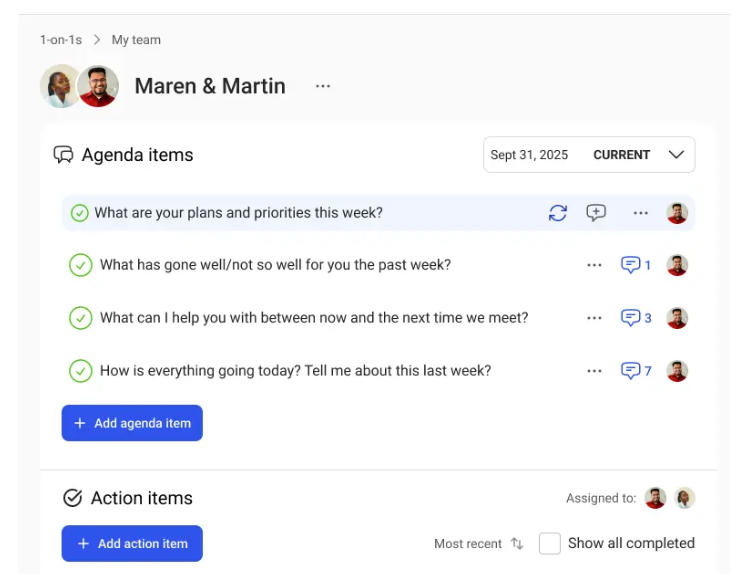
This is where a tool like the Manager 1:1 tool by Quantum Workplace keeps all agendas, notes, and action items in one shared space. Both sides can add topics before the meeting, track follow-ups with due dates, and build a searchable history that makes every conversation built on the last one.
How Often Should You Hold One-on-One Meetings?
Consistency matters more than frequency. A biweekly one-on-one that never gets canceled beats a weekly one that gets rescheduled half the time.
If you manage a larger team, start biweekly and add more frequent weekly check-ins for anyone new, struggling, or working through a transition.
One-on-One Meeting Frequency
Frequency
Best For
Watch Out for
Weekly
New hires, performance plans, fast-moving or remote teams
Can feel excessive for autonomous employees. Keep to max 20-25 min.
Biweekly
Most teams and roles. Enough time for progress between meetings.
Loses momentum if meetings get canceled. Protect the streak.
Monthly
Senior managers or leaders with other regular touchpoints.
Too infrequent for most. Issues get unnoticed for weeks.
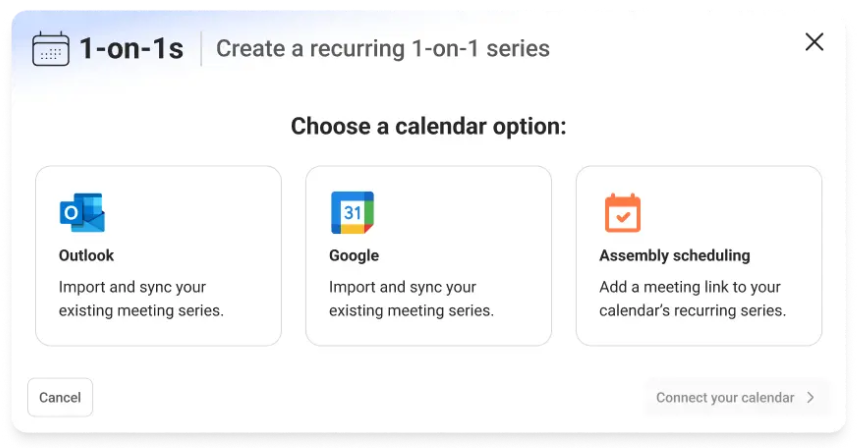
Whatever frequency you choose, protect it. Assembly's Manager 1:1 tool makes that easier by syncing recurring one-on-ones with Google Calendar or Outlook, adjusting for time zones across distributed teams, and sending automated reminders so meetings do not quietly disappear from the calendar.
Questions to Ask in One-on-One Meetings
The right question can turn a surface-level check-in into a conversation that reveals what your employee actually needs. Here are some questions organized by what you are trying to learn.
1. Questions to Check Engagement
What part of your work is energizing you the most lately?
Is anything about your current role feeling frustrating or draining?
On a scale of 1-10, how is your motivation this week? What would move it up one point?
Do you feel your contributions are visible to the wider team?
2. Questions to Support Growth and Development
Where do you want to be in your career 12 months from now?
What skills are you most interested in developing?
Is there a project you would love to take on but have not had the chance?
If budget was not a constraint, what courses would you enroll in to grow your career?
3. Questions to Gather Honest Feedback
What is one thing I could do differently as your manager?
Do you feel safe raising concerns or disagreeing in team discussions?
How useful do you find our one-on-ones? What would make them better?
7 One-on-One Meeting Agenda Templates for Different Scenarios
The best agenda depends on the conversation you need to have. Here are seven templates we've put together for the most common scenarios. Feel free to adjust them based on what your direct report needs.
1. First One-on-One With a New Employee (30 min)
Your first one-on-one sets the tone for the entire relationship. The goal is to build rapport, set expectations, and learn how your new hire likes to work.
How are your first few weeks feeling? What has surprised you, good or bad? (5 min)
How do you prefer to receive feedback, direct and in the moment, or written with time to process? (5 min)
What does a good manager look like to you? What did your best manager do that you valued? (5 min)
What do you need from me in your first 30 days to feel set up for success? (5 min)
Here is how our one-on-ones will work: this time belongs to you, not to status updates. Let's agree on a frequency that works. (5 min)
One thing I am excited about is having you on this team. (5 min)
Weekly one-on-ones should feel like a quick pulse check, not a project standup. Keep task updates in Slack and use this time for what only a live conversation can do.
One word to describe your week so far. Why that word? (3 min)
What is the one thing you most need from me this week? (5 min)
What is your biggest blocker right now, and what have you already tried? (5 min)
One thing I noticed that went well. One thing to keep an eye on. (5 min)
Confirm next steps: who does what and by when. (2 min)
3. Monthly One-on-One Meeting (45 min)
Monthly one-on-ones are for zooming out and looking at the bigger picture. Avoid the day-to-day and talk about career direction, team health, and whether the role still feels right.
Looking back at this month, what are you most proud of? What drained you? (10 min)
Where do you want to be in 12 months, and does your current work feel like it is moving you there? (10 min)
How is the team dynamic right now? Any friction, or anyone you are collaborating well with that I should know about? (10 min)
What is one thing I could do differently as your manager? (10 min)
What does a great next month look like for you? (5 min)
4. Sales One-on-One Meeting (30 min)
Sales one-on-ones work best when they focus on coaching, not auditing. Your reps already see the dashboard, so use this time to build confidence and sharpen skills. Use this time to build skill and to not add pressure.
How are you feeling about your number this quarter, honestly? (3 min)
Walk me through your best win this week. What did you do differently that worked? (5 min)
Pick one deal that is stuck. Let's role-play the next conversation together. (10 min)
What is one part of your selling process you want to get sharper at? (7 min)
What do you need from me before our next meeting to close faster? (5 min)
5. Performance Feedback One-on-One (30 min)
Performance conversations don't have to wait for annual reviews. When you spot a pattern, it helps to address it while the context is still fresh. We recommend using the SBI framework: Situation, Behavior, Impact.
Set the tone: "I want to talk about something specific I have noticed. This is not a formal review, just an honest conversation." (2 min)
Share the observation using SBI: "In Tuesday's client call [situation], you talked over the client twice [behavior], and they disengaged for the rest of the meeting [impact]." (5 min)
Ask for their side: "How do you see it? Is there context I am missing?" (8 min)
Co-create a plan: "What would help? Here is what I can do to support you." (10 min)
Close with care: "I am telling you this because I am invested in your growth, not because I am keeping score." (5 min)
Assembly's Manager 1:1 tool has a private notes feature for sensitive observations only you can see, and shared notes for the action plan you agree on together.
6. Remote Employee One-on-One (30 min)
Remote one-on-ones need to make up for everything a hallway conversation would normally catch. Prioritize connection and visibility over task tracking.
What is happening in your life outside of work? Remote employees rarely get asked. (5 min)
Do you feel your contributions are visible to people beyond your direct team? What work deserves more recognition right now? (5 min)
Are there meetings you sit in that waste your time, or meetings you wish you were included in? (5 min)
How are your boundaries? Is the workload sustainable, or are you quietly absorbing too much? (5 min)
What is one thing that would make your remote experience better that is within my power to change? (5 min)
Confirm action items: who does what by when. (5 min)
Between one-on-ones, Assembly's peer recognition and community spaces keep remote employees connected and visible to the wider team.
7. Stay Interview One-on-One (30 min)
You don’t need to wait for an exit interview to find out why someone is thinking about leaving. Stay interviews help you understand what keeps your best people engaged and what might push them out the door.
What do you look forward to when you come to work each day? (5 min)
If you could change one thing about your role or team tomorrow, what would it be? (5 min)
Have you thought about leaving in the last six months? What triggered that? (5 min)
Do you feel your compensation and growth path reflect the value you bring? (5 min)
What would make this the best job you have ever had? (5 min)
What is one thing I can commit to changing or improving for you right now? (5 min)
How Assembly Manager 1:1 Helps You Run Better One-on-Ones
Most managers have great intentions when it comes to 1:1s. The right tools can help turn those intentions into a consistent, meaningful habit.
Imagine having all your agendas, action items, and past conversations in one place, easy to find and easy to build on.
Assembly's Manager 1:1 tool solves this by giving you and your direct reports one shared space built specifically for one-on-ones.
Never start unprepared. Assembly's shared agenda builder lets both sides add topics before the meeting using pre-built templates or custom talking points. No more opening with "so, any updates?"
Never lose an action item. The action tracker assigns every commitment a due date and an owner. Follow-up reminders keep both sides accountable, and open items carry forward to the next meeting automatically.
Keep the conversation going between meetings. Private and shared notes let you capture sensitive observations only you can see, while giving both sides a single source of truth. The searchable meeting history means performance review prep takes minutes instead of hours.
Recognize great work in the moment. The built-in recognition feature lets you celebrate a win right inside your one-on-one and push it to your public company feed so the whole team sees it for better visibility.
Spot problems before they escalate. Performance insights and engagement dashboards show you which direct reports are getting consistent attention and which ones are slipping through the cracks.
Scheduling stays effortless. Smart scheduling syncs recurring meetings with Google Calendar or Outlook, handles time zones for distributed teams, and sends automated reminders so neither side forgets to show up.
Smart Scheduling by Assembly
Teams using Assembly report 89% more productive one-on-one conversations and 85% better follow-through on commitments.
5 Common One-on-One Meeting Mistakes (And How to Avoid Them)
You can have the perfect framework and template, and still run ineffective one-on-one meetings. Here are the five most common ones and how to avoid them.
1. Turning One-on-Ones Meeting Into Status Updates
Status updates belong in Slack or project tools. Your one-on-one meeting is the only recurring time to talk about how your direct report is really doing. Set a ground rule early: "Let’s keep task updates to Slack. This time is for you." If your direct report defaults to status updates, gently redirect: "That’s helpful context. But how are you feeling about the workload overall?"
2. Canceling or Rescheduling Too Often
Every cancellation tells your direct report that something else is more important than them. Do it twice in a row, and you have set a tone that is very hard to reverse. Treat one-on-ones as non-negotiable. If a conflict is truly unavoidable, reschedule within the same week, not the next one.
3. Not Following Up on What Was Discussed
One of the simplest and most powerful ways to build trust is to follow through on what you discussed. When your team sees you acting on what comes up in one-on-ones, they'll bring more meaningful topics to the table every time. Try starting every meeting by reviewing action items from the last one.
4. Doing All the Talking
If you are speaking most of the time, you are running a briefing. Aim for a 70:30 listening-to-talking ratio. When both sides add agenda topics beforehand, the balance shifts naturally.
5. Skipping Recognition
Jumping straight into problems makes employees associate one-on-ones with criticism rather than support. Open each meeting by recognizing something positive: "I saw the way you handled the client escalation last week. That was impressive."
Turning One-on-Ones Into a Habit Employees Value
You do not need a complicated framework. You need consistency, the right questions, follow-through on what you promised, and a genuine willingness to listen.
The templates and questions we've shared here give you a starting point. The real impact comes from showing up, week after week, and making the actual conversation count. When employees feel heard, supported, and recognized regularly, engagement goes up, retention improves, and performance follows.
Ready to transform your one-on-ones? Book a demo with Assembly and see the Manager 1:1 platform in action.
Frequently Asked Questions
How Long Should a One-on-One Meeting Be?
25-30 minutes works for weekly one-on-ones. For monthly or career-focused conversations, block 45 minutes. Quality matters more than length.
How Do You Run Effective One-on-Ones With Remote Employees?
Share the agenda in advance, turn cameras on, and prioritize personal check-ins over task updates. Use a shared tool like Assembly's Manager 1:1 to keep notes and action items centralized.
What Should You Do When an Employee Says Everything Is Fine?
Ask something more specific. "What is the most frustrating part of your work right now?" invites honesty better than "How are things going?"
How Often Should Managers Have One-on-Ones?
Biweekly works for most teams. Go weekly for new hires or employees working through challenges. Monthly is only enough for senior, autonomous contributors.
Should One-on-Ones Have a Fixed Agenda?
A loose structure helps, but do not script the entire meeting. Let your direct report add their own topics and leave room for the conversation to go where it needs to.
What Is the Biggest One-on-One Mistake Managers Make?
Not following up. When you promise to act on something and do not, employees stop raising real issues. Track every commitment and review it at the start of the next meeting.
Can One-on-One Meetings Improve Employee Retention?
Yes. Employees leave when they feel invisible or unsupported. Consistent one-on-ones are the most direct way to fix both.
Who Should Set the Agenda for a One-on-One?
The employee. One-on-ones are their meeting, not yours. Managers can add topics, but the direct report should drive what gets discussed first.
class SampleComponent extends React.Component {
  // using the experimental public class field syntax below. We can also attach
  // the contextType to the current class
  static contextType = ColorContext;
  render() {
    return <Button color={this.color} />
  }
}
You block 30 minutes. You scramble for talking points. You review tasks that could have been a Slack message.
The meeting ends… and nothing meaningful really happened.
No real insight. No deeper trust. No early warning signs caught.
That’s a missed leadership opportunity.
According to research reports, Employees who have weekly check-ins with their managers are twice as likely to trust their manager and feel a sense of belonging at work. Those conversations also build the foundation for a more structured mid-year performance review. That makes one-on-ones one of the most powerful tools you have to build trust, spot concerns early, and keep your best people engaged.
The problem isn’t that managers don’t care. Most were simply never taught how to run these meetings well.
In this guide, you’ll learn a clear structure for effective one-on-ones, plus real examples and ready-to-use templates you can apply immediately.
What Makes a One-on-One Meeting Effective?
You should understand that a one-on-one is not your typical project update. It is this one recurring meeting that belongs to your direct report, not you.
The best one-on-one should feel like a conversation between two people who actually trust each other enough to talk about what is actually going on.
From what we’ve seen, the most effective one-on-ones share a few things in common:
The employee drives the agenda. Your direct report brings the topics that matter most to them. When both people contribute, the conversation becomes much richer and more useful for everyone.
There is real follow-through. If you agree to remove a blocker, it needs to happen before the next meeting. Follow-through is one of the fastest ways to build trust with your direct report.
Feedback flows both ways. Great one-on-ones create and nurture a space for employees to share feedback upward, including what you as a manager, could do differently.
They happen consistently. Showing up consistently sends a powerful message: this conversation matters, and so do you. Consistency builds the psychological safety and trust that employees need to bring up real topics instead of surface-level updates.
How to Effectively Run a One-on-One Meeting
Running a great one-on-one comes down to three phases: preparing with intention, listening more than you talk, and following through on what you promised. Here is how to approach each one.
1. Before the Meeting
The five minutes you spend preparing before a one-on-one determines whether the next 30 minutes are productive or wasted. Here is how to make sure that does not happen:
Review notes and action items from your last one-on-one. Even a quick glance at your last meeting's notes shows your direct report that you value this time together.
Checkrecent work, peer recognition, or feedback so you can refere specific contributions.
Share the agenda 24 hours in advance: "Here are my topics. What would you like to add?"
2. During the Meeting
If you notice you're talking more than half the time, that's a signal to step back and create more space for your direct report. Your role is to ask good questions, listen, and make space for your direct report to lead.
Start with a genuine check-in, not "how are you" on autopilot. Try: "How did the last product launch feel from your side?"
Let your direct report lead the first half. If they say "nothing", that's a great opportunity to ask a more specific question and open the door.
Ask open-ended questions. "What is the biggest thing slowing you down?" opens a door. "Is everything on track?" closes it.
End with clear next steps. "I will talk to David about the resource issue by Thursday" instead of "I will look into it."
After the Meeting
This phase easiest to overlook. It is where the real impact of a one-on-one meeting is either built or lost. The meeting ends, the next call starts, and those action items quietly slip. Few small actions can make a big difference:
Send a brief recap with action items within 24 hours.
Actually do the things you committed to. Your credibility as a manager is built in these moments.
Reference past conversations in future meetings. It shows that your direct report's words carry weight.
This is where a tool like the Manager 1:1 tool by Quantum Workplace keeps all agendas, notes, and action items in one shared space. Both sides can add topics before the meeting, track follow-ups with due dates, and build a searchable history that makes every conversation built on the last one.
How Often Should You Hold One-on-One Meetings?
Consistency matters more than frequency. A biweekly one-on-one that never gets canceled beats a weekly one that gets rescheduled half the time.
If you manage a larger team, start biweekly and add more frequent weekly check-ins for anyone new, struggling, or working through a transition.
One-on-One Meeting Frequency
Frequency
Best For
Watch Out for
Weekly
New hires, performance plans, fast-moving or remote teams
Can feel excessive for autonomous employees. Keep to max 20-25 min.
Biweekly
Most teams and roles. Enough time for progress between meetings.
Loses momentum if meetings get canceled. Protect the streak.
Monthly
Senior managers or leaders with other regular touchpoints.
Too infrequent for most. Issues get unnoticed for weeks.
Whatever frequency you choose, protect it. Assembly's Manager 1:1 tool makes that easier by syncing recurring one-on-ones with Google Calendar or Outlook, adjusting for time zones across distributed teams, and sending automated reminders so meetings do not quietly disappear from the calendar.
Questions to Ask in One-on-One Meetings
The right question can turn a surface-level check-in into a conversation that reveals what your employee actually needs. Here are some questions organized by what you are trying to learn.
1. Questions to Check Engagement
What part of your work is energizing you the most lately?
Is anything about your current role feeling frustrating or draining?
On a scale of 1-10, how is your motivation this week? What would move it up one point?
Do you feel your contributions are visible to the wider team?
2. Questions to Support Growth and Development
Where do you want to be in your career 12 months from now?
What skills are you most interested in developing?
Is there a project you would love to take on but have not had the chance?
If budget was not a constraint, what courses would you enroll in to grow your career?
3. Questions to Gather Honest Feedback
What is one thing I could do differently as your manager?
Do you feel safe raising concerns or disagreeing in team discussions?
How useful do you find our one-on-ones? What would make them better?
7 One-on-One Meeting Agenda Templates for Different Scenarios
The best agenda depends on the conversation you need to have. Here are seven templates we've put together for the most common scenarios. Feel free to adjust them based on what your direct report needs.
1. First One-on-One With a New Employee (30 min)
Your first one-on-one sets the tone for the entire relationship. The goal is to build rapport, set expectations, and learn how your new hire likes to work.
How are your first few weeks feeling? What has surprised you, good or bad? (5 min)
How do you prefer to receive feedback, direct and in the moment, or written with time to process? (5 min)
What does a good manager look like to you? What did your best manager do that you valued? (5 min)
What do you need from me in your first 30 days to feel set up for success? (5 min)
Here is how our one-on-ones will work: this time belongs to you, not to status updates. Let's agree on a frequency that works. (5 min)
One thing I am excited about is having you on this team. (5 min)
Weekly one-on-ones should feel like a quick pulse check, not a project standup. Keep task updates in Slack and use this time for what only a live conversation can do.
One word to describe your week so far. Why that word? (3 min)
What is the one thing you most need from me this week? (5 min)
What is your biggest blocker right now, and what have you already tried? (5 min)
One thing I noticed that went well. One thing to keep an eye on. (5 min)
Confirm next steps: who does what and by when. (2 min)
3. Monthly One-on-One Meeting (45 min)
Monthly one-on-ones are for zooming out and looking at the bigger picture. Avoid the day-to-day and talk about career direction, team health, and whether the role still feels right.
Looking back at this month, what are you most proud of? What drained you? (10 min)
Where do you want to be in 12 months, and does your current work feel like it is moving you there? (10 min)
How is the team dynamic right now? Any friction, or anyone you are collaborating well with that I should know about? (10 min)
What is one thing I could do differently as your manager? (10 min)
What does a great next month look like for you? (5 min)
4. Sales One-on-One Meeting (30 min)
Sales one-on-ones work best when they focus on coaching, not auditing. Your reps already see the dashboard, so use this time to build confidence and sharpen skills. Use this time to build skill and to not add pressure.
How are you feeling about your number this quarter, honestly? (3 min)
Walk me through your best win this week. What did you do differently that worked? (5 min)
Pick one deal that is stuck. Let's role-play the next conversation together. (10 min)
What is one part of your selling process you want to get sharper at? (7 min)
What do you need from me before our next meeting to close faster? (5 min)
5. Performance Feedback One-on-One (30 min)
Performance conversations don't have to wait for annual reviews. When you spot a pattern, it helps to address it while the context is still fresh. We recommend using the SBI framework: Situation, Behavior, Impact.
Set the tone: "I want to talk about something specific I have noticed. This is not a formal review, just an honest conversation." (2 min)
Share the observation using SBI: "In Tuesday's client call [situation], you talked over the client twice [behavior], and they disengaged for the rest of the meeting [impact]." (5 min)
Ask for their side: "How do you see it? Is there context I am missing?" (8 min)
Co-create a plan: "What would help? Here is what I can do to support you." (10 min)
Close with care: "I am telling you this because I am invested in your growth, not because I am keeping score." (5 min)
Assembly's Manager 1:1 tool has a private notes feature for sensitive observations only you can see, and shared notes for the action plan you agree on together.
6. Remote Employee One-on-One (30 min)
Remote one-on-ones need to make up for everything a hallway conversation would normally catch. Prioritize connection and visibility over task tracking.
What is happening in your life outside of work? Remote employees rarely get asked. (5 min)
Do you feel your contributions are visible to people beyond your direct team? What work deserves more recognition right now? (5 min)
Are there meetings you sit in that waste your time, or meetings you wish you were included in? (5 min)
How are your boundaries? Is the workload sustainable, or are you quietly absorbing too much? (5 min)
What is one thing that would make your remote experience better that is within my power to change? (5 min)
Confirm action items: who does what by when. (5 min)
Between one-on-ones, Assembly's peer recognition and community spaces keep remote employees connected and visible to the wider team.
7. Stay Interview One-on-One (30 min)
You don’t need to wait for an exit interview to find out why someone is thinking about leaving. Stay interviews help you understand what keeps your best people engaged and what might push them out the door.
What do you look forward to when you come to work each day? (5 min)
If you could change one thing about your role or team tomorrow, what would it be? (5 min)
Have you thought about leaving in the last six months? What triggered that? (5 min)
Do you feel your compensation and growth path reflect the value you bring? (5 min)
What would make this the best job you have ever had? (5 min)
What is one thing I can commit to changing or improving for you right now? (5 min)
How Assembly Manager 1:1 Helps You Run Better One-on-Ones
Most managers have great intentions when it comes to 1:1s. The right tools can help turn those intentions into a consistent, meaningful habit.
Imagine having all your agendas, action items, and past conversations in one place, easy to find and easy to build on.
Assembly's Manager 1:1 tool solves this by giving you and your direct reports one shared space built specifically for one-on-ones.
Never start unprepared. Assembly's shared agenda builder lets both sides add topics before the meeting using pre-built templates or custom talking points. No more opening with "so, any updates?"
Never lose an action item. The action tracker assigns every commitment a due date and an owner. Follow-up reminders keep both sides accountable, and open items carry forward to the next meeting automatically.
Keep the conversation going between meetings. Private and shared notes let you capture sensitive observations only you can see, while giving both sides a single source of truth. The searchable meeting history means performance review prep takes minutes instead of hours.
Recognize great work in the moment. The built-in recognition feature lets you celebrate a win right inside your one-on-one and push it to your public company feed so the whole team sees it for better visibility.
Spot problems before they escalate. Performance insights and engagement dashboards show you which direct reports are getting consistent attention and which ones are slipping through the cracks.
Scheduling stays effortless. Smart scheduling syncs recurring meetings with Google Calendar or Outlook, handles time zones for distributed teams, and sends automated reminders so neither side forgets to show up.
Smart Scheduling by Assembly
Teams using Assembly report 89% more productive one-on-one conversations and 85% better follow-through on commitments.
5 Common One-on-One Meeting Mistakes (And How to Avoid Them)
You can have the perfect framework and template, and still run ineffective one-on-one meetings. Here are the five most common ones and how to avoid them.
1. Turning One-on-Ones Meeting Into Status Updates
Status updates belong in Slack or project tools. Your one-on-one meeting is the only recurring time to talk about how your direct report is really doing. Set a ground rule early: "Let’s keep task updates to Slack. This time is for you." If your direct report defaults to status updates, gently redirect: "That’s helpful context. But how are you feeling about the workload overall?"
2. Canceling or Rescheduling Too Often
Every cancellation tells your direct report that something else is more important than them. Do it twice in a row, and you have set a tone that is very hard to reverse. Treat one-on-ones as non-negotiable. If a conflict is truly unavoidable, reschedule within the same week, not the next one.
3. Not Following Up on What Was Discussed
One of the simplest and most powerful ways to build trust is to follow through on what you discussed. When your team sees you acting on what comes up in one-on-ones, they'll bring more meaningful topics to the table every time. Try starting every meeting by reviewing action items from the last one.
4. Doing All the Talking
If you are speaking most of the time, you are running a briefing. Aim for a 70:30 listening-to-talking ratio. When both sides add agenda topics beforehand, the balance shifts naturally.
5. Skipping Recognition
Jumping straight into problems makes employees associate one-on-ones with criticism rather than support. Open each meeting by recognizing something positive: "I saw the way you handled the client escalation last week. That was impressive."
Turning One-on-Ones Into a Habit Employees Value
You do not need a complicated framework. You need consistency, the right questions, follow-through on what you promised, and a genuine willingness to listen.
The templates and questions we've shared here give you a starting point. The real impact comes from showing up, week after week, and making the actual conversation count. When employees feel heard, supported, and recognized regularly, engagement goes up, retention improves, and performance follows.
Ready to transform your one-on-ones? Book a demo with Assembly and see the Manager 1:1 platform in action.
Frequently Asked Questions
How Long Should a One-on-One Meeting Be?
25-30 minutes works for weekly one-on-ones. For monthly or career-focused conversations, block 45 minutes. Quality matters more than length.
How Do You Run Effective One-on-Ones With Remote Employees?
Share the agenda in advance, turn cameras on, and prioritize personal check-ins over task updates. Use a shared tool like Assembly's Manager 1:1 to keep notes and action items centralized.
What Should You Do When an Employee Says Everything Is Fine?
Ask something more specific. "What is the most frustrating part of your work right now?" invites honesty better than "How are things going?"
How Often Should Managers Have One-on-Ones?
Biweekly works for most teams. Go weekly for new hires or employees working through challenges. Monthly is only enough for senior, autonomous contributors.
Should One-on-Ones Have a Fixed Agenda?
A loose structure helps, but do not script the entire meeting. Let your direct report add their own topics and leave room for the conversation to go where it needs to.
What Is the Biggest One-on-One Mistake Managers Make?
Not following up. When you promise to act on something and do not, employees stop raising real issues. Track every commitment and review it at the start of the next meeting.
Can One-on-One Meetings Improve Employee Retention?
Yes. Employees leave when they feel invisible or unsupported. Consistent one-on-ones are the most direct way to fix both.
Who Should Set the Agenda for a One-on-One?
The employee. One-on-ones are their meeting, not yours. Managers can add topics, but the direct report should drive what gets discussed first.
Browse our Free Employee Recognition Guide
Get the foundational knowledge on creating an employee recognition program that boosts employee engagement and helps them feel valued.






.png)