When companies reach 500 to 2,000 employees, recognition tends to become inconsistent across the organization.
Most mid-size companies already have some form of employee recognition. It might be a Slack channel where managers celebrate wins, an Employee of the Month program, or informal shoutouts from leaders who prioritize recognition.
These efforts are well-intentioned, but they rarely create a consistent recognition experience across the organization. According to Quantum Workplace's research report, 67% of employees say their organization has a recognition program, yet 40% say they don’t receive meaningful recognition.
The gap tends to show up most clearly in who gets recognized. Employees who work closely with senior leaders or have highly engaged managers are more likely to receive appreciation regularly. Meanwhile, employees in support functions, remote teams, or cross-functional roles can be easier to overlook even when their contributions are just as valuable.
The problem isn't a lack of intent to recognize the employee. It's a lack of the right recognition strategies and systems that make recognition consistent, visible, and scalable as the organization grows.
This guide covers eight employee recognition strategies that work for organizations with 500 to 2,000 employees. You'll find how to implement each one effectively and see how Assembly (by Quantum Workplace) helps HR teams build a recognition program that reaches every employee, regardless of their team, role, or location.
Why Employee Recognition Is Uniquely Challenging for Mid-Size Companies with 500 to 2,000 Employees?
Ask an HR leader at a 1,000-person company whether recognition is working, and the honest answer is usually "it depends on who you ask."
Ask someone on the sales team, and they might say yes because their manager celebrates wins publicly, teammates regularly recognize one another, and appreciation is part of the team's culture.
Ask someone in operations or IT support, and you may hear a very different story. They work just as hard, but recognition is less frequent because their contributions happen behind the scenes.
Same company. Same recognition program. Completely different employee experience. This can be because of the following reasons.
1. Recognition Varies Based on Individual Managers
Inconsistency is the biggest recognition challenge companies face at this size. Recognition depends too heavily on individual managers and team cultures. Employees with engaged managers receive regular appreciation, while equally valuable contributions in other parts of the business often go unnoticed.
According to research reports, 2 in 3 employees want more recognition for their work, nearly half don't believe they'll be recognized even if they contribute. When recognition is this uneven, the gap between who feels valued and who doesn't grows as the employees grows.
2. Many Valuable Contributions Go Unrecognized
At 200 employees, most contributions happen within view of someone who can acknowledge them. Beyond 500, that changes.
The engineer who unblocks three teammates during a difficult sprint. The customer success manager who saves an at-risk account after hours. The HR team member who quietly guides a new hire through their first difficult month.
These contributions make a real difference to the business, but they often happen behind the scenes. Without a structured way to surface and celebrate them, many employees never receive the recognition they deserve.
3. Recognition Tools Are Either Too Basic or Too Complex
Mid-size companies face another challenge when choosing recognition tools. The informal approaches that worked at 150 employees, such as a Slack channel or a monthly team shoutout, no longer create a consistent experience across the organization. At the same time, many enterprise recognition platforms are built for companies several times larger, bringing implementation complexity and costs that don't always fit the needs of a 500- or 1,000-person business.
These are the recognition challenges most mid-size companies face as they grow. The strategies in this guide will help you create a recognition program that is consistent, visible, and scalable without losing the personal touch that makes recognition meaningful.
As you put these strategies into practice, the right technology can make a significant difference.
Assembly (by Quantum Workplace) is built for exactly this stage. It gives HR teams the tools to put these strategies into practice across departments, locations, and remote teams without the complexity of enterprise platforms or the limitations of tools built for smaller companies.
8 Best Employee Recognition Strategies for Organizations with 500-2,000 Employees
Recognition doesn't break down because organizations stop caring about their employees. It fails because the informal habits that carried culture at a smaller size were never built to grow for mid-size companies. Here are the strategies for improving employee recognition programs that actually work at 500 to 2,000 employees.
1. Build Peer-to-Peer Recognition Into Everyday Work
Managers can't see every contribution. It's difficult to keep track of everything happening across the organization with hundreds of employees and dozens of teams.
Some of the most valuable work happens between peers. A sales rep shares a competitive insight with a colleague before a big pitch. A designer spends an hour helping a marketer refine a presentation. A team lead steps in to support a colleague during a difficult week without being asked.
These moments shape organizational culture, but they rarely appear in performance reviews or manager updates. According to Quantum Workplace's report, 1 in 5 employees received zero recognition in the past year. Peer recognition can help close that gap by giving employees a way to recognize contributions that managers may not see.
Employees can recognize the contributions they experience firsthand instead of waiting for a manager to notice them later. This makes recognition more inclusive and better reflects how work actually gets done.
The easier you make recognition, the more often it happens. Connecting your recognition platform to tools like Slack and Microsoft Teams allows employees to celebrate great work as part of their everyday conversations, without asking them to switch platforms or remember another process.
Assembly brings peer recognition into the tools employees already use, making appreciation part of the workflow rather than another HR initiative.
2. Tie Every Recognition Moment to a Company Value
In smaller companies, employees learn company values by working alongside leaders and teammates every day.
Mid-size companies operate differently. Employees work across departments, offices, and time zones. New hires join throughout the year, and many employees rarely interact with senior leaders. As a result, company values can easily become words on a wall instead of behaviors employees experience every day.
Connecting every recognition moment to a company value helps bridge that gap. It tells employees not only what they did well but why it mattered to the organization. At the same time, it gives everyone else a real example of what that value looks like in practice.
For example, if one of your company values is customer commitment, then instead of saying "great job on resolving that customer issue," say "thank you for staying with the customer until the issue was fully resolved. That is exactly what customer commitment looks like, and it made a real difference in their experience with us."
That single sentence shows everyone else what your company values look like in practice.
3. Automate Milestone Recognition Consistently
In smaller companies, birthdays and work anniversaries rarely go unnoticed. Someone on the team remembers, a manager organizes a celebration, or a colleague starts the conversation.
Mid-size companies don't have that advantage. With hundreds of employees spread across departments, locations, and remote teams, important milestones may be missed without a system in place.
A missed fifth anniversary tells an employee that five years of their career went unnoticed.According to a Quantum Workplace report, nearly half of employees don't believe they'll be recognized even if they contribute to the organization's success. Automating milestone recognition helps give employees confidence that their contributions will be recognized at the moments that matter
By connecting your recognition platform to your HRIS, every birthday, work anniversary, and career milestone is celebrated consistently, regardless of where employees work or who they report to.
Assembly (by Quantum Workplace) handles this automatically, so HR teams can make sure every employee feels acknowledged at the moments that matter most without the manual overhead.
4. Give Managers a Recognition Playbook
Manager consistency is one of the biggest differences between a strong recognition culture and a weak one.
Some managers make it a priority. They celebrate wins, acknowledge effort, and make appreciation part of everyday work. Others are focused on hiring, project deadlines, customer issues, and performance conversations, so recognition happens much less often.
The result is two employees doing equally valuable work but having completely different experiences. According to reports, 3 in 5 employees say recognition at their organization is inconsistent, top-down, gated by approvals, or nearly absent. When recognition depends heavily on individual manager behavior, employees can have very different recognition experiences across the same organization.
Giving managers a simple playbook can make a significant difference. Show them what to recognize, how to make recognition specific, how often to do it, and how to acknowledge employees in less visible roles, such as support teams, remote workers, and cross-functional contributors.
When every manager works from the same expectations, recognition stops depending on individual habits. It becomes a consistent part of the employee experience across the organization.
5. Use Data to Surface Who is Being Missed
Recognition data is not just about seeing who’s getting celebrated. It also helps you see who isn't.
In a mid-size organization, it's almost impossible for HR leaders to know whether recognition is reaching every department, location, or employee group without looking at the data. By the time someone says they don't feel appreciated, the problem has often existed for months.
Use your recognition data to identify patterns: which teams participate the most, which managers rarely recognize their employees, and are remote employees receiving the same level of recognition as office-based teams?
Assembly (by Quantum Workplace)’s Dora AI makes these insights easy to understand. Instead of building reports manually, HR leaders can ask simple questions like, "Who hasn't been recognized this month?" and quickly identify where recognition needs more attention.
6. Introduce Peer-Nominated Employee Awards
Peer-nominated awards give employees a way to recognize valuable contributions and bring them greater visibility across the organization.
Quarterly values awards, team awards, or employee spotlights create moments for the wider organization to celebrate great work. They also give employees a chance to see which contributions and behaviors the company values most.
Who gets to nominate matters just as much as the award itself. If nominations come only from managers, contributions outside their immediate line of sight can easily be missed. A manager may not know about the colleague who helped another team meet a deadline, mentored a new employee, or stepped in to solve a problem outside their role.
Peer nominations help bring those contributions forward. Employees can recognize the people they work with every day, giving meaningful work that might otherwise go unnoticed a chance to be celebrated across the organization.
Assembly by Quantum Workplace makes it easy to collect peer nominations, manage awards, and celebrate employees across the organization, helping HR teams run recognition programs that are consistent, transparent, and scalable.
Assembly (by Quantum Workplace) makes it easy to collect peer nominations, manage awards, and celebrate employees across the organization, helping HR teams run recognition programs that are consistent, transparent, and scalable.
7. Recognize Contribution, Not Just Results
Most recognition programs celebrate the outputs. Contributions that lead to those results are often go unrecognised.
The project coordinator who keeps everyone aligned, the support specialist who prevents a customer issue from escalating, or the manager who helps a new employee succeed all play an important role in the team's success. These contributions directly support business outcomes, but they rarely appear on a performance dashboard.
Recognizing these contributions encourages collaboration, knowledge sharing, and continuous improvement. It tells employees that how they help the organization succeed matters just as much as the outcome.
According to Quantum Workplace's research, 65% of employees look for additional ways to contribute and 59% put in extra effort. This shows how meaningful recognition can encourage employees to contribute beyond their core responsibilities.
8. Support Manager 1:1s as a Consistent Recognition Touchpoint
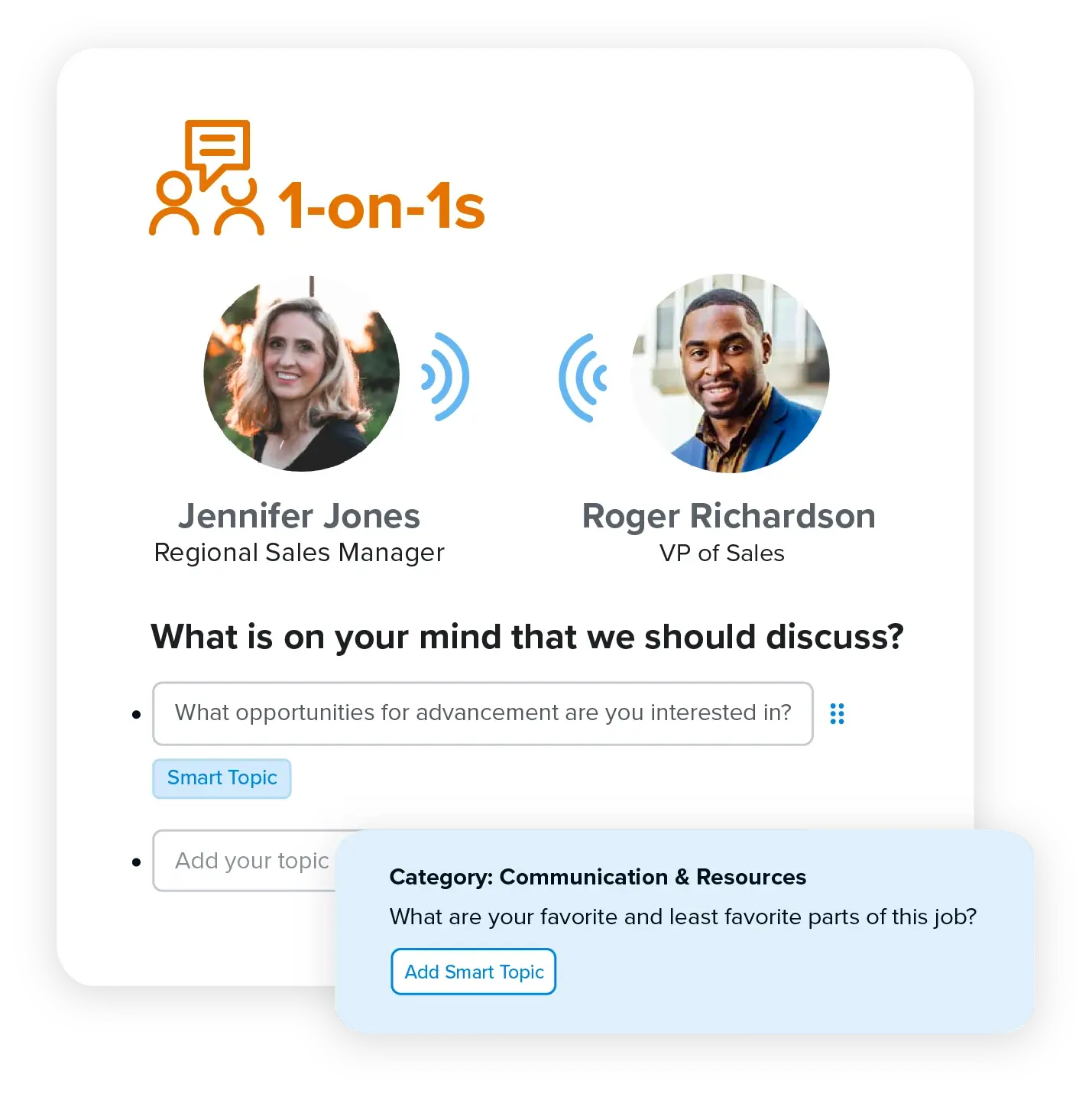
Regular 1:1s between managers and employees are one of the most underused recognition touchpoints in mid-size organizations. When a manager uses a 1:1 to point out something specific an employee did, explain why it mattered, and connect it to their growth, the recognition feels personal and meaningful.
The biggest challenge with 1:1s is consistency. Some managers run them well while others turn them into status updates or cancel them when things get busy. When 1:1s are inconsistent, some employees receive regular, meaningful recognition while others can go weeks without a genuine conversation about their work.
Quantum Workplace's 1:1 meeting software gives managers HR-approved conversation templates, shared agendas, and action tracking built into their existing workflow. So, recognition does not get skipped when the agenda fills up with project updates and deadlines.
How to Develop & Implement Employee Recognition Strategies
Building a recognition program at this size does not require launching everything at once. The most successful mid-size companies start with a solid foundation, build employee adoption, and expand the program over time.
1. Start Small and Build from There
You don't need to introduce every recognition initiative on day one. Start with the habits employees can easily adopt, such as peer-to-peer recognition and automated milestone celebrations.
They create a visible baseline of appreciation without requiring a full program redesign or significant manager behavior change. Once recognition becomes part of everyday work, you can introduce formal awards, value-based recognition, and advanced reporting.
2. Get Leadership and Manager Buy-In Early
Recognition programs fail when they are treated as an HR initiative rather than an organizational priority. Before launching anything, get visible commitment from senior leadership.
When a VP recognizes someone publicly in the shared feed, when a department head references a company value in a shoutout, when leadership treats recognition as something they do rather than something they sponsor, it changes how every manager and employee below them responds to the program.
3. Roll Out in Phases
A phased approach works better than a big launch. Start with the infrastructure like peer recognition, milestone automation, and the tools your team already uses. In the second phase, introduce the formal program.
In the third phase, use recognition data and manager dashboards to identify gaps and refine. Each phase builds on the one before it without overwhelming managers or HR teams.
4. Communicate Clearly and Often
Employees cannot participate in a program they do not understand. Before launch, explain what the program is, why the organization is investing in it, and what employees are expected to do.
After launch, share participation data, celebrate early recognition moments publicly, and remind managers of their role consistently. Recognition culture builds through repeated, visible communication from leadership and HR.
5. Measure Participation Before You Measure Impact
In the first 90 days. Track participation rates by team and location. Identify which managers are engaging and which are not.
Look for early signs like whether the same small group is receiving all the recognition or whether it is spreading across the organization. Impact on engagement and retention takes longer to show up. Participation tells you whether the foundation is solid enough to get there.
6. Adjust Based on What the Data Shows
No recognition program runs perfectly from day one. After the first quarter, review what the data is telling you.
Low participation in a specific department usually means a communication or access problem, not a motivation problem. Recognition concentrated in the same employees usually means the criteria or nomination process needs to change.
Use Dora AI to surface these patterns in plain language so adjustments are based on what is actually happening not on assumptions.
Why Should You Consider Assembly (by Quantum Workplace) for Employee Recognition for Your Company?
Many recognition tools are either designed for small teams that start to feel limited as your organization grows, or built for global enterprises, bringing implementation complexity, administrative overhead, and costs that don't always make sense for a company with 500 to 2,000 employees.
Assembly (by Quantum Workplace) is built exactly for mid-size companies that need more than a basic recognition tool but don't want the complexity of an enterprise platform. It brings together peer-to-peer recognition, milestone celebrations, manager recognition, analytics, and AI-powered insights in one easy-to-manage platform, helping HR teams scale recognition without adding administrative overhead.
Peer-to-peer recognition flows through Slack and Microsoft Teams so employees give and receive appreciation without switching platforms or changing behavior. Every recognition moment is connected to a company value and visible across the organization.
Milestone automation connects to BambooHR, ADP, and Workday, so every birthday, work anniversary, and service milestone is acknowledged on the right date. As the team grows from 500 to 2,000, the automated layer scales without any additional overhead.
Dora AI gives HR leaders visibility into which teams are going unrecognized, which managers have not participated, and where recognition is concentrated and where it is missing. So, HR can act on it before it shows up in an exit interview.
Through its connection with Quantum Workplace, recognition data connects to engagement surveys, development and performance conversations. It gives HR leaders a complete picture of how recognition is influencing the broader employee experience, not just program participation rates.
Book a demo and see how employee recognition, engagement, performance, and development come together in one place.
Final Words
Building a strong recognition culture at a company with 500 to 2,000 employees isn't about having the biggest budget or the most sophisticated program. It's about making sure appreciation reaches every employee.
The most successful mid-size companies make recognition part of everyday work. They make it easy for employees to recognize one another, support managers in recognizing their teams, and ensure no one gets overlooked.
You don't have to transform your recognition program overnight. Start with one strategy, build the right habits, and expand from there. Over time, those small, consistent actions create a recognition culture that strengthens engagement, reinforces your company values, and helps every employee feel seen.
If you're ready to build a recognition program that scales with your organization, Assembly by Quantum Workplace gives your HR team the tools to make recognition consistent, visible, and meaningful across every department, location, and team.
Frequently Asked Questions
What are the most common challenges mid-size companies face with employee recognition?
Inconsistency is the most common challenge faced by companies with 500 to 2,000 employees. Recognition becomes dependent on individual manager behaviour, and managers vary significantly. Some prioritise it. Others are too stretched to think about it consistently. The result is a culture where some teams feel appreciated, and others feel invisible. The second most common challenge is visibility. The same high-visibility employees keep receiving recognition while quieter contributors in less prominent roles are routinely overlooked.
How do you keep employee recognition personal when your company has hundreds of employees?
Personal recognition starts with being specific. Instead of generic praise, recognise the behaviour, achievement, or company value an employee demonstrated. Combining manager recognition with peer-to-peer recognition also helps surface contributions that leaders may not see, making appreciation feel more authentic and meaningful across the organisation.
How much does an employee recognition programme cost for a 1,000-person company?
There is no single number that works for every organisation. A commonly used benchmark is 1% of total payroll, but most mid-size companies start well below that and increase investment as the programme builds momentum. What matters more than the total budget is how it is structured. Platform costs, peer recognition rewards, milestone gifts, and formal award budgets are different expenses serving different purposes. Tracking them separately gives HR a clearer picture of what the programme is actually costing and what it is producing. Assembly (by Quantum Workplace) scales from $2 per user per month, so the platform layer does not require a large upfront commitment before the programme has proven its value.
What is the best employee recognition software for a company with 500 to 2,000 employees?
The best recognition software for this size is one that employees can use inside the tools they already rely on. Look for peer-to-peer recognition, company-value alignment, automated milestones, Slack and Microsoft Teams integration, and participation analytics that show HR where recognition is and is not reaching. Assembly (by Quantum Workplace) is built for exactly this range. It starts from $2 per user per month and deploys in days without a long implementation process.
Does Assembly work for companies with multiple offices and remote teams?
Yes. Assembly (by Quantum Workplace) is designed for distributed teams. Recognition flows through Slack and Microsoft Teams so remote employees give and receive appreciation in the same channels as their in-office colleagues. Milestone automation ensures no birthday or work anniversary is missed regardless of location or time zone. The recognition feed is visible across the whole organisation, so remote employees are not invisible to the teams they rarely meet in person.
What metrics should I track for an employee recognition programme at a mid-size company?
The three most useful metrics are participation rate, recognition equity, and manager participation rate. Participation rate tells you what percentage of employees gave or received recognition in the last 30 days. Recognition equity tells you how evenly distributed that recognition is across teams, locations, and roles. Manager participation rate shows which managers are actively recognising their teams and which are not. These three together tell you whether the programme is reaching everyone or concentrated in the same people.
class SampleComponent extends React.Component {
  // using the experimental public class field syntax below. We can also attach
  // the contextType to the current class
  static contextType = ColorContext;
  render() {
    return <Button color={this.color} />
  }
}
When companies reach 500 to 2,000 employees, recognition tends to become inconsistent across the organization.
Most mid-size companies already have some form of employee recognition. It might be a Slack channel where managers celebrate wins, an Employee of the Month program, or informal shoutouts from leaders who prioritize recognition.
These efforts are well-intentioned, but they rarely create a consistent recognition experience across the organization. According to Quantum Workplace's research report, 67% of employees say their organization has a recognition program, yet 40% say they don’t receive meaningful recognition.
The gap tends to show up most clearly in who gets recognized. Employees who work closely with senior leaders or have highly engaged managers are more likely to receive appreciation regularly. Meanwhile, employees in support functions, remote teams, or cross-functional roles can be easier to overlook even when their contributions are just as valuable.
The problem isn't a lack of intent to recognize the employee. It's a lack of the right recognition strategies and systems that make recognition consistent, visible, and scalable as the organization grows.
This guide covers eight employee recognition strategies that work for organizations with 500 to 2,000 employees. You'll find how to implement each one effectively and see how Assembly (by Quantum Workplace) helps HR teams build a recognition program that reaches every employee, regardless of their team, role, or location.
Why Employee Recognition Is Uniquely Challenging for Mid-Size Companies with 500 to 2,000 Employees?
Ask an HR leader at a 1,000-person company whether recognition is working, and the honest answer is usually "it depends on who you ask."
Ask someone on the sales team, and they might say yes because their manager celebrates wins publicly, teammates regularly recognize one another, and appreciation is part of the team's culture.
Ask someone in operations or IT support, and you may hear a very different story. They work just as hard, but recognition is less frequent because their contributions happen behind the scenes.
Same company. Same recognition program. Completely different employee experience. This can be because of the following reasons.
1. Recognition Varies Based on Individual Managers
Inconsistency is the biggest recognition challenge companies face at this size. Recognition depends too heavily on individual managers and team cultures. Employees with engaged managers receive regular appreciation, while equally valuable contributions in other parts of the business often go unnoticed.
According to research reports, 2 in 3 employees want more recognition for their work, nearly half don't believe they'll be recognized even if they contribute. When recognition is this uneven, the gap between who feels valued and who doesn't grows as the employees grows.
2. Many Valuable Contributions Go Unrecognized
At 200 employees, most contributions happen within view of someone who can acknowledge them. Beyond 500, that changes.
The engineer who unblocks three teammates during a difficult sprint. The customer success manager who saves an at-risk account after hours. The HR team member who quietly guides a new hire through their first difficult month.
These contributions make a real difference to the business, but they often happen behind the scenes. Without a structured way to surface and celebrate them, many employees never receive the recognition they deserve.
3. Recognition Tools Are Either Too Basic or Too Complex
Mid-size companies face another challenge when choosing recognition tools. The informal approaches that worked at 150 employees, such as a Slack channel or a monthly team shoutout, no longer create a consistent experience across the organization. At the same time, many enterprise recognition platforms are built for companies several times larger, bringing implementation complexity and costs that don't always fit the needs of a 500- or 1,000-person business.
These are the recognition challenges most mid-size companies face as they grow. The strategies in this guide will help you create a recognition program that is consistent, visible, and scalable without losing the personal touch that makes recognition meaningful.
As you put these strategies into practice, the right technology can make a significant difference.
Assembly (by Quantum Workplace) is built for exactly this stage. It gives HR teams the tools to put these strategies into practice across departments, locations, and remote teams without the complexity of enterprise platforms or the limitations of tools built for smaller companies.
8 Best Employee Recognition Strategies for Organizations with 500-2,000 Employees
Recognition doesn't break down because organizations stop caring about their employees. It fails because the informal habits that carried culture at a smaller size were never built to grow for mid-size companies. Here are the strategies for improving employee recognition programs that actually work at 500 to 2,000 employees.
1. Build Peer-to-Peer Recognition Into Everyday Work
Managers can't see every contribution. It's difficult to keep track of everything happening across the organization with hundreds of employees and dozens of teams.
Some of the most valuable work happens between peers. A sales rep shares a competitive insight with a colleague before a big pitch. A designer spends an hour helping a marketer refine a presentation. A team lead steps in to support a colleague during a difficult week without being asked.
These moments shape organizational culture, but they rarely appear in performance reviews or manager updates. According to Quantum Workplace's report, 1 in 5 employees received zero recognition in the past year. Peer recognition can help close that gap by giving employees a way to recognize contributions that managers may not see.
Employees can recognize the contributions they experience firsthand instead of waiting for a manager to notice them later. This makes recognition more inclusive and better reflects how work actually gets done.
The easier you make recognition, the more often it happens. Connecting your recognition platform to tools like Slack and Microsoft Teams allows employees to celebrate great work as part of their everyday conversations, without asking them to switch platforms or remember another process.
Assembly brings peer recognition into the tools employees already use, making appreciation part of the workflow rather than another HR initiative.
2. Tie Every Recognition Moment to a Company Value
In smaller companies, employees learn company values by working alongside leaders and teammates every day.
Mid-size companies operate differently. Employees work across departments, offices, and time zones. New hires join throughout the year, and many employees rarely interact with senior leaders. As a result, company values can easily become words on a wall instead of behaviors employees experience every day.
Connecting every recognition moment to a company value helps bridge that gap. It tells employees not only what they did well but why it mattered to the organization. At the same time, it gives everyone else a real example of what that value looks like in practice.
For example, if one of your company values is customer commitment, then instead of saying "great job on resolving that customer issue," say "thank you for staying with the customer until the issue was fully resolved. That is exactly what customer commitment looks like, and it made a real difference in their experience with us."
That single sentence shows everyone else what your company values look like in practice.
3. Automate Milestone Recognition Consistently
In smaller companies, birthdays and work anniversaries rarely go unnoticed. Someone on the team remembers, a manager organizes a celebration, or a colleague starts the conversation.
Mid-size companies don't have that advantage. With hundreds of employees spread across departments, locations, and remote teams, important milestones may be missed without a system in place.
A missed fifth anniversary tells an employee that five years of their career went unnoticed.According to a Quantum Workplace report, nearly half of employees don't believe they'll be recognized even if they contribute to the organization's success. Automating milestone recognition helps give employees confidence that their contributions will be recognized at the moments that matter
By connecting your recognition platform to your HRIS, every birthday, work anniversary, and career milestone is celebrated consistently, regardless of where employees work or who they report to.
Assembly (by Quantum Workplace) handles this automatically, so HR teams can make sure every employee feels acknowledged at the moments that matter most without the manual overhead.
4. Give Managers a Recognition Playbook
Manager consistency is one of the biggest differences between a strong recognition culture and a weak one.
Some managers make it a priority. They celebrate wins, acknowledge effort, and make appreciation part of everyday work. Others are focused on hiring, project deadlines, customer issues, and performance conversations, so recognition happens much less often.
The result is two employees doing equally valuable work but having completely different experiences. According to reports, 3 in 5 employees say recognition at their organization is inconsistent, top-down, gated by approvals, or nearly absent. When recognition depends heavily on individual manager behavior, employees can have very different recognition experiences across the same organization.
Giving managers a simple playbook can make a significant difference. Show them what to recognize, how to make recognition specific, how often to do it, and how to acknowledge employees in less visible roles, such as support teams, remote workers, and cross-functional contributors.
When every manager works from the same expectations, recognition stops depending on individual habits. It becomes a consistent part of the employee experience across the organization.
5. Use Data to Surface Who is Being Missed
Recognition data is not just about seeing who’s getting celebrated. It also helps you see who isn't.
In a mid-size organization, it's almost impossible for HR leaders to know whether recognition is reaching every department, location, or employee group without looking at the data. By the time someone says they don't feel appreciated, the problem has often existed for months.
Use your recognition data to identify patterns: which teams participate the most, which managers rarely recognize their employees, and are remote employees receiving the same level of recognition as office-based teams?
Assembly (by Quantum Workplace)’s Dora AI makes these insights easy to understand. Instead of building reports manually, HR leaders can ask simple questions like, "Who hasn't been recognized this month?" and quickly identify where recognition needs more attention.
6. Introduce Peer-Nominated Employee Awards
Peer-nominated awards give employees a way to recognize valuable contributions and bring them greater visibility across the organization.
Quarterly values awards, team awards, or employee spotlights create moments for the wider organization to celebrate great work. They also give employees a chance to see which contributions and behaviors the company values most.
Who gets to nominate matters just as much as the award itself. If nominations come only from managers, contributions outside their immediate line of sight can easily be missed. A manager may not know about the colleague who helped another team meet a deadline, mentored a new employee, or stepped in to solve a problem outside their role.
Peer nominations help bring those contributions forward. Employees can recognize the people they work with every day, giving meaningful work that might otherwise go unnoticed a chance to be celebrated across the organization.
Assembly by Quantum Workplace makes it easy to collect peer nominations, manage awards, and celebrate employees across the organization, helping HR teams run recognition programs that are consistent, transparent, and scalable.
Assembly (by Quantum Workplace) makes it easy to collect peer nominations, manage awards, and celebrate employees across the organization, helping HR teams run recognition programs that are consistent, transparent, and scalable.
7. Recognize Contribution, Not Just Results
Most recognition programs celebrate the outputs. Contributions that lead to those results are often go unrecognised.
The project coordinator who keeps everyone aligned, the support specialist who prevents a customer issue from escalating, or the manager who helps a new employee succeed all play an important role in the team's success. These contributions directly support business outcomes, but they rarely appear on a performance dashboard.
Recognizing these contributions encourages collaboration, knowledge sharing, and continuous improvement. It tells employees that how they help the organization succeed matters just as much as the outcome.
According to Quantum Workplace's research, 65% of employees look for additional ways to contribute and 59% put in extra effort. This shows how meaningful recognition can encourage employees to contribute beyond their core responsibilities.
8. Support Manager 1:1s as a Consistent Recognition Touchpoint
Regular 1:1s between managers and employees are one of the most underused recognition touchpoints in mid-size organizations. When a manager uses a 1:1 to point out something specific an employee did, explain why it mattered, and connect it to their growth, the recognition feels personal and meaningful.
The biggest challenge with 1:1s is consistency. Some managers run them well while others turn them into status updates or cancel them when things get busy. When 1:1s are inconsistent, some employees receive regular, meaningful recognition while others can go weeks without a genuine conversation about their work.
Quantum Workplace's 1:1 meeting software gives managers HR-approved conversation templates, shared agendas, and action tracking built into their existing workflow. So, recognition does not get skipped when the agenda fills up with project updates and deadlines.
How to Develop & Implement Employee Recognition Strategies
Building a recognition program at this size does not require launching everything at once. The most successful mid-size companies start with a solid foundation, build employee adoption, and expand the program over time.
1. Start Small and Build from There
You don't need to introduce every recognition initiative on day one. Start with the habits employees can easily adopt, such as peer-to-peer recognition and automated milestone celebrations.
They create a visible baseline of appreciation without requiring a full program redesign or significant manager behavior change. Once recognition becomes part of everyday work, you can introduce formal awards, value-based recognition, and advanced reporting.
2. Get Leadership and Manager Buy-In Early
Recognition programs fail when they are treated as an HR initiative rather than an organizational priority. Before launching anything, get visible commitment from senior leadership.
When a VP recognizes someone publicly in the shared feed, when a department head references a company value in a shoutout, when leadership treats recognition as something they do rather than something they sponsor, it changes how every manager and employee below them responds to the program.
3. Roll Out in Phases
A phased approach works better than a big launch. Start with the infrastructure like peer recognition, milestone automation, and the tools your team already uses. In the second phase, introduce the formal program.
In the third phase, use recognition data and manager dashboards to identify gaps and refine. Each phase builds on the one before it without overwhelming managers or HR teams.
4. Communicate Clearly and Often
Employees cannot participate in a program they do not understand. Before launch, explain what the program is, why the organization is investing in it, and what employees are expected to do.
After launch, share participation data, celebrate early recognition moments publicly, and remind managers of their role consistently. Recognition culture builds through repeated, visible communication from leadership and HR.
5. Measure Participation Before You Measure Impact
In the first 90 days. Track participation rates by team and location. Identify which managers are engaging and which are not.
Look for early signs like whether the same small group is receiving all the recognition or whether it is spreading across the organization. Impact on engagement and retention takes longer to show up. Participation tells you whether the foundation is solid enough to get there.
6. Adjust Based on What the Data Shows
No recognition program runs perfectly from day one. After the first quarter, review what the data is telling you.
Low participation in a specific department usually means a communication or access problem, not a motivation problem. Recognition concentrated in the same employees usually means the criteria or nomination process needs to change.
Use Dora AI to surface these patterns in plain language so adjustments are based on what is actually happening not on assumptions.
Why Should You Consider Assembly (by Quantum Workplace) for Employee Recognition for Your Company?
Many recognition tools are either designed for small teams that start to feel limited as your organization grows, or built for global enterprises, bringing implementation complexity, administrative overhead, and costs that don't always make sense for a company with 500 to 2,000 employees.
Assembly (by Quantum Workplace) is built exactly for mid-size companies that need more than a basic recognition tool but don't want the complexity of an enterprise platform. It brings together peer-to-peer recognition, milestone celebrations, manager recognition, analytics, and AI-powered insights in one easy-to-manage platform, helping HR teams scale recognition without adding administrative overhead.
Peer-to-peer recognition flows through Slack and Microsoft Teams so employees give and receive appreciation without switching platforms or changing behavior. Every recognition moment is connected to a company value and visible across the organization.
Milestone automation connects to BambooHR, ADP, and Workday, so every birthday, work anniversary, and service milestone is acknowledged on the right date. As the team grows from 500 to 2,000, the automated layer scales without any additional overhead.
Dora AI gives HR leaders visibility into which teams are going unrecognized, which managers have not participated, and where recognition is concentrated and where it is missing. So, HR can act on it before it shows up in an exit interview.
Through its connection with Quantum Workplace, recognition data connects to engagement surveys, development and performance conversations. It gives HR leaders a complete picture of how recognition is influencing the broader employee experience, not just program participation rates.
Book a demo and see how employee recognition, engagement, performance, and development come together in one place.
Final Words
Building a strong recognition culture at a company with 500 to 2,000 employees isn't about having the biggest budget or the most sophisticated program. It's about making sure appreciation reaches every employee.
The most successful mid-size companies make recognition part of everyday work. They make it easy for employees to recognize one another, support managers in recognizing their teams, and ensure no one gets overlooked.
You don't have to transform your recognition program overnight. Start with one strategy, build the right habits, and expand from there. Over time, those small, consistent actions create a recognition culture that strengthens engagement, reinforces your company values, and helps every employee feel seen.
If you're ready to build a recognition program that scales with your organization, Assembly by Quantum Workplace gives your HR team the tools to make recognition consistent, visible, and meaningful across every department, location, and team.
Frequently Asked Questions
What are the most common challenges mid-size companies face with employee recognition?
Inconsistency is the most common challenge faced by companies with 500 to 2,000 employees. Recognition becomes dependent on individual manager behaviour, and managers vary significantly. Some prioritise it. Others are too stretched to think about it consistently. The result is a culture where some teams feel appreciated, and others feel invisible. The second most common challenge is visibility. The same high-visibility employees keep receiving recognition while quieter contributors in less prominent roles are routinely overlooked.
How do you keep employee recognition personal when your company has hundreds of employees?
Personal recognition starts with being specific. Instead of generic praise, recognise the behaviour, achievement, or company value an employee demonstrated. Combining manager recognition with peer-to-peer recognition also helps surface contributions that leaders may not see, making appreciation feel more authentic and meaningful across the organisation.
How much does an employee recognition programme cost for a 1,000-person company?
There is no single number that works for every organisation. A commonly used benchmark is 1% of total payroll, but most mid-size companies start well below that and increase investment as the programme builds momentum. What matters more than the total budget is how it is structured. Platform costs, peer recognition rewards, milestone gifts, and formal award budgets are different expenses serving different purposes. Tracking them separately gives HR a clearer picture of what the programme is actually costing and what it is producing. Assembly (by Quantum Workplace) scales from $2 per user per month, so the platform layer does not require a large upfront commitment before the programme has proven its value.
What is the best employee recognition software for a company with 500 to 2,000 employees?
The best recognition software for this size is one that employees can use inside the tools they already rely on. Look for peer-to-peer recognition, company-value alignment, automated milestones, Slack and Microsoft Teams integration, and participation analytics that show HR where recognition is and is not reaching. Assembly (by Quantum Workplace) is built for exactly this range. It starts from $2 per user per month and deploys in days without a long implementation process.
Does Assembly work for companies with multiple offices and remote teams?
Yes. Assembly (by Quantum Workplace) is designed for distributed teams. Recognition flows through Slack and Microsoft Teams so remote employees give and receive appreciation in the same channels as their in-office colleagues. Milestone automation ensures no birthday or work anniversary is missed regardless of location or time zone. The recognition feed is visible across the whole organisation, so remote employees are not invisible to the teams they rarely meet in person.
What metrics should I track for an employee recognition programme at a mid-size company?
The three most useful metrics are participation rate, recognition equity, and manager participation rate. Participation rate tells you what percentage of employees gave or received recognition in the last 30 days. Recognition equity tells you how evenly distributed that recognition is across teams, locations, and roles. Manager participation rate shows which managers are actively recognising their teams and which are not. These three together tell you whether the programme is reaching everyone or concentrated in the same people.
Browse our Free Employee Recognition Guide
Get the foundational knowledge on creating an employee recognition program that boosts employee engagement and helps them feel valued.






.png)