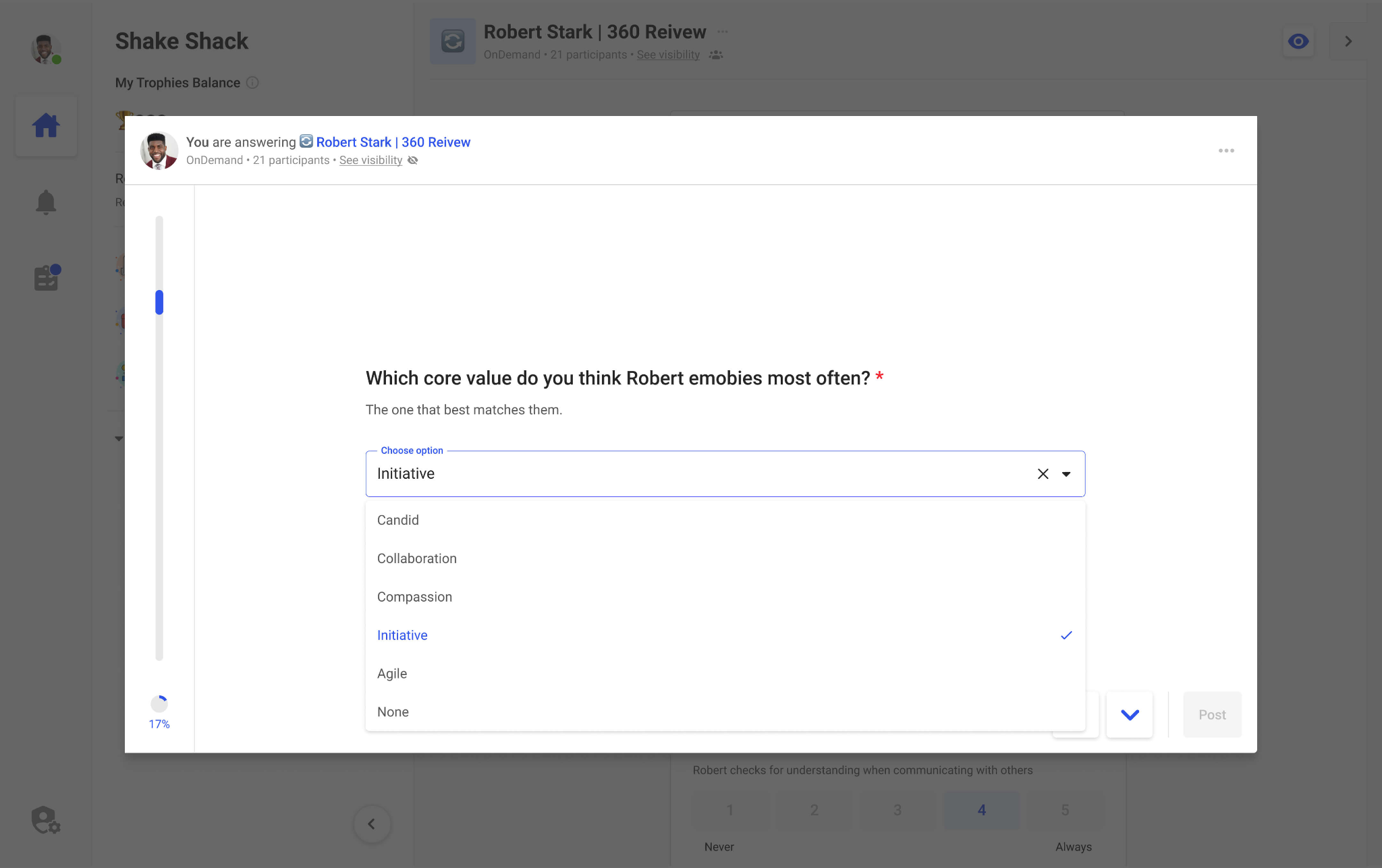
Everyone experiences the workplace a little differently. A manager sees how someone performs against goals and deadlines. Peers see how they collaborate when projects get busy or when several teams need the same resource. Direct reports see what day-to-day leadership actually feels like, from team meetings to difficult conversations.
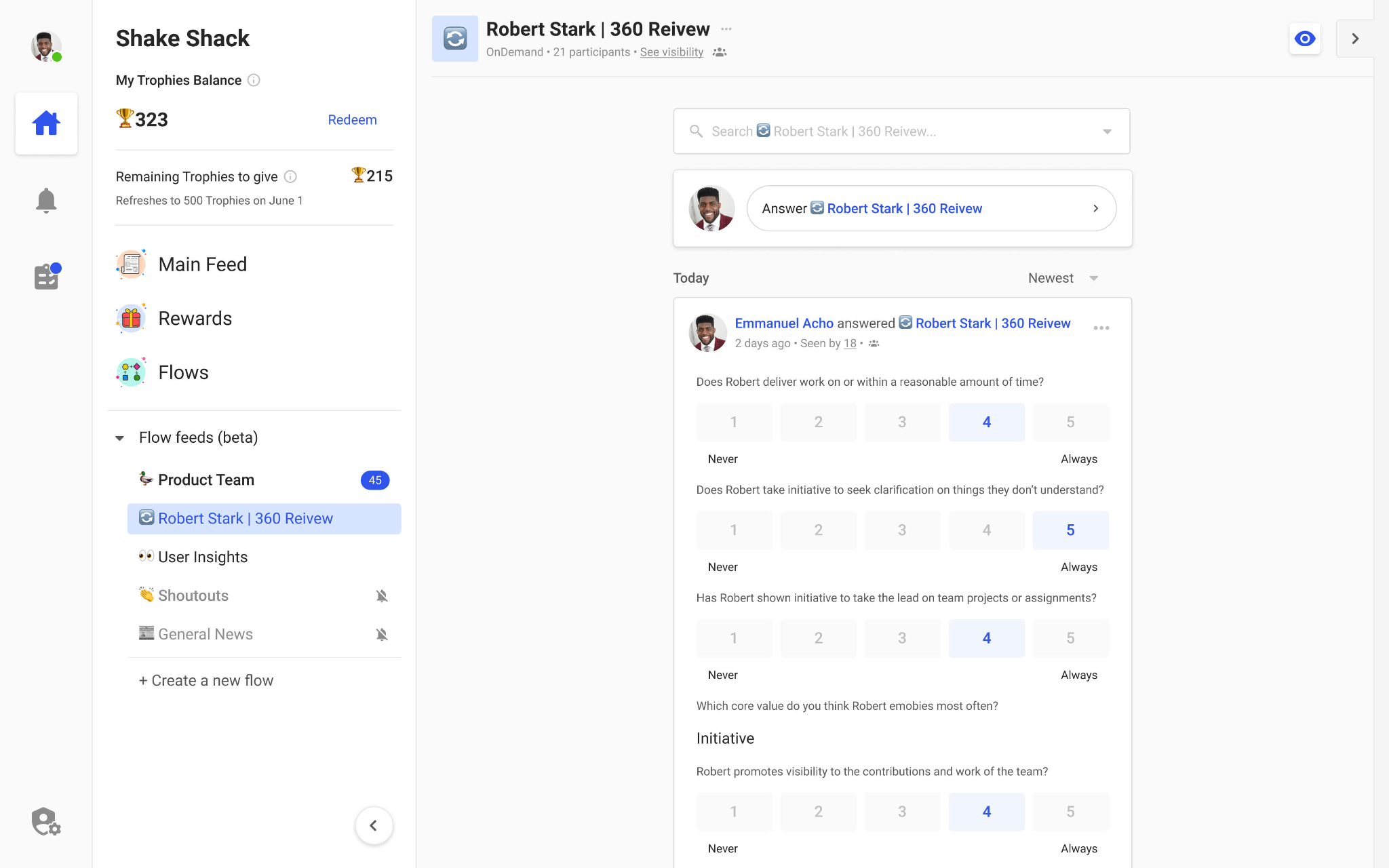
360-degree feedback brings those perspectives together in one structured process. Peers, direct reports, supervisors, and the employee all share input through the same review. If you look at how 360 degree feedback examples work across different organizations, they all follow this same idea: collect specific observations from the people closest to the work, then use those patterns to support development.
Quantum Workplace research found that employees who receive more frequent feedback are 2x more engaged, 3x less likely to look for other jobs, and 1.4x more likely to stay at their organization. A McKinsey Global Survey reinforced this: 68% of respondents said ongoing coaching and feedback conversations had a positive impact on individual performance, and companies with effective performance management systems were nearly 3x more likely to outperform their peers.
For many teams, the challenge comes down to the quality of the feedback people give. General comments such as “great team player” leave very little for someone to work with. Specific feedback gives the employee something they can understand and act on. For example: “You consistently loop in stakeholders before making cross-team decisions, which helps projects stay on track.”
In this guide, we’ll share practical 360 degree feedback examples for managers and peers that you can use as a starting point. We’ll also explain how 360 feedback works, which questions to include, common challenges teams run into, and how to use a 360 degree feedback template. We’ll also look at how Assembly (by Quantum Workplace) can support structured 360 reviews alongside everyday peer recognition.
What Is 360-Degree Feedback?
360-degree feedback is a review process where employees receive input from several people they work with regularly. This usually includes peers, direct reports, and supervisors. In some cases, external stakeholders such as clients may also take part. The employee completes a self-assessment as part of the same review cycle.
Each group sees a different part of how someone works. A peer on a shared project may notice how that person communicates during a sprint review. A direct report sees how their manager responds when a deadline is missed or priorities change. A supervisor may focus more on how the employee presents results, manages responsibilities, or communicates with leadership. Bringing these perspectives together gives the employee (and their manager) a more complete view of their performance.
Most organizations use 360-degree feedback as a development tool. When employees understand that the process is focused on growth, raters are more likely to share specific and useful observations. Employees can then use that feedback to identify strengths, recognize patterns in how others experience their work, and choose areas they want to develop further.
How 360-Degree Feedback Works
Most organizations follow a simple cycle for 360-degree feedback, usually once or twice a year.
Choose the right participants. The employee and their manager usually select 6 to 12 people who work with the employee regularly. This group can include peers, direct reports, and cross-functional partners so the feedback reflects a range of working relationships.
Send a standardized survey. Everyone receives the same set of questions. These often combine rating scales, such as 1 to 5, with open-ended questions about areas like communication, teamwork, leadership, and problem-solving.
Bring the results together. HR or a facilitator combines the responses into one report. The report highlights common themes, shows where the employee’s self-assessment lines up with how others see them, and surfaces areas that may be worth discussing further.
Have a feedback conversation. The employee reviews the results with their manager, HR partner, or coach. Together, they can identify the most useful themes and turn them into a practical development plan.
Some teams also use quarterly pulse check-ins between full 360 cycles to see how employees are progressing in specific development areas. If you’re building or refining your own process, Quantum Workplace’s 360 feedback questions guide offers ready-to-use questions and practical tips for structuring surveys that generate useful, actionable feedback.
What Are the Benefits of 360-Degree Feedback?
A well-designed 360-degree feedback process can support employee development, strengthen team relationships, and give managers a clearer view of how people experience their leadership. Here are five ways it can help:
Employees Get a Fuller Picture of Their Performance
One person can only see part of how an employee works. A manager may see how someone presents in leadership meetings, while a teammate may see how that same person supports a new hire during onboarding or handles a difficult cross-functional project.
360-degree feedback brings those observations together. Employees get a broader picture of the strengths others consistently notice, along with specific areas where they can continue developing.
Honest Conversations Become Part of the Culture
When teams regularly take part in 360 reviews, people become more comfortable giving and receiving thoughtful feedback. Over time, those conversations can become part of everyday work rather than something that only happens during a formal review cycle.
For teams looking to build that habit more consistently, our guide to creating a culture of continuous feedback covers practical ways to make feedback a regular part of how people work together.
Managers Get Specific Insight Into Their Leadership Style
Direct reports experience a manager's leadership every day. They see how priorities are communicated, how pressure is handled, how disagreements are managed, and whether people feel supported when challenges come up.
That kind of feedback can help managers understand how their leadership style comes across in practice. A McKinsey Survey found that when managers effectively coach and develop their employees, 74% rate their performance management systems as effective, and 62% say their organizations outperform competitors.
Teams can also use performance review software to run customizable 360 review cycles, collect self-assessments and peer feedback, and help managers write clearer, more constructive feedback.
Feedback From Multiple Raters Produces a More Balanced View
A 360 review typically includes feedback from 6 to 12 people across different roles and working relationships. When the same observation shows up across several raters, it carries more weight than any single person's impression. For example, if four people mention that someone communicates priorities clearly, that pattern gives the employee a stronger signal about one of their strengths. The same applies when similar development areas come up across different raters.
When these patterns are consistent across several raters, employees can use them with more confidence in their development planning. For more examples of what useful workplace feedback can look like, you can also explore these employee feedback examples.
Regular, Multi-Source Feedback Supports Engagement and Retention
Employees who receive feedback from several people on a regular basis tend to feel more connected to their work and more invested in their own growth. Quantum Workplace's research on feedback culture found that employees who receive more frequent feedback are 2x more engaged, 3x less likely to look for another job, and 1.4x more likely to stay at their organization.
When people see that their team and their organization are paying attention to how they work and giving them real input to build on, they're more likely to stay and continue developing in their role.
11 Examples of 360-Degree Feedback for Managers and Peers
The most useful 360 feedback gives someone a clear picture of what happened, how they handled it, and why it mattered. Here are 11 examples you can adapt for common workplace scenarios. Each one works as 360 feedback for manager development or peer-to-peer conversations.
1. Peer feedback on collaboration
“On the last product launch, you were really good about sharing updates before meetings, so everyone knew where things stood. I’d like to see you bring quieter people into the discussion a little more. There were a few times when they had useful context and didn’t get much room to share it.”
This works because it points to a real situation, explains the impact, and gives the person one clear behavior to work on.
2. Direct report feedback on communication
“I appreciate that you usually explain why a decision was made. It helps me understand what’s important and where I should focus. It would also help if deadlines were clearer at the beginning of a project, especially when several priorities are moving at once.”
This gives the manager useful context about what’s working and where clearer communication could make day-to-day planning easier.
3. Manager feedback on ownership
“You’ve taken much more ownership of the client accounts this quarter, and the improvement is noticeable. One thing that would help you grow further is bringing a possible solution when you flag a problem, even if it still needs discussion.”
The feedback recognizes progress and gives the employee a specific way to take more ownership.
4. Peer feedback on accountability
“I know I can rely on you to follow through when you commit to something. On the few occasions when a deadline has moved, you’ve also been good about letting people know early. Keeping that habit is important because a lot of our work depends on each other.”
This works well because it focuses on a behavior the peer sees regularly and explains why it matters to the team.
5. Direct report feedback on leadership
“You’re good at giving people room to make decisions without checking every detail with you. I’d like a little more direction when priorities change quickly, though. A short update on what should move up or down would make those weeks much easier to manage.”
This gives the manager a clear view of how their leadership style is experienced by the team.
6. Manager feedback on development
“You’ve become much more confident presenting to clients over the last few months. Your explanations are clearer, and you handle questions more comfortably. Spending a little more time on the opening of the presentation would help you set the direction earlier.”
The feedback stays focused on a specific area of growth and gives the employee something practical to improve next.
7. Peer feedback on adaptability
“You handle changing priorities well and usually adjust quickly without making the change harder for everyone else. During the last sprint, you also helped us figure out what could move to the next week, which made the handoff much smoother.”
This is useful because it shows how the person’s adaptability affects the rest of the team, rather than describing flexibility in general terms.
8. Peer feedback on recognition and support
“You’re one of the people who consistently gives others credit for their work. I noticed it again after the last release when you called out the QA team and explained what they had caught before launch. That kind of recognition makes a difference.”
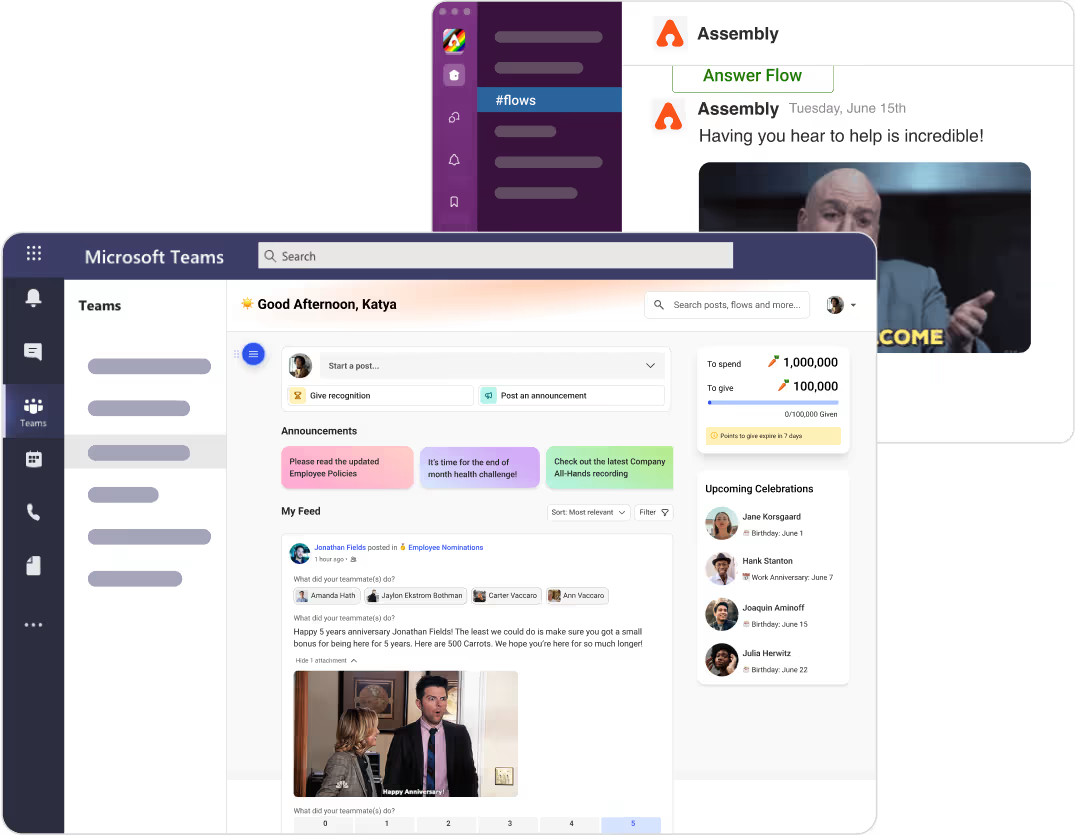
This feedback works because it recognizes a specific contribution, explains its impact, and reinforces a behavior the team should continue. With Assembly (by Quantum Workplace), peers can share that kind of recognition directly through Slack or Teams, making it easier to acknowledge contributions while the work is still fresh.
9. Direct report feedback on conflict resolution
“When there’s disagreement in a meeting, you usually give people enough space to explain what’s actually causing the issue. The conversation between design and engineering last month could have gone in circles, and you helped everyone get clear on what needed to be decided.”
This works because it describes the manager’s behavior in a tense situation and shows the practical impact on the team.
10. Peer feedback on receiving criticism
"When someone raises a concern about your work in a group setting, you tend to respond quickly and move the conversation forward before the other person has fully explained their point. I've seen it happen in the last two sprint retros. It can make people hesitant to bring things up. Taking a few extra seconds to hear the full concern before responding would go a long way."
This is harder feedback to receive, but it's specific about the behavior, the setting where it happened, and the effect it has on the team. That level of detail makes it easier for the person to understand the pattern and decide how they want to work on it.
11. Manager feedback on strategic thinking
“You’ve gotten much better at connecting your work back to the bigger goals of the team. In the last planning session, you explained why the customer research mattered before getting into the details, and that helped everyone understand the priority.”
This gives the employee a concrete example of strategic thinking and reinforces a behavior worth continuing.
The questions you ask shape the kind of feedback you get. Broad questions often lead to broad answers, while questions about specific behaviors make it easier for people to share useful observations.
A good 360 feedback survey should give raters enough direction to think about real interactions, projects, and working habits.
Questions for Employees to Ask
Employees can use questions like these when asking peers, managers, or direct reports for feedback:
What’s one thing I do that makes working with me easier?
Where could I communicate more clearly with the team?
How do I handle competing priorities when deadlines overlap?
Can you think of a recent situation where I could have collaborated better?
What’s one thing I could change that would make me more effective in my role?
Questions for Employers to Ask
HR teams and managers can include questions like these when building a 360 review survey:
How effectively does this person communicate in team settings?
How do they respond when someone gives them feedback?
Can you share an example of when this person went beyond their role to support the team?
How well do they manage their workload and deadlines?
What is one area they could focus on developing over the next six months?
How does this manager make room for different perspectives when making decisions?
The responses to these questions can also give managers useful topics to revisit during regular one-on-ones. Quantum Workplace’s one-on-one meeting software gives managers and employees a shared place for agendas, notes, and follow-up, so development areas from a 360 review can carry into future conversations.
Challenges in Implementing 360-Degree Feedback
360-degree feedback can be valuable, but the process needs to be designed carefully. Most problems come from how the survey is structured, how feedback is collected, and what happens after employees receive their results. Some common challenges teams face are:
Feedback fatigue. Reviewing too many people in one cycle can quickly become overwhelming. When employees are asked to complete feedback requests at once, the quality of their responses often drops. Keeping each person’s review load manageable gives them more time to provide thoughtful feedback.
Lack of follow-through. A 360 review only becomes useful when someone actually does something with the feedback. Employees should have a follow-up conversation with their manager, HR partner, or coach and leave with a clear idea of what they want to work on.
Poorly written questions. Broad questions such as “How is this person performing?” usually lead to equally broad answers. Questions tied to specific behaviors, such as communication, collaboration, or decision-making, give raters something concrete to respond to.
Using 360 feedback for disciplinary decisions. People are more likely to be open when they understand how their feedback will be used. If a process is introduced as a development exercise, the organization should be clear about whether those responses will also influence formal performance decisions.
360 Degree Feedback Strengths and Weaknesses
360-degree feedback can give employees and managers a broader view of how someone works across different relationships. It can also become difficult to interpret when the process is poorly designed or the follow-up is weak.
Strengths of 360 Degree Feedback:
Employees get feedback from several people who see different parts of their work. A manager might see how someone presents to leadership, while a peer sees how they handle a messy handoff between teams.
Blind spots come to the surface more naturally. Things that employees or their managers wouldn't notice on their own often show up when multiple raters point to the same pattern.
Comparing a self-assessment with how others see you builds real self-awareness. Employees can see where their own view lines up with their raters and where there's a gap worth exploring.
Over time, the process helps build a culture where giving and receiving honest, specific feedback is just how the team works. It becomes part of the rhythm rather than something people dread.
Managers get a view of their leadership that's hard to get any other way. Direct reports and peers can share observations about day-to-day leadership that a manager's own boss would rarely see.
Weaknesses of 360 Degree Feedback:
The quality of feedback depends on how well raters actually know the person's work. When someone doesn't have enough context, they tend to fall back on general impressions like "great to work with" rather than giving something specific.
Big gaps between self-ratings and what others say can be hard to sit with. Some employees shut down when the numbers don't match up, which makes it harder for them to use the feedback productively.
360 feedback works well for things like communication, collaboration, and leadership style. It's less helpful for evaluating deep technical skills where a subject matter expert's input matters more than a generic feedback.
A report full of themes and ratings can feel overwhelming if there's no plan attached to it. Employees need help figuring out what to focus on first and what to do with what they've learned.
Running 360 reviews takes real time from HR, managers, and the people filling out surveys. In larger organizations, that's a significant ask, and it's only worth it if the follow-through is consistent
The strongest 360 programs give employees time to understand the feedback and turn the main themes into a practical development plan. Our guide on why effective feedback starts with recognition looks at how recognition can make feedback conversations feel more grounded and useful.
360-Degree Feedback Template and Evaluation Sample
A simple 360 degree feedback template can make the review process easier to run and easier for employees to complete. The table below also works as a 360 degree appraisal example if your organization uses 360 feedback as part of formal performance reviews. The goal is to keep questions focused on specific behaviors and give raters enough space to add context. You can use this 360 degree evaluation sample as a baseline and adjust the categories to match the competencies your organization tracks.
360 Degree Feedback Template
Section
Sample Question
Response Format
Communication
How clearly does this person share information with the team?
1 to 5 scale + comment
Collaboration
Can you share a recent example of this person working well with others?
Open-ended
Leadership
How effectively does this person support the growth of others?
1 to 5 scale + comment
Accountability
How consistently does this person follow through on commitments and deadlines?
1 to 5 scale + comment
Adaptability
How well does this person adjust when priorities or plans change?
Open-ended
Overall
What is one strength this person should keep building on, and what is one area they could develop further?
Open-ended
If you want a ready-made starting point, this 360 review template by Assembly (by Quantum Workplace) lets you customize questions, manage who sees the results, and keep responses organized in one place.
How to Implement 360-Degree Feedback in Your Organization
A good 360-degree feedback process needs clear expectations, manageable surveys, and consistent follow-up. These tips can help you build a process employees understand and actually use.
Define the purpose clearly: Decide what you want the 360 review to support, such as employee development, leadership growth, or broader performance conversations. Explain that purpose before the review begins so employees know how their feedback will be used.
Pilot the process with a small group: Running the first cycle with one or two teams gives you a chance to see how the questions, survey length, and feedback discussions work in practice. You can then make adjustments before rolling it out more widely across the organization.
Show raters what useful feedback looks like: Many employees haven’t had much guidance on writing specific, behavior-based feedback. A short guide with 360 appraisal feedback examples can help people understand the level of detail that makes a response useful.
Set a deadline for the follow-up conversation: Employees should have time to review their results with a manager, HR partner, or mentor while the feedback is still fresh. Setting a clear deadline, such as within 30 days of receiving the report, helps keep that conversation from getting pushed aside.
Use tools that support the full review cycle: Managing survey distribution, anonymity, reports, and follow-up in separate places can make the process harder to maintain. Quantum Workplace’s performance management platform brings goals, feedback, 360 reviews, and one-on-ones into one system.
360-degree feedback works best when people know what the process is for, the questions are specific, and there’s a clear follow-up after the review. The examples, questions, and templates in this guide give you a practical starting point for building or improving your own process.
The real value comes from what happens after the responses are collected. Employees need time to understand the patterns in their feedback, talk through them with someone they trust, and decide what they want to work on next.
Assembly (by Quantum Workplace) brings 360 reviews, peer recognition, and ongoing performance conversations into one connected platform, so the feedback your team collects can turn into real development over time.
Frequently Asked Questions
What is a 360 degree feedback example?
A 360 degree feedback example is a specific comment about how someone works, shared by a peer, manager, direct report, or another person they regularly work with. For example: "You kept the project team updated throughout the Q3 launch, which made it easier for everyone to adjust when the timeline changed." Useful feedback focuses on a behavior the person can recognize and act on.
How often should organizations run 360 reviews for managers?
Many organizations run 360 reviews once or twice a year. Some teams also use shorter check-ins between full review cycles to see how someone is progressing on specific development goals. The right schedule depends on how many people are involved and how much time the organization can dedicate to follow-up conversations.
Can 360-degree feedback be used for performance evaluations?
360 feedback can add useful context to a performance review because it brings in perspectives from people who work with the employee in different ways. Organizations should be clear about how the feedback will be used before the review begins, especially if the results may influence decisions around performance, promotion, or compensation.
What makes a good 360 degree feedback template?
A good 360 degree feedback template combines rating questions with open-ended prompts. The questions should focus on specific areas such as communication, collaboration, leadership, accountability, and adaptability. Keeping the survey focused also makes it easier for raters to give thoughtful answers.
How do you handle negative feedback in a 360 review?
Negative feedback is easier to act on when it points to a specific behavior and explains the impact. A comment such as "Communication could be better" leaves a lot open to interpretation. A more useful example would be: "In the last two project kickoffs, some key requirements were shared after work had already started, which made planning more difficult for the team." Once the feedback is clear, the employee and manager can use it to agree on a practical development goal and revisit it in future conversations. Our guide to building a culture of feedback has more ideas for making those conversations part of regular work.
Can you share a 360 feedback strengths and weaknesses example?
A strength might look like: "You consistently keep the team updated on project changes before they affect other people's work, which helps everyone plan ahead." A weakness might look like: "When priorities shift, there is sometimes a gap before the team hears about the change, which can lead to people working on tasks that are no longer the top priority." The most useful feedback in both cases ties the observation to a specific behavior and explains the impact on the team.
class SampleComponent extends React.Component {
  // using the experimental public class field syntax below. We can also attach
  // the contextType to the current class
  static contextType = ColorContext;
  render() {
    return <Button color={this.color} />
  }
}
Everyone experiences the workplace a little differently. A manager sees how someone performs against goals and deadlines. Peers see how they collaborate when projects get busy or when several teams need the same resource. Direct reports see what day-to-day leadership actually feels like, from team meetings to difficult conversations.
360-degree feedback brings those perspectives together in one structured process. Peers, direct reports, supervisors, and the employee all share input through the same review. If you look at how 360 degree feedback examples work across different organizations, they all follow this same idea: collect specific observations from the people closest to the work, then use those patterns to support development.
Quantum Workplace research found that employees who receive more frequent feedback are 2x more engaged, 3x less likely to look for other jobs, and 1.4x more likely to stay at their organization. A McKinsey Global Survey reinforced this: 68% of respondents said ongoing coaching and feedback conversations had a positive impact on individual performance, and companies with effective performance management systems were nearly 3x more likely to outperform their peers.
For many teams, the challenge comes down to the quality of the feedback people give. General comments such as “great team player” leave very little for someone to work with. Specific feedback gives the employee something they can understand and act on. For example: “You consistently loop in stakeholders before making cross-team decisions, which helps projects stay on track.”
In this guide, we’ll share practical 360 degree feedback examples for managers and peers that you can use as a starting point. We’ll also explain how 360 feedback works, which questions to include, common challenges teams run into, and how to use a 360 degree feedback template. We’ll also look at how Assembly (by Quantum Workplace) can support structured 360 reviews alongside everyday peer recognition.
What Is 360-Degree Feedback?
360-degree feedback is a review process where employees receive input from several people they work with regularly. This usually includes peers, direct reports, and supervisors. In some cases, external stakeholders such as clients may also take part. The employee completes a self-assessment as part of the same review cycle.
Each group sees a different part of how someone works. A peer on a shared project may notice how that person communicates during a sprint review. A direct report sees how their manager responds when a deadline is missed or priorities change. A supervisor may focus more on how the employee presents results, manages responsibilities, or communicates with leadership. Bringing these perspectives together gives the employee (and their manager) a more complete view of their performance.
Most organizations use 360-degree feedback as a development tool. When employees understand that the process is focused on growth, raters are more likely to share specific and useful observations. Employees can then use that feedback to identify strengths, recognize patterns in how others experience their work, and choose areas they want to develop further.
How 360-Degree Feedback Works
Most organizations follow a simple cycle for 360-degree feedback, usually once or twice a year.
Choose the right participants. The employee and their manager usually select 6 to 12 people who work with the employee regularly. This group can include peers, direct reports, and cross-functional partners so the feedback reflects a range of working relationships.
Send a standardized survey. Everyone receives the same set of questions. These often combine rating scales, such as 1 to 5, with open-ended questions about areas like communication, teamwork, leadership, and problem-solving.
Bring the results together. HR or a facilitator combines the responses into one report. The report highlights common themes, shows where the employee’s self-assessment lines up with how others see them, and surfaces areas that may be worth discussing further.
Have a feedback conversation. The employee reviews the results with their manager, HR partner, or coach. Together, they can identify the most useful themes and turn them into a practical development plan.
Some teams also use quarterly pulse check-ins between full 360 cycles to see how employees are progressing in specific development areas. If you’re building or refining your own process, Quantum Workplace’s 360 feedback questions guide offers ready-to-use questions and practical tips for structuring surveys that generate useful, actionable feedback.
What Are the Benefits of 360-Degree Feedback?
A well-designed 360-degree feedback process can support employee development, strengthen team relationships, and give managers a clearer view of how people experience their leadership. Here are five ways it can help:
Employees Get a Fuller Picture of Their Performance
One person can only see part of how an employee works. A manager may see how someone presents in leadership meetings, while a teammate may see how that same person supports a new hire during onboarding or handles a difficult cross-functional project.
360-degree feedback brings those observations together. Employees get a broader picture of the strengths others consistently notice, along with specific areas where they can continue developing.
Honest Conversations Become Part of the Culture
When teams regularly take part in 360 reviews, people become more comfortable giving and receiving thoughtful feedback. Over time, those conversations can become part of everyday work rather than something that only happens during a formal review cycle.
For teams looking to build that habit more consistently, our guide to creating a culture of continuous feedback covers practical ways to make feedback a regular part of how people work together.
Managers Get Specific Insight Into Their Leadership Style
Direct reports experience a manager's leadership every day. They see how priorities are communicated, how pressure is handled, how disagreements are managed, and whether people feel supported when challenges come up.
That kind of feedback can help managers understand how their leadership style comes across in practice. A McKinsey Survey found that when managers effectively coach and develop their employees, 74% rate their performance management systems as effective, and 62% say their organizations outperform competitors.
Teams can also use performance review software to run customizable 360 review cycles, collect self-assessments and peer feedback, and help managers write clearer, more constructive feedback.
Feedback From Multiple Raters Produces a More Balanced View
A 360 review typically includes feedback from 6 to 12 people across different roles and working relationships. When the same observation shows up across several raters, it carries more weight than any single person's impression. For example, if four people mention that someone communicates priorities clearly, that pattern gives the employee a stronger signal about one of their strengths. The same applies when similar development areas come up across different raters.
When these patterns are consistent across several raters, employees can use them with more confidence in their development planning. For more examples of what useful workplace feedback can look like, you can also explore these employee feedback examples.
Regular, Multi-Source Feedback Supports Engagement and Retention
Employees who receive feedback from several people on a regular basis tend to feel more connected to their work and more invested in their own growth. Quantum Workplace's research on feedback culture found that employees who receive more frequent feedback are 2x more engaged, 3x less likely to look for another job, and 1.4x more likely to stay at their organization.
When people see that their team and their organization are paying attention to how they work and giving them real input to build on, they're more likely to stay and continue developing in their role.
11 Examples of 360-Degree Feedback for Managers and Peers
The most useful 360 feedback gives someone a clear picture of what happened, how they handled it, and why it mattered. Here are 11 examples you can adapt for common workplace scenarios. Each one works as 360 feedback for manager development or peer-to-peer conversations.
1. Peer feedback on collaboration
“On the last product launch, you were really good about sharing updates before meetings, so everyone knew where things stood. I’d like to see you bring quieter people into the discussion a little more. There were a few times when they had useful context and didn’t get much room to share it.”
This works because it points to a real situation, explains the impact, and gives the person one clear behavior to work on.
2. Direct report feedback on communication
“I appreciate that you usually explain why a decision was made. It helps me understand what’s important and where I should focus. It would also help if deadlines were clearer at the beginning of a project, especially when several priorities are moving at once.”
This gives the manager useful context about what’s working and where clearer communication could make day-to-day planning easier.
3. Manager feedback on ownership
“You’ve taken much more ownership of the client accounts this quarter, and the improvement is noticeable. One thing that would help you grow further is bringing a possible solution when you flag a problem, even if it still needs discussion.”
The feedback recognizes progress and gives the employee a specific way to take more ownership.
4. Peer feedback on accountability
“I know I can rely on you to follow through when you commit to something. On the few occasions when a deadline has moved, you’ve also been good about letting people know early. Keeping that habit is important because a lot of our work depends on each other.”
This works well because it focuses on a behavior the peer sees regularly and explains why it matters to the team.
5. Direct report feedback on leadership
“You’re good at giving people room to make decisions without checking every detail with you. I’d like a little more direction when priorities change quickly, though. A short update on what should move up or down would make those weeks much easier to manage.”
This gives the manager a clear view of how their leadership style is experienced by the team.
6. Manager feedback on development
“You’ve become much more confident presenting to clients over the last few months. Your explanations are clearer, and you handle questions more comfortably. Spending a little more time on the opening of the presentation would help you set the direction earlier.”
The feedback stays focused on a specific area of growth and gives the employee something practical to improve next.
7. Peer feedback on adaptability
“You handle changing priorities well and usually adjust quickly without making the change harder for everyone else. During the last sprint, you also helped us figure out what could move to the next week, which made the handoff much smoother.”
This is useful because it shows how the person’s adaptability affects the rest of the team, rather than describing flexibility in general terms.
8. Peer feedback on recognition and support
“You’re one of the people who consistently gives others credit for their work. I noticed it again after the last release when you called out the QA team and explained what they had caught before launch. That kind of recognition makes a difference.”
This feedback works because it recognizes a specific contribution, explains its impact, and reinforces a behavior the team should continue. With Assembly (by Quantum Workplace), peers can share that kind of recognition directly through Slack or Teams, making it easier to acknowledge contributions while the work is still fresh.
9. Direct report feedback on conflict resolution
“When there’s disagreement in a meeting, you usually give people enough space to explain what’s actually causing the issue. The conversation between design and engineering last month could have gone in circles, and you helped everyone get clear on what needed to be decided.”
This works because it describes the manager’s behavior in a tense situation and shows the practical impact on the team.
10. Peer feedback on receiving criticism
"When someone raises a concern about your work in a group setting, you tend to respond quickly and move the conversation forward before the other person has fully explained their point. I've seen it happen in the last two sprint retros. It can make people hesitant to bring things up. Taking a few extra seconds to hear the full concern before responding would go a long way."
This is harder feedback to receive, but it's specific about the behavior, the setting where it happened, and the effect it has on the team. That level of detail makes it easier for the person to understand the pattern and decide how they want to work on it.
11. Manager feedback on strategic thinking
“You’ve gotten much better at connecting your work back to the bigger goals of the team. In the last planning session, you explained why the customer research mattered before getting into the details, and that helped everyone understand the priority.”
This gives the employee a concrete example of strategic thinking and reinforces a behavior worth continuing.
The questions you ask shape the kind of feedback you get. Broad questions often lead to broad answers, while questions about specific behaviors make it easier for people to share useful observations.
A good 360 feedback survey should give raters enough direction to think about real interactions, projects, and working habits.
Questions for Employees to Ask
Employees can use questions like these when asking peers, managers, or direct reports for feedback:
What’s one thing I do that makes working with me easier?
Where could I communicate more clearly with the team?
How do I handle competing priorities when deadlines overlap?
Can you think of a recent situation where I could have collaborated better?
What’s one thing I could change that would make me more effective in my role?
Questions for Employers to Ask
HR teams and managers can include questions like these when building a 360 review survey:
How effectively does this person communicate in team settings?
How do they respond when someone gives them feedback?
Can you share an example of when this person went beyond their role to support the team?
How well do they manage their workload and deadlines?
What is one area they could focus on developing over the next six months?
How does this manager make room for different perspectives when making decisions?
The responses to these questions can also give managers useful topics to revisit during regular one-on-ones. Quantum Workplace’s one-on-one meeting software gives managers and employees a shared place for agendas, notes, and follow-up, so development areas from a 360 review can carry into future conversations.
Challenges in Implementing 360-Degree Feedback
360-degree feedback can be valuable, but the process needs to be designed carefully. Most problems come from how the survey is structured, how feedback is collected, and what happens after employees receive their results. Some common challenges teams face are:
Feedback fatigue. Reviewing too many people in one cycle can quickly become overwhelming. When employees are asked to complete feedback requests at once, the quality of their responses often drops. Keeping each person’s review load manageable gives them more time to provide thoughtful feedback.
Lack of follow-through. A 360 review only becomes useful when someone actually does something with the feedback. Employees should have a follow-up conversation with their manager, HR partner, or coach and leave with a clear idea of what they want to work on.
Poorly written questions. Broad questions such as “How is this person performing?” usually lead to equally broad answers. Questions tied to specific behaviors, such as communication, collaboration, or decision-making, give raters something concrete to respond to.
Using 360 feedback for disciplinary decisions. People are more likely to be open when they understand how their feedback will be used. If a process is introduced as a development exercise, the organization should be clear about whether those responses will also influence formal performance decisions.
360 Degree Feedback Strengths and Weaknesses
360-degree feedback can give employees and managers a broader view of how someone works across different relationships. It can also become difficult to interpret when the process is poorly designed or the follow-up is weak.
Strengths of 360 Degree Feedback:
Employees get feedback from several people who see different parts of their work. A manager might see how someone presents to leadership, while a peer sees how they handle a messy handoff between teams.
Blind spots come to the surface more naturally. Things that employees or their managers wouldn't notice on their own often show up when multiple raters point to the same pattern.
Comparing a self-assessment with how others see you builds real self-awareness. Employees can see where their own view lines up with their raters and where there's a gap worth exploring.
Over time, the process helps build a culture where giving and receiving honest, specific feedback is just how the team works. It becomes part of the rhythm rather than something people dread.
Managers get a view of their leadership that's hard to get any other way. Direct reports and peers can share observations about day-to-day leadership that a manager's own boss would rarely see.
Weaknesses of 360 Degree Feedback:
The quality of feedback depends on how well raters actually know the person's work. When someone doesn't have enough context, they tend to fall back on general impressions like "great to work with" rather than giving something specific.
Big gaps between self-ratings and what others say can be hard to sit with. Some employees shut down when the numbers don't match up, which makes it harder for them to use the feedback productively.
360 feedback works well for things like communication, collaboration, and leadership style. It's less helpful for evaluating deep technical skills where a subject matter expert's input matters more than a generic feedback.
A report full of themes and ratings can feel overwhelming if there's no plan attached to it. Employees need help figuring out what to focus on first and what to do with what they've learned.
Running 360 reviews takes real time from HR, managers, and the people filling out surveys. In larger organizations, that's a significant ask, and it's only worth it if the follow-through is consistent
The strongest 360 programs give employees time to understand the feedback and turn the main themes into a practical development plan. Our guide on why effective feedback starts with recognition looks at how recognition can make feedback conversations feel more grounded and useful.
360-Degree Feedback Template and Evaluation Sample
A simple 360 degree feedback template can make the review process easier to run and easier for employees to complete. The table below also works as a 360 degree appraisal example if your organization uses 360 feedback as part of formal performance reviews. The goal is to keep questions focused on specific behaviors and give raters enough space to add context. You can use this 360 degree evaluation sample as a baseline and adjust the categories to match the competencies your organization tracks.
360 Degree Feedback Template
Section
Sample Question
Response Format
Communication
How clearly does this person share information with the team?
1 to 5 scale + comment
Collaboration
Can you share a recent example of this person working well with others?
Open-ended
Leadership
How effectively does this person support the growth of others?
1 to 5 scale + comment
Accountability
How consistently does this person follow through on commitments and deadlines?
1 to 5 scale + comment
Adaptability
How well does this person adjust when priorities or plans change?
Open-ended
Overall
What is one strength this person should keep building on, and what is one area they could develop further?
Open-ended
If you want a ready-made starting point, this 360 review template by Assembly (by Quantum Workplace) lets you customize questions, manage who sees the results, and keep responses organized in one place.
How to Implement 360-Degree Feedback in Your Organization
A good 360-degree feedback process needs clear expectations, manageable surveys, and consistent follow-up. These tips can help you build a process employees understand and actually use.
Define the purpose clearly: Decide what you want the 360 review to support, such as employee development, leadership growth, or broader performance conversations. Explain that purpose before the review begins so employees know how their feedback will be used.
Pilot the process with a small group: Running the first cycle with one or two teams gives you a chance to see how the questions, survey length, and feedback discussions work in practice. You can then make adjustments before rolling it out more widely across the organization.
Show raters what useful feedback looks like: Many employees haven’t had much guidance on writing specific, behavior-based feedback. A short guide with 360 appraisal feedback examples can help people understand the level of detail that makes a response useful.
Set a deadline for the follow-up conversation: Employees should have time to review their results with a manager, HR partner, or mentor while the feedback is still fresh. Setting a clear deadline, such as within 30 days of receiving the report, helps keep that conversation from getting pushed aside.
Use tools that support the full review cycle: Managing survey distribution, anonymity, reports, and follow-up in separate places can make the process harder to maintain. Quantum Workplace’s performance management platform brings goals, feedback, 360 reviews, and one-on-ones into one system.
360-degree feedback works best when people know what the process is for, the questions are specific, and there’s a clear follow-up after the review. The examples, questions, and templates in this guide give you a practical starting point for building or improving your own process.
The real value comes from what happens after the responses are collected. Employees need time to understand the patterns in their feedback, talk through them with someone they trust, and decide what they want to work on next.
Assembly (by Quantum Workplace) brings 360 reviews, peer recognition, and ongoing performance conversations into one connected platform, so the feedback your team collects can turn into real development over time.
Frequently Asked Questions
What is a 360 degree feedback example?
A 360 degree feedback example is a specific comment about how someone works, shared by a peer, manager, direct report, or another person they regularly work with. For example: "You kept the project team updated throughout the Q3 launch, which made it easier for everyone to adjust when the timeline changed." Useful feedback focuses on a behavior the person can recognize and act on.
How often should organizations run 360 reviews for managers?
Many organizations run 360 reviews once or twice a year. Some teams also use shorter check-ins between full review cycles to see how someone is progressing on specific development goals. The right schedule depends on how many people are involved and how much time the organization can dedicate to follow-up conversations.
Can 360-degree feedback be used for performance evaluations?
360 feedback can add useful context to a performance review because it brings in perspectives from people who work with the employee in different ways. Organizations should be clear about how the feedback will be used before the review begins, especially if the results may influence decisions around performance, promotion, or compensation.
What makes a good 360 degree feedback template?
A good 360 degree feedback template combines rating questions with open-ended prompts. The questions should focus on specific areas such as communication, collaboration, leadership, accountability, and adaptability. Keeping the survey focused also makes it easier for raters to give thoughtful answers.
How do you handle negative feedback in a 360 review?
Negative feedback is easier to act on when it points to a specific behavior and explains the impact. A comment such as "Communication could be better" leaves a lot open to interpretation. A more useful example would be: "In the last two project kickoffs, some key requirements were shared after work had already started, which made planning more difficult for the team." Once the feedback is clear, the employee and manager can use it to agree on a practical development goal and revisit it in future conversations. Our guide to building a culture of feedback has more ideas for making those conversations part of regular work.
Can you share a 360 feedback strengths and weaknesses example?
A strength might look like: "You consistently keep the team updated on project changes before they affect other people's work, which helps everyone plan ahead." A weakness might look like: "When priorities shift, there is sometimes a gap before the team hears about the change, which can lead to people working on tasks that are no longer the top priority." The most useful feedback in both cases ties the observation to a specific behavior and explains the impact on the team.
Browse our Free Employee Recognition Guide
Get the foundational knowledge on creating an employee recognition program that boosts employee engagement and helps them feel valued.






.png)