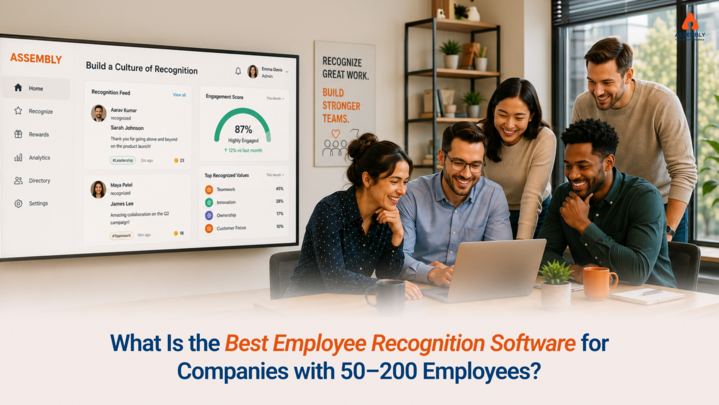
Most employee recognition software is built for companies with thousands of employees. The pricing assumes enterprise budgets. The feature sets assume dedicated HR operations teams. The implementation timelines assume months of setup work.
That creates a real problem for companies in the 50–200 employee range. You are past the startup phase where a Slack channel and a thank-you note were enough. But you are not yet at the scale where a six-figure recognition platform makes sense. You need something that works today, grows with you, and doesn't require a full implementation project to get started.
This guide covers what to look for at this specific company size, and the seven platforms that actually fit and not enterprise tools scaled down, but recognition software built for where you are right now.
Why 50–200 Employees Is a Unique Buying Situation for Recognition Software
At 50 employees, recognition usually still happens informally. A manager notices good work. A shout-out happens in a team meeting. The CEO knows everyone's name. It works, but it doesn't scale.
By the time you reach 100 employees, the gaps start to show. Contributions go unnoticed. Remote employees feel invisible. New hires don't understand what the company values in practice. Managers get busy and recognition becomes inconsistent. People start to disengage quietly.
By 200 employees, those gaps become expensive. Turnover rises. Culture fragments across teams. What used to happen naturally now needs a system behind it.
That transition from informal recognition to a real, repeatable programme, is what this buying decision is actually about. You are not just picking software. You are deciding when and how to make recognition part of how your company operates every day.
The challenge is that most platforms are built for one of two extremes. Tools designed for startups are too lightweight to sustain a real programme. Enterprise platforms designed for 1,000+ employees come with complexity, pricing, and implementation requirements that don't make sense at this stage.
The platforms in this guide sit in the middle and most of them are designed specifically to serve it.
What to Look for in Employee Recognition Software at This Size
Before comparing platforms, it helps to know which features actually matter at 50–200 employees and which ones you can safely ignore.
1) Ease of adoption
A platform your team doesn't use is not a recognition programme. It's a budget line item. At this size, you need something employees and managers pick up without a training day. Look for participation rates in reviews, not just feature lists.
Manager-only recognition misses most of what happens in a 50–200 person company. Colleagues see contributions that managers don't. A platform that lets employees recognise each other creates a culture where appreciation flows in all directions, not just top-down.
3) Values integration
Recognition that's tied to company values does two things at once for you. It reinforces the behaviours you want to see more of, and it shows new employees what the culture actually looks like in practice.
4) Milestone automation
Birthdays and work anniversaries should not depend on someone remembering. At 100+ employees, manual milestone tracking breaks down. Automation ensures every employee is recognised at the right time without adding admin work to someone's plate.
5) Integrations that fit your stack
Most companies in this size range run on Slack or Microsoft Teams. Your recognition platform should live inside those tools, not require employees to open a separate app. HRIS integration (BambooHR, ADP, Rippling) is also important for milestone data and onboarding sync.
It should become part of daily employee engagement rather than a separate task.
6) Transparent pricing
Avoid platforms with custom enterprise pricing at this stage. The platforms that work best for 50–200 employee companies publish their pricing clearly.
What can you keep for later scaling stages? Advanced compensation modelling, complex calibration workflows, multi-country compliance infrastructure, and 360-degree performance review systems. Those matter at scale. Right now, you need recognition that is simple, visible, and consistent.
Best Employee Recognition Software for 50–200 Employees in 2026
Platform Comparison
Platform
Best Situation
Not the Right Fit If
Assembly by Quantum Workplace
You want one platform covering peer recognition, milestones, rewards, and engagement visibility — all inside Slack or Teams
You need full performance review cycles without pairing with Quantum Workplace
Nectar
You are formalising recognition for the first time and want values tied to every shout-out
Your team is global and needs strong international reward options
Bonusly
Recognition happens occasionally and you need to make it a daily habit quickly
You need deep analytics or advanced admin controls
Motivosity
You need to prove recognition ROI to leadership with real engagement data
Your team is outside the US and needs international reward flexibility
Kudos
Culture is a strategic priority and you want data on which values are actually showing up
You need transparent upfront pricing without a sales conversation
Qarrot
Your team is sceptical of recognition and needs it tied to real outcomes
You need global features or enterprise-level analytics
Kudoboard
Milestone moments are the specific gap, especially for remote or hybrid teams
You want an everyday recognition feed, not just milestone celebrations
1. Assembly (by Quantum Workplace)
Quantum Workplace is the employee success platform behind Assembly. Where Quantum Workplace powers performance management, engagement surveys, and people analytics at scale, Assembly focuses on recognition, rewards, and milestone celebrations, making appreciation a daily part of how teams operate. Together, they give HR leaders a connected view of recognition and engagement in one ecosystem.
Assembly (by Quantum Workplace) is built for companies that want recognition to happen naturally inside the tools their team already uses. For companies with 50-200 people, there is no time for new habit adoption or learning a separate tool.
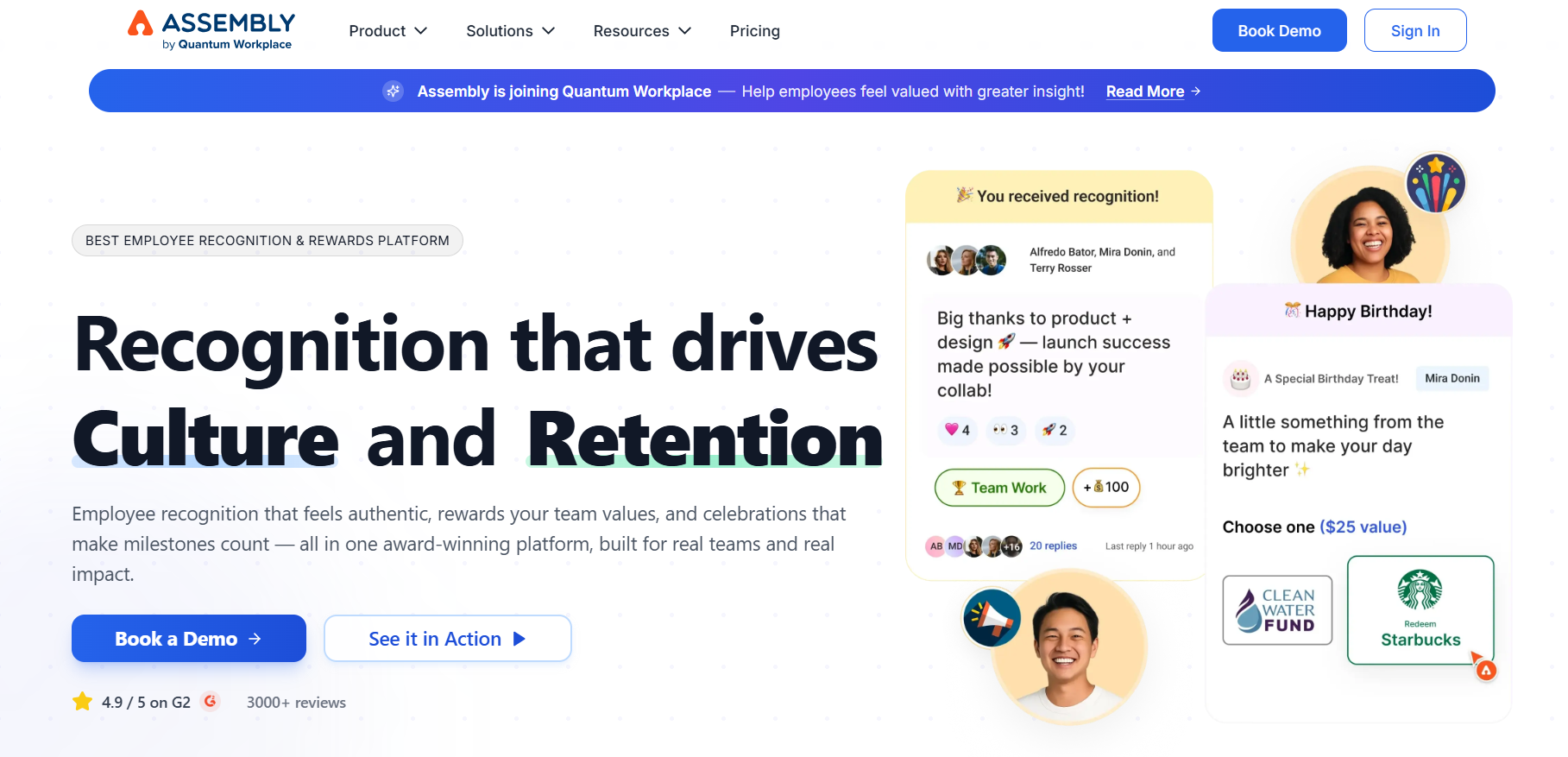
Their peer-to-peer recognition runs inside Slack, Microsoft Teams, or your HRIS, so appreciation happens in the flow of work rather than as a separate task. The Boost feature makes social recognition feel conversational by letting employees award points directly in post replies.
The automated milestones celebration system is one of the most practical features available for companies in the 50–200 range. The Welcome Bot and Anniversary Bot trigger personalized recognition moments for birthdays, work anniversaries, and milestones automatically based on profile data, so no milestone gets missed as the team grows.
Admins can embed company values into every recognition post, keeping culture visible and reinforced without any extra effort from the person giving the shout-out. The rewards catalogue gives employees flexibility to choose something meaningful from gift cards and experiences to charitable donations and Amazon purchases.
Assembly (by Quantum Workplace) also includes Dora AI, which surfaces recognition patterns and flags employees who haven't been recently recognised, giving HR leaders early visibility into engagement gaps before they become retention problems.
For a team of 50–200 people where HR is often one or two people, the combination of automation, simplicity, and analytics makes Assembly (by Quantum Workplace), the most practical starting point.
Key strengths:
90%+ participation rates by employees
Ease of adoption as it runs inside Slack and Teams
Automated milestone celebrations reduce admin work to zero
Dora AI identifies recognition gaps before they become engagement problems
Rewards catalogue includes gift cards, experiences, Amazon, donations, and custom rewards
Free onboarding and unlimited training included
Limitations:
Reward catalogue navigation can feel unintuitive for some first-time users
Some users report occasional slow load times
Pricing: Plans start at $2/employee/month
2. Nectar
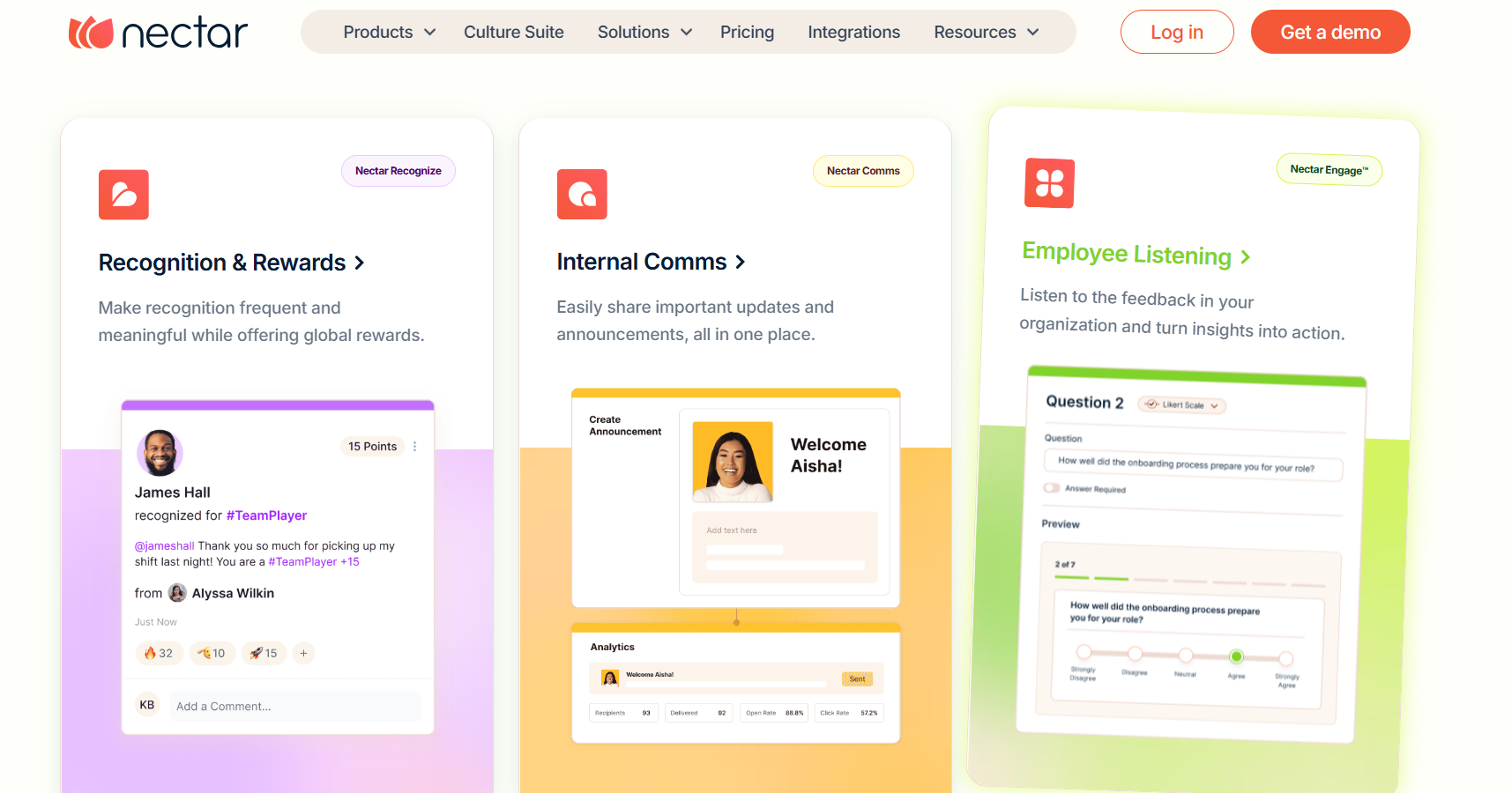
Nectar is purpose-built for mid-sized teams that are formalising their recognition programme for the first time. It's one of the cleanest starting points for a company in the 50–200 range that wants structure without complexity.
Every shout-out in Nectar is tied directly to a company core value. That single design decision does more for culture than most platforms achieve with a full feature set. Recognition stops being a feel-good moment and starts being a visible, repeatable signal of what the organisation actually values.
The nomination programme lets employees surface peer contributions that managers would otherwise miss. For a growing team where managers are increasingly stretched, this matters. The people closest to the work often see the most important contributions, Nectar gives them a formal way to surface those.
Nectar holds an official partnership with SHRM, the largest HR professional organisation in the world. SHRM used Nectar internally before formalising the partnership which tells you something about the platform's credibility beyond marketing claims.
The reporting dashboard shows participation rates, recognition trends, and which values are being recognised most frequently, giving a small HR team the data they need to make the programme better without spending hours pulling it together manually.
Key strengths:
Every recognition moment is tied to a company value which reinforces culture automatically
Peer nomination programme surfaces contributions managers typically miss
Clean, simple interface with low learning curve
SHRM partnership adds independent credibility
Milestone automation for birthdays and work anniversaries built in
Limitations:
International reward availability is more limited than enterprise platforms
Works best for single-region or US-based teams
Less depth in analytics compared to platforms like Motivosity
Pricing: Starts at $2.50/employee/month
3. Bonusly
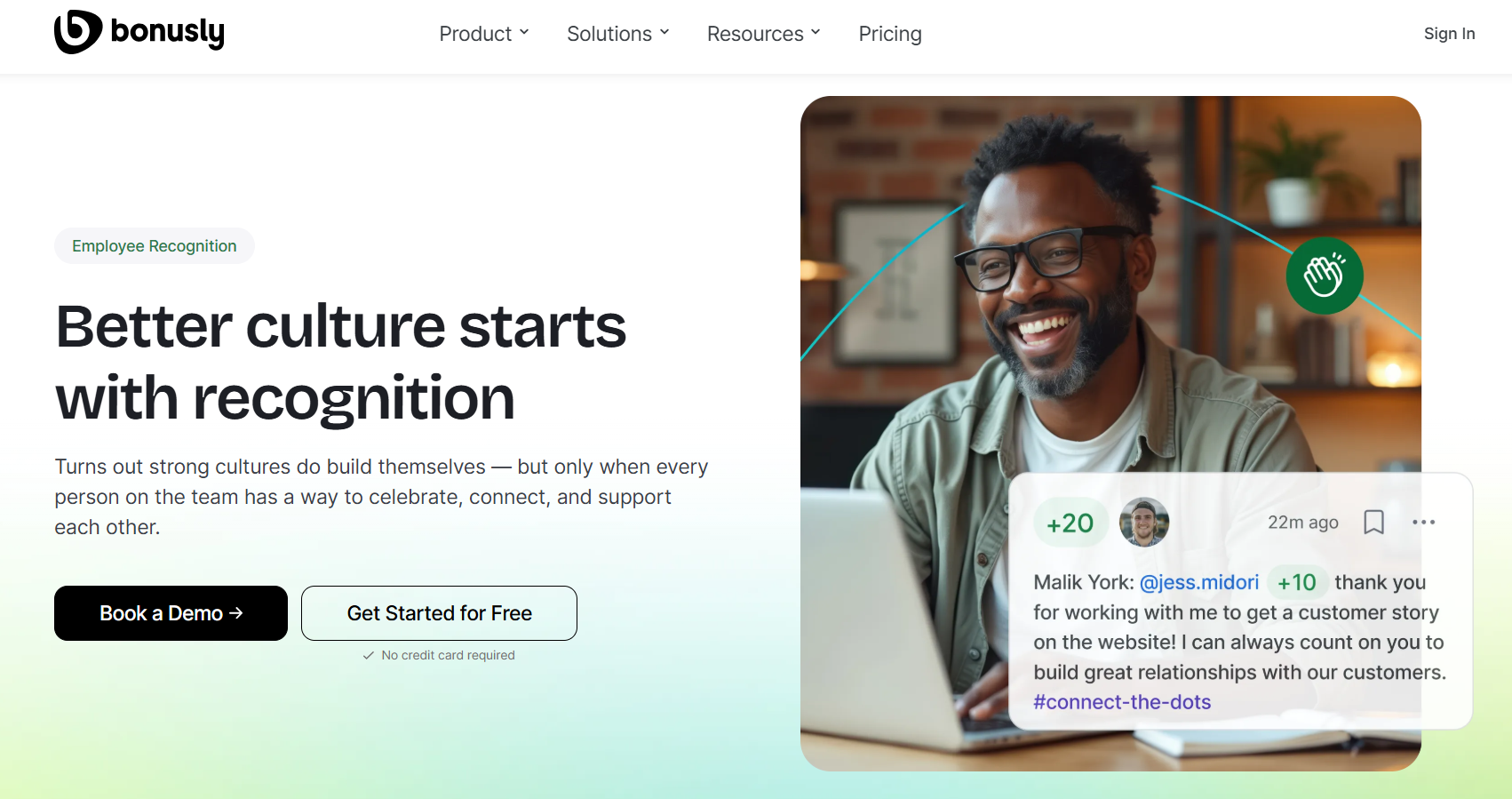
Bonusly is the simplest way to build a daily recognition habit. It focuses on micro-bonuses, small points that employees give each other for everyday contributions and it runs entirely inside Slack and Microsoft Teams.
The model works particularly well for companies in the 50–200 range because it does not try to be a full HR platform. It does one thing make peer recognition frequent, visible, and easy and it does it well.
Employees receive a monthly allowance of points to give to colleagues. Each recognition moment shows up in a public feed where the whole team can see it, react to it, and add their own points. Over time, that feed becomes a real-time record of the contributions that matter to the team which is useful data during performance conversations and promotion discussions.
The reward catalogue covers gift cards, charitable donations, and custom rewards, with enough variety to give employees a genuine choice without overwhelming them with options.
For a company that wants to move from informal appreciation to a visible, consistent culture of recognition without a major implementation project, Bonusly is one of the fastest paths to results.
Key strengths:
Micro-bonus model builds a daily recognition habit quickly
Public recognition feed creates visibility across the whole team
Fast to implement - teams are typically running within days, not weeks
Broad reward catalogue with gift cards, donations, and custom options
1:1 tools and pulse checks included for managers
Limitations:
Less suited for global teams that need region-specific reward options
Admin controls are lighter than more enterprise-focused platforms
Monthly point allowances reset, which some users find frustrating
Pricing: Starts at $3/user/month
4. Motivosity
Motivosity is the right choice for a 50–200 person company that wants to measure whether recognition is actually working or not.
Most recognition platforms tell you participation numbers. Motivosity goes further with its MV6 survey which is a proprietary six-question pulse that benchmarks eNPS, trust, and morale on a recurring basis. You can see how sentiment shifts as the recognition programme rolls out and track whether those shifts connect to real engagement outcomes.
For a small HR team that needs to demonstrate the ROI of a recognition programme to leadership, that data is valuable. You are not just reporting activity. You are showing a direct line between recognition investment and employee behaviour.
The peer-to-peer appreciation feed, spot bonuses, and milestone celebrations cover the core recognition use cases well. The lifestyle spending accounts add a flexible benefit layer that most mid-sized companies don't have access to outside of a full compensation platform.
Motivosity also includes manager tools like 1:1 agendas, team recognition summaries, and engagement trend reports that help managers stay connected to how their team is actually feeling, not just how their work is tracking.
Key strengths:
MV6 pulse survey connects recognition activity to real engagement data
Lifestyle spending accounts give employees flexible benefit options
Manager tools include 1:1 agendas and team engagement summaries
Custom survey builder lets HR target specific programmes and initiatives
Strong reporting that shows sentiment trends over time
Limitations:
The ThanksMatters Visa card reward option is US-focused
International teams may find the reward catalogue less useful than US-based teams
More setup required than lighter-weight platforms like Bonusly
Pricing: Starts at $2/user/month
5. Kudos
Kudos sits at the intersection of recognition and culture analytics. It is designed for organisations that want to understand which company values are actually being lived and not just celebrated in an annual survey.
Every recognition message in Kudos is tagged to a value, a behaviour, or a cultural goal. Over time, the platform builds a data layer that shows HR leaders which values are showing up in day-to-day work, which teams are driving culture, and where gaps are forming before they become visible problems.
For a company of 50–200 people in a phase of intentional culture-building after a period of rapid hiring, for example, Kudos gives HR the visibility to see whether culture is taking hold, not just whether people are sending shout-outs.
The social recognition feed keeps appreciation visible across the whole team. Peer nominations, milestone celebrations, and manager recognition all flow through the same feed, which means everyone can see what the company values in practice every day.
Key strengths:
Culture analytics show which values are being lived across teams
Values-based recognition makes every shout-out a culture signal
Strong peer nomination programme
Clean interface with high employee adoption rates
Integrates with Slack, Teams, and major HRIS platforms
Limitations:
Custom pricing makes it harder to evaluate budget fit without a sales call
Global reward support is more limited than enterprise platforms
Analytics depth can feel like more than a small HR team needs at 50 employees
Pricing: Custom pricing based on team size
6. Qarrot
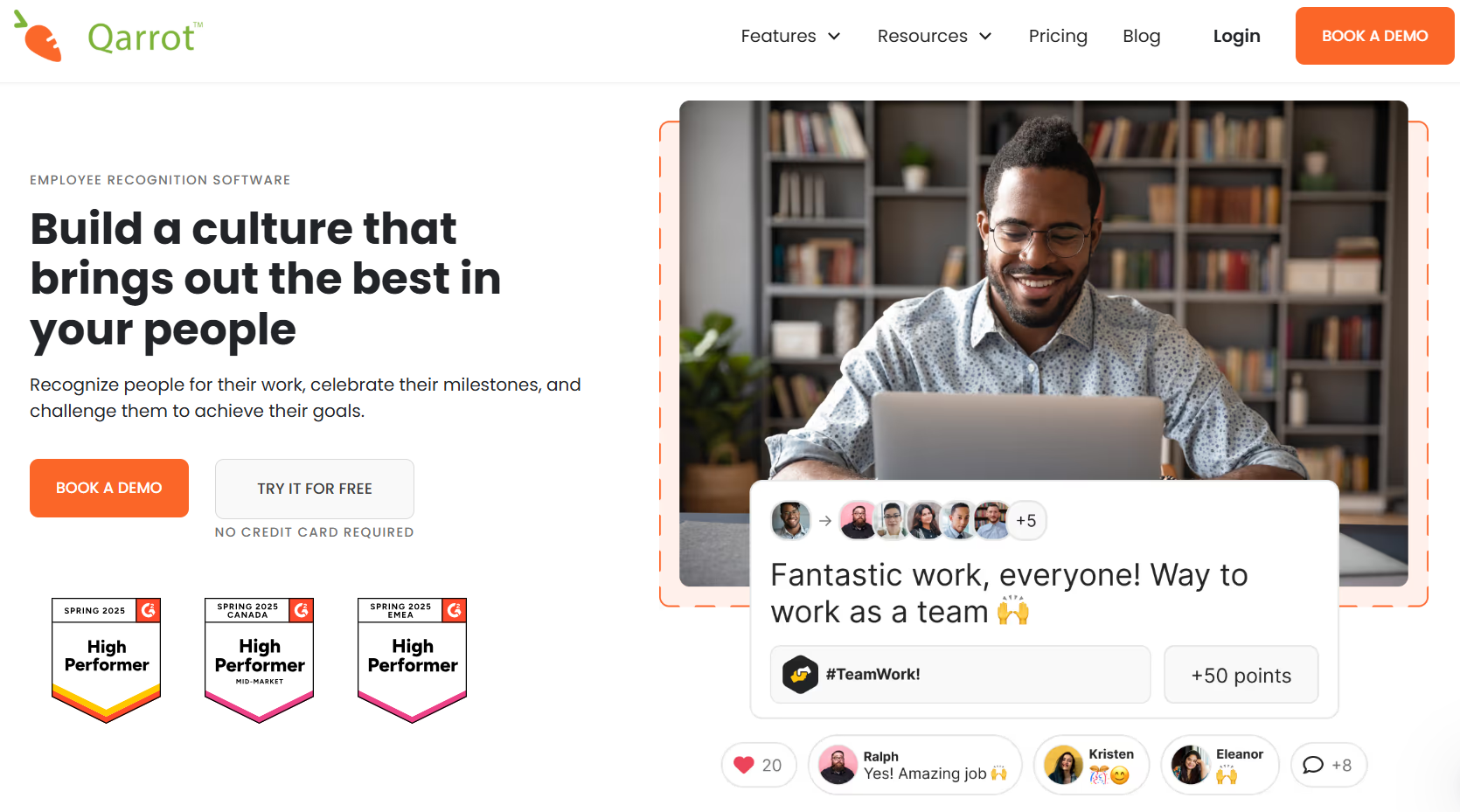
Qarrot is built from the ground up for companies under 1,000 employees. That positioning matters. Most recognition platforms are designed for enterprise and offered to smaller teams at a reduced price. Qarrot starts with the needs of a 50–500 person company and builds from there.
The result is a platform that does not overwhelm a small HR team with features they won't use, but still covers the recognition use cases that matter like goal-based awards, peer recognition, milestone celebrations, and a public social feed that keeps contributions visible.
The goal-based awards feature is a practical differentiator. You can tie recognition directly to specific outcomes, be it a completed project, a closed deal or a resolved customer issue, which gives the programme credibility beyond social appreciation. Employees understand exactly what is being recognised and why.
Setup is fast. Most teams are running within a day or two. And the pricing is transparent, you know what you're paying before you talk to anyone in sales.
Key strengths:
Built specifically for sub-1,000 employee companies, not an enterprise tool scaled down
Goal-based awards tie recognition to specific, measurable outcomes
Public social feed keeps contributions visible across the team
Fast setup - most teams are running within days
Transparent pricing with no minimum contract requirements
Limitations:
Fewer advanced analytics than larger platforms
Global reward features are more limited for international teams
Less brand recognition than established platforms, fewer third-party review sources available.
Pricing: Starts at $3/user/month
7. Kudoboard
Kudoboard does one thing better than almost any other platform: it makes milestone moments feel genuinely personal, even for remote and hybrid teams.
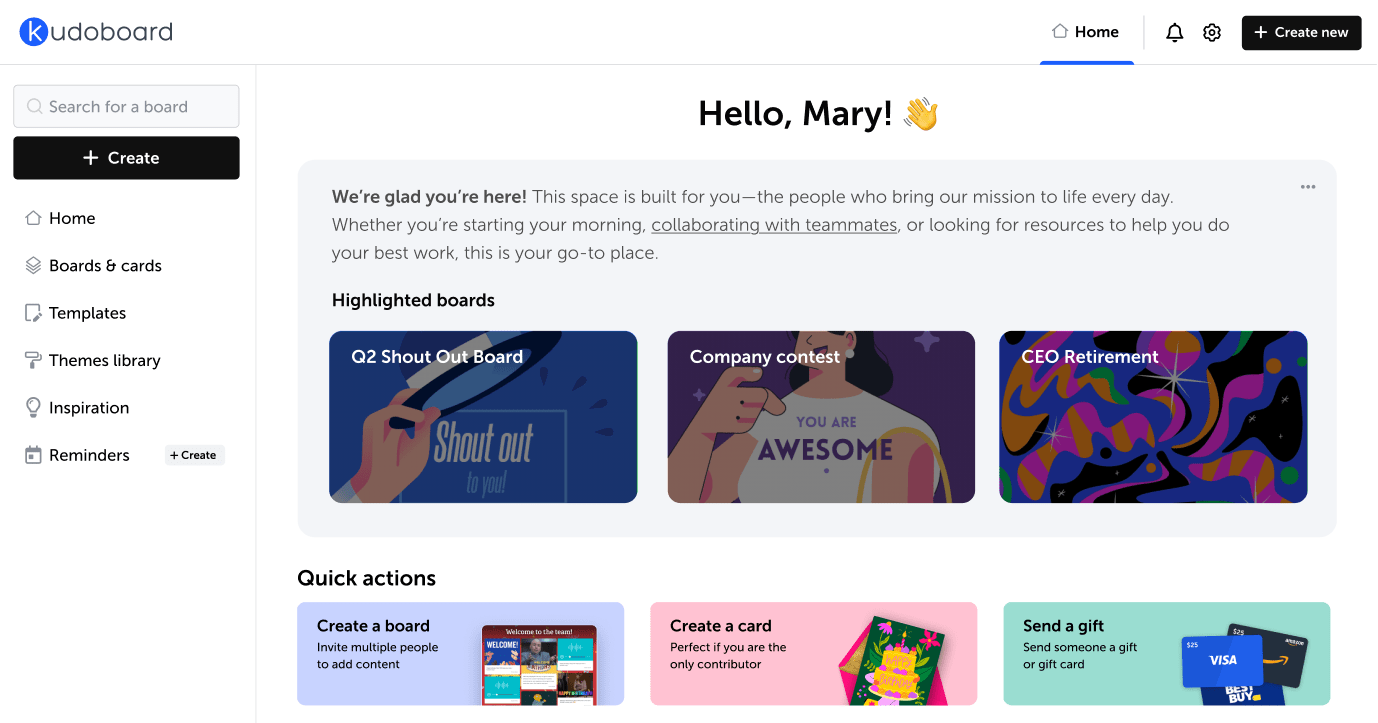
Most recognition platforms automate milestone celebrations as a system notification or a generic message. Kudoboard turns them into collaborative boards where teams contribute messages, photos, videos, and GIFs together, and the result is a shared celebration that the recipient can return to long after the moment has passed.
For a 50–200 person company where milestone recognition has been inconsistent or generic, Kudoboard solves a specific problem well. It doesn't try to replace a full recognition platform. It fills the gap that most platforms leave, making important moments feel like real events rather than automated checkboxes.
Boards can be scheduled in advance and branded to match the company identity. Analytics track participation and board views, giving HR a simple way to see whether milestone moments are landing.
Key strengths:
Collaborative boards make milestone moments genuinely memorable
Works naturally for remote and hybrid teams
Scheduled in advance - no last-minute scramble before a work anniversary
Custom branding keeps the experience on-brand
Simple, low-cost entry point for companies that don't yet need a full platform
Limitations:
Not a full recognition system. Best used for milestone and celebration moments rather than everyday peer recognition
Less suited for organisations that want a continuous recognition feed
Limited reward catalogue compared to full-platform alternatives
Pricing is higher as compared to other platforms.
Pricing: Starts at $25/month billed annually for teams up to 50, scaling in 50-employee tiers
Why Assembly (by Quantum Workplace) Is the Right Fit for Companies at This Stage
Every platform on this list does something well. The right choice depends on where your biggest recognition gap is right now.
But for a company of 50–200 people that wants one platform to cover everyday peer recognition, milestone automation, rewards, and engagement visibility without a complex implementation, Assembly (by Quantum Workplace) is the clearest starting point.
Here is why it works specifically at this stage.
i) It meets employees where they already are
Assembly (by Quantum Workplace) runs inside Slack and Microsoft Teams where recognition happens in the same place where work is already happening. Employees don't need to learn a new tool.
Their 90%+ participation rates reflect something the benefits of employee recognition software research consistently shows - adoption is what makes recognition programmes work, not feature depth.
ii) It scales with you
A platform that works for 50 people should still work at 200. The automated celebration system, values integration, and rewards catalogue from Assembly (by Quantum Workplace) are all designed to scale without adding admin complexity. As your team grows, the programme grows with it.
iii) It gives HR visibility without adding work
Dora AI surfaces recognition gaps automatically. You don't need to run a separate report to find out which employees haven't been recognised recently. That information comes to you, which makes it easier to act before disengagement sets in.
iv) It connects recognition to something tangible
The rewards catalogue - gift cards, Amazon purchases, experiences, charitable donations, and custom company perks gives employees a reason to care about the points they earn. Recognition that comes with a choice of real reward means more than recognition alone.
The custom employee recognition awards feature from Assembly (by Quantum Workplace) lets teams create award categories tied to specific values and behaviours.
v) The economics make sense
At $2/employee/month with free onboarding and unlimited training, Assembly (by Quantum Workplace) is one of the most accessible platforms on this list. There's no minimum contract to hit, no implementation fee to budget for, and no need to build a business case around a significant capital expense.
The companies that get recognition right at the 50–200 stage don't wait until they're bigger to invest in it. They build the habit early, and the culture that grows from it becomes one of their strongest retention and engagement tools as they scale.
Book a demo to see how Assembly (by Quantum Workplace) fits into the way your team already works.
Final Thoughts
The 50–200 employee stage is one of the most important inflection points in a company's culture. Informal recognition stops being enough. But the complexity and cost of enterprise platforms isn't justified yet either.
The right tool is one your team will actually use, one that makes recognition feel natural rather than forced, and one that gives HR the visibility to see whether it's working without adding hours of manual work.
What matters most is starting. Start with the gap that matters most to your company right now- inconsistent peer recognition, milestones celebrations missed frequently, recognition not tied to culture or values data. This will point you to where to begin.
The companies that get this right at the 50–200 stage don't wait until they're bigger to invest in it. They build the habit early. And the culture that grows from it becomes one of their strongest retention and engagement tools as they scale.
Frequently Asked Questions
What is the best employee recognition software for small and mid-sized companies?
Assembly (by Quantum Workplace), Nectar, and Bonusly consistently rank as the strongest options for companies in the 50–200 employee range. Assembly by Quantum Workplace works best for teams that want recognition to happen inside Slack or Teams with minimal setup. Nectar is the strongest choice for teams formalising a values-based programme for the first time. Bonusly is the fastest way to build a daily peer recognition habit.
How much does employee recognition software cost for a 50–200 person company?
Most platforms in this range cost between $2 and $5 per employee per month. Assembly (by Quantum Workplace) starts at $2/employee/month. Nectar starts at $2.50. Bonusly and Qarrot start at $3. Kudoboard starts at $25/month for up to 50 employees and scales in 50-employee tiers. Avoid platforms with custom enterprise pricing at this stage as it typically signals the tool is designed for a larger company.
What features matter most for recognition software at this company size?
Peer-to-peer recognition, values integration, milestone automation, and integrations with Slack or Teams are the most important features for 50–200 person companies. Advanced features like compensation modelling, complex calibration, and multi-country compliance infrastructure are less relevant at this stage and add unnecessary cost and complexity.
Is enterprise recognition software like Achievers or Workhuman suitable for a 50–200 person company?
No. Achievers explicitly positions itself for companies with 500+ employees, and Workhuman is designed for large, global enterprises. Both platforms are priced and structured for a scale that does not match the needs or budgets of a 50–200 person company. The platforms on this list are better suited to this stage.
How long does it take to implement employee recognition software at this size?
Most platforms on this list can be implemented within a few days. Assembly (by Quantum Workplace), Bonusly, and Nectar are typically running within 48 hours of setup. Qarrot and Motivosity take slightly longer but are still measured in days rather than weeks. Enterprise platforms that require months of implementation work are not the right fit for this company size.
When should a company start investing in recognition software?
The right time is when informal recognition stops being consistent, which for most companies happens somewhere between 50 and 75 employees. Waiting until recognition has become a visible problem means culture has already started to fragment. Building the programme before the gaps appear is always easier than repairing engagement after it drops.
class SampleComponent extends React.Component {
  // using the experimental public class field syntax below. We can also attach
  // the contextType to the current class
  static contextType = ColorContext;
  render() {
    return <Button color={this.color} />
  }
}
Most employee recognition software is built for companies with thousands of employees. The pricing assumes enterprise budgets. The feature sets assume dedicated HR operations teams. The implementation timelines assume months of setup work.
That creates a real problem for companies in the 50–200 employee range. You are past the startup phase where a Slack channel and a thank-you note were enough. But you are not yet at the scale where a six-figure recognition platform makes sense. You need something that works today, grows with you, and doesn't require a full implementation project to get started.
This guide covers what to look for at this specific company size, and the seven platforms that actually fit and not enterprise tools scaled down, but recognition software built for where you are right now.
Why 50–200 Employees Is a Unique Buying Situation for Recognition Software
At 50 employees, recognition usually still happens informally. A manager notices good work. A shout-out happens in a team meeting. The CEO knows everyone's name. It works, but it doesn't scale.
By the time you reach 100 employees, the gaps start to show. Contributions go unnoticed. Remote employees feel invisible. New hires don't understand what the company values in practice. Managers get busy and recognition becomes inconsistent. People start to disengage quietly.
By 200 employees, those gaps become expensive. Turnover rises. Culture fragments across teams. What used to happen naturally now needs a system behind it.
That transition from informal recognition to a real, repeatable programme, is what this buying decision is actually about. You are not just picking software. You are deciding when and how to make recognition part of how your company operates every day.
The challenge is that most platforms are built for one of two extremes. Tools designed for startups are too lightweight to sustain a real programme. Enterprise platforms designed for 1,000+ employees come with complexity, pricing, and implementation requirements that don't make sense at this stage.
The platforms in this guide sit in the middle and most of them are designed specifically to serve it.
What to Look for in Employee Recognition Software at This Size
Before comparing platforms, it helps to know which features actually matter at 50–200 employees and which ones you can safely ignore.
1) Ease of adoption
A platform your team doesn't use is not a recognition programme. It's a budget line item. At this size, you need something employees and managers pick up without a training day. Look for participation rates in reviews, not just feature lists.
Manager-only recognition misses most of what happens in a 50–200 person company. Colleagues see contributions that managers don't. A platform that lets employees recognise each other creates a culture where appreciation flows in all directions, not just top-down.
3) Values integration
Recognition that's tied to company values does two things at once for you. It reinforces the behaviours you want to see more of, and it shows new employees what the culture actually looks like in practice.
4) Milestone automation
Birthdays and work anniversaries should not depend on someone remembering. At 100+ employees, manual milestone tracking breaks down. Automation ensures every employee is recognised at the right time without adding admin work to someone's plate.
5) Integrations that fit your stack
Most companies in this size range run on Slack or Microsoft Teams. Your recognition platform should live inside those tools, not require employees to open a separate app. HRIS integration (BambooHR, ADP, Rippling) is also important for milestone data and onboarding sync.
It should become part of daily employee engagement rather than a separate task.
6) Transparent pricing
Avoid platforms with custom enterprise pricing at this stage. The platforms that work best for 50–200 employee companies publish their pricing clearly.
What can you keep for later scaling stages? Advanced compensation modelling, complex calibration workflows, multi-country compliance infrastructure, and 360-degree performance review systems. Those matter at scale. Right now, you need recognition that is simple, visible, and consistent.
Best Employee Recognition Software for 50–200 Employees in 2026
Platform Comparison
Platform
Best Situation
Not the Right Fit If
Assembly by Quantum Workplace
You want one platform covering peer recognition, milestones, rewards, and engagement visibility — all inside Slack or Teams
You need full performance review cycles without pairing with Quantum Workplace
Nectar
You are formalising recognition for the first time and want values tied to every shout-out
Your team is global and needs strong international reward options
Bonusly
Recognition happens occasionally and you need to make it a daily habit quickly
You need deep analytics or advanced admin controls
Motivosity
You need to prove recognition ROI to leadership with real engagement data
Your team is outside the US and needs international reward flexibility
Kudos
Culture is a strategic priority and you want data on which values are actually showing up
You need transparent upfront pricing without a sales conversation
Qarrot
Your team is sceptical of recognition and needs it tied to real outcomes
You need global features or enterprise-level analytics
Kudoboard
Milestone moments are the specific gap, especially for remote or hybrid teams
You want an everyday recognition feed, not just milestone celebrations
1. Assembly (by Quantum Workplace)
Quantum Workplace is the employee success platform behind Assembly. Where Quantum Workplace powers performance management, engagement surveys, and people analytics at scale, Assembly focuses on recognition, rewards, and milestone celebrations, making appreciation a daily part of how teams operate. Together, they give HR leaders a connected view of recognition and engagement in one ecosystem.
Assembly (by Quantum Workplace) is built for companies that want recognition to happen naturally inside the tools their team already uses. For companies with 50-200 people, there is no time for new habit adoption or learning a separate tool.
Their peer-to-peer recognition runs inside Slack, Microsoft Teams, or your HRIS, so appreciation happens in the flow of work rather than as a separate task. The Boost feature makes social recognition feel conversational by letting employees award points directly in post replies.
The automated milestones celebration system is one of the most practical features available for companies in the 50–200 range. The Welcome Bot and Anniversary Bot trigger personalized recognition moments for birthdays, work anniversaries, and milestones automatically based on profile data, so no milestone gets missed as the team grows.
Admins can embed company values into every recognition post, keeping culture visible and reinforced without any extra effort from the person giving the shout-out. The rewards catalogue gives employees flexibility to choose something meaningful from gift cards and experiences to charitable donations and Amazon purchases.
Assembly (by Quantum Workplace) also includes Dora AI, which surfaces recognition patterns and flags employees who haven't been recently recognised, giving HR leaders early visibility into engagement gaps before they become retention problems.
For a team of 50–200 people where HR is often one or two people, the combination of automation, simplicity, and analytics makes Assembly (by Quantum Workplace), the most practical starting point.
Key strengths:
90%+ participation rates by employees
Ease of adoption as it runs inside Slack and Teams
Automated milestone celebrations reduce admin work to zero
Dora AI identifies recognition gaps before they become engagement problems
Rewards catalogue includes gift cards, experiences, Amazon, donations, and custom rewards
Free onboarding and unlimited training included
Limitations:
Reward catalogue navigation can feel unintuitive for some first-time users
Some users report occasional slow load times
Pricing: Plans start at $2/employee/month
2. Nectar
Nectar is purpose-built for mid-sized teams that are formalising their recognition programme for the first time. It's one of the cleanest starting points for a company in the 50–200 range that wants structure without complexity.
Every shout-out in Nectar is tied directly to a company core value. That single design decision does more for culture than most platforms achieve with a full feature set. Recognition stops being a feel-good moment and starts being a visible, repeatable signal of what the organisation actually values.
The nomination programme lets employees surface peer contributions that managers would otherwise miss. For a growing team where managers are increasingly stretched, this matters. The people closest to the work often see the most important contributions, Nectar gives them a formal way to surface those.
Nectar holds an official partnership with SHRM, the largest HR professional organisation in the world. SHRM used Nectar internally before formalising the partnership which tells you something about the platform's credibility beyond marketing claims.
The reporting dashboard shows participation rates, recognition trends, and which values are being recognised most frequently, giving a small HR team the data they need to make the programme better without spending hours pulling it together manually.
Key strengths:
Every recognition moment is tied to a company value which reinforces culture automatically
Peer nomination programme surfaces contributions managers typically miss
Clean, simple interface with low learning curve
SHRM partnership adds independent credibility
Milestone automation for birthdays and work anniversaries built in
Limitations:
International reward availability is more limited than enterprise platforms
Works best for single-region or US-based teams
Less depth in analytics compared to platforms like Motivosity
Pricing: Starts at $2.50/employee/month
3. Bonusly
Bonusly is the simplest way to build a daily recognition habit. It focuses on micro-bonuses, small points that employees give each other for everyday contributions and it runs entirely inside Slack and Microsoft Teams.
The model works particularly well for companies in the 50–200 range because it does not try to be a full HR platform. It does one thing make peer recognition frequent, visible, and easy and it does it well.
Employees receive a monthly allowance of points to give to colleagues. Each recognition moment shows up in a public feed where the whole team can see it, react to it, and add their own points. Over time, that feed becomes a real-time record of the contributions that matter to the team which is useful data during performance conversations and promotion discussions.
The reward catalogue covers gift cards, charitable donations, and custom rewards, with enough variety to give employees a genuine choice without overwhelming them with options.
For a company that wants to move from informal appreciation to a visible, consistent culture of recognition without a major implementation project, Bonusly is one of the fastest paths to results.
Key strengths:
Micro-bonus model builds a daily recognition habit quickly
Public recognition feed creates visibility across the whole team
Fast to implement - teams are typically running within days, not weeks
Broad reward catalogue with gift cards, donations, and custom options
1:1 tools and pulse checks included for managers
Limitations:
Less suited for global teams that need region-specific reward options
Admin controls are lighter than more enterprise-focused platforms
Monthly point allowances reset, which some users find frustrating
Pricing: Starts at $3/user/month
4. Motivosity
Motivosity is the right choice for a 50–200 person company that wants to measure whether recognition is actually working or not.
Most recognition platforms tell you participation numbers. Motivosity goes further with its MV6 survey which is a proprietary six-question pulse that benchmarks eNPS, trust, and morale on a recurring basis. You can see how sentiment shifts as the recognition programme rolls out and track whether those shifts connect to real engagement outcomes.
For a small HR team that needs to demonstrate the ROI of a recognition programme to leadership, that data is valuable. You are not just reporting activity. You are showing a direct line between recognition investment and employee behaviour.
The peer-to-peer appreciation feed, spot bonuses, and milestone celebrations cover the core recognition use cases well. The lifestyle spending accounts add a flexible benefit layer that most mid-sized companies don't have access to outside of a full compensation platform.
Motivosity also includes manager tools like 1:1 agendas, team recognition summaries, and engagement trend reports that help managers stay connected to how their team is actually feeling, not just how their work is tracking.
Key strengths:
MV6 pulse survey connects recognition activity to real engagement data
Lifestyle spending accounts give employees flexible benefit options
Manager tools include 1:1 agendas and team engagement summaries
Custom survey builder lets HR target specific programmes and initiatives
Strong reporting that shows sentiment trends over time
Limitations:
The ThanksMatters Visa card reward option is US-focused
International teams may find the reward catalogue less useful than US-based teams
More setup required than lighter-weight platforms like Bonusly
Pricing: Starts at $2/user/month
5. Kudos
Kudos sits at the intersection of recognition and culture analytics. It is designed for organisations that want to understand which company values are actually being lived and not just celebrated in an annual survey.
Every recognition message in Kudos is tagged to a value, a behaviour, or a cultural goal. Over time, the platform builds a data layer that shows HR leaders which values are showing up in day-to-day work, which teams are driving culture, and where gaps are forming before they become visible problems.
For a company of 50–200 people in a phase of intentional culture-building after a period of rapid hiring, for example, Kudos gives HR the visibility to see whether culture is taking hold, not just whether people are sending shout-outs.
The social recognition feed keeps appreciation visible across the whole team. Peer nominations, milestone celebrations, and manager recognition all flow through the same feed, which means everyone can see what the company values in practice every day.
Key strengths:
Culture analytics show which values are being lived across teams
Values-based recognition makes every shout-out a culture signal
Strong peer nomination programme
Clean interface with high employee adoption rates
Integrates with Slack, Teams, and major HRIS platforms
Limitations:
Custom pricing makes it harder to evaluate budget fit without a sales call
Global reward support is more limited than enterprise platforms
Analytics depth can feel like more than a small HR team needs at 50 employees
Pricing: Custom pricing based on team size
6. Qarrot
Qarrot is built from the ground up for companies under 1,000 employees. That positioning matters. Most recognition platforms are designed for enterprise and offered to smaller teams at a reduced price. Qarrot starts with the needs of a 50–500 person company and builds from there.
The result is a platform that does not overwhelm a small HR team with features they won't use, but still covers the recognition use cases that matter like goal-based awards, peer recognition, milestone celebrations, and a public social feed that keeps contributions visible.
The goal-based awards feature is a practical differentiator. You can tie recognition directly to specific outcomes, be it a completed project, a closed deal or a resolved customer issue, which gives the programme credibility beyond social appreciation. Employees understand exactly what is being recognised and why.
Setup is fast. Most teams are running within a day or two. And the pricing is transparent, you know what you're paying before you talk to anyone in sales.
Key strengths:
Built specifically for sub-1,000 employee companies, not an enterprise tool scaled down
Goal-based awards tie recognition to specific, measurable outcomes
Public social feed keeps contributions visible across the team
Fast setup - most teams are running within days
Transparent pricing with no minimum contract requirements
Limitations:
Fewer advanced analytics than larger platforms
Global reward features are more limited for international teams
Less brand recognition than established platforms, fewer third-party review sources available.
Pricing: Starts at $3/user/month
7. Kudoboard
Kudoboard does one thing better than almost any other platform: it makes milestone moments feel genuinely personal, even for remote and hybrid teams.
Most recognition platforms automate milestone celebrations as a system notification or a generic message. Kudoboard turns them into collaborative boards where teams contribute messages, photos, videos, and GIFs together, and the result is a shared celebration that the recipient can return to long after the moment has passed.
For a 50–200 person company where milestone recognition has been inconsistent or generic, Kudoboard solves a specific problem well. It doesn't try to replace a full recognition platform. It fills the gap that most platforms leave, making important moments feel like real events rather than automated checkboxes.
Boards can be scheduled in advance and branded to match the company identity. Analytics track participation and board views, giving HR a simple way to see whether milestone moments are landing.
Key strengths:
Collaborative boards make milestone moments genuinely memorable
Works naturally for remote and hybrid teams
Scheduled in advance - no last-minute scramble before a work anniversary
Custom branding keeps the experience on-brand
Simple, low-cost entry point for companies that don't yet need a full platform
Limitations:
Not a full recognition system. Best used for milestone and celebration moments rather than everyday peer recognition
Less suited for organisations that want a continuous recognition feed
Limited reward catalogue compared to full-platform alternatives
Pricing is higher as compared to other platforms.
Pricing: Starts at $25/month billed annually for teams up to 50, scaling in 50-employee tiers
Why Assembly (by Quantum Workplace) Is the Right Fit for Companies at This Stage
Every platform on this list does something well. The right choice depends on where your biggest recognition gap is right now.
But for a company of 50–200 people that wants one platform to cover everyday peer recognition, milestone automation, rewards, and engagement visibility without a complex implementation, Assembly (by Quantum Workplace) is the clearest starting point.
Here is why it works specifically at this stage.
i) It meets employees where they already are
Assembly (by Quantum Workplace) runs inside Slack and Microsoft Teams where recognition happens in the same place where work is already happening. Employees don't need to learn a new tool.
Their 90%+ participation rates reflect something the benefits of employee recognition software research consistently shows - adoption is what makes recognition programmes work, not feature depth.
ii) It scales with you
A platform that works for 50 people should still work at 200. The automated celebration system, values integration, and rewards catalogue from Assembly (by Quantum Workplace) are all designed to scale without adding admin complexity. As your team grows, the programme grows with it.
iii) It gives HR visibility without adding work
Dora AI surfaces recognition gaps automatically. You don't need to run a separate report to find out which employees haven't been recognised recently. That information comes to you, which makes it easier to act before disengagement sets in.
iv) It connects recognition to something tangible
The rewards catalogue - gift cards, Amazon purchases, experiences, charitable donations, and custom company perks gives employees a reason to care about the points they earn. Recognition that comes with a choice of real reward means more than recognition alone.
The custom employee recognition awards feature from Assembly (by Quantum Workplace) lets teams create award categories tied to specific values and behaviours.
v) The economics make sense
At $2/employee/month with free onboarding and unlimited training, Assembly (by Quantum Workplace) is one of the most accessible platforms on this list. There's no minimum contract to hit, no implementation fee to budget for, and no need to build a business case around a significant capital expense.
The companies that get recognition right at the 50–200 stage don't wait until they're bigger to invest in it. They build the habit early, and the culture that grows from it becomes one of their strongest retention and engagement tools as they scale.
Book a demo to see how Assembly (by Quantum Workplace) fits into the way your team already works.
Final Thoughts
The 50–200 employee stage is one of the most important inflection points in a company's culture. Informal recognition stops being enough. But the complexity and cost of enterprise platforms isn't justified yet either.
The right tool is one your team will actually use, one that makes recognition feel natural rather than forced, and one that gives HR the visibility to see whether it's working without adding hours of manual work.
What matters most is starting. Start with the gap that matters most to your company right now- inconsistent peer recognition, milestones celebrations missed frequently, recognition not tied to culture or values data. This will point you to where to begin.
The companies that get this right at the 50–200 stage don't wait until they're bigger to invest in it. They build the habit early. And the culture that grows from it becomes one of their strongest retention and engagement tools as they scale.
Frequently Asked Questions
What is the best employee recognition software for small and mid-sized companies?
Assembly (by Quantum Workplace), Nectar, and Bonusly consistently rank as the strongest options for companies in the 50–200 employee range. Assembly by Quantum Workplace works best for teams that want recognition to happen inside Slack or Teams with minimal setup. Nectar is the strongest choice for teams formalising a values-based programme for the first time. Bonusly is the fastest way to build a daily peer recognition habit.
How much does employee recognition software cost for a 50–200 person company?
Most platforms in this range cost between $2 and $5 per employee per month. Assembly (by Quantum Workplace) starts at $2/employee/month. Nectar starts at $2.50. Bonusly and Qarrot start at $3. Kudoboard starts at $25/month for up to 50 employees and scales in 50-employee tiers. Avoid platforms with custom enterprise pricing at this stage as it typically signals the tool is designed for a larger company.
What features matter most for recognition software at this company size?
Peer-to-peer recognition, values integration, milestone automation, and integrations with Slack or Teams are the most important features for 50–200 person companies. Advanced features like compensation modelling, complex calibration, and multi-country compliance infrastructure are less relevant at this stage and add unnecessary cost and complexity.
Is enterprise recognition software like Achievers or Workhuman suitable for a 50–200 person company?
No. Achievers explicitly positions itself for companies with 500+ employees, and Workhuman is designed for large, global enterprises. Both platforms are priced and structured for a scale that does not match the needs or budgets of a 50–200 person company. The platforms on this list are better suited to this stage.
How long does it take to implement employee recognition software at this size?
Most platforms on this list can be implemented within a few days. Assembly (by Quantum Workplace), Bonusly, and Nectar are typically running within 48 hours of setup. Qarrot and Motivosity take slightly longer but are still measured in days rather than weeks. Enterprise platforms that require months of implementation work are not the right fit for this company size.
When should a company start investing in recognition software?
The right time is when informal recognition stops being consistent, which for most companies happens somewhere between 50 and 75 employees. Waiting until recognition has become a visible problem means culture has already started to fragment. Building the programme before the gaps appear is always easier than repairing engagement after it drops.
Browse our Free Employee Recognition Guide
Get the foundational knowledge on creating an employee recognition program that boosts employee engagement and helps them feel valued.





.png)