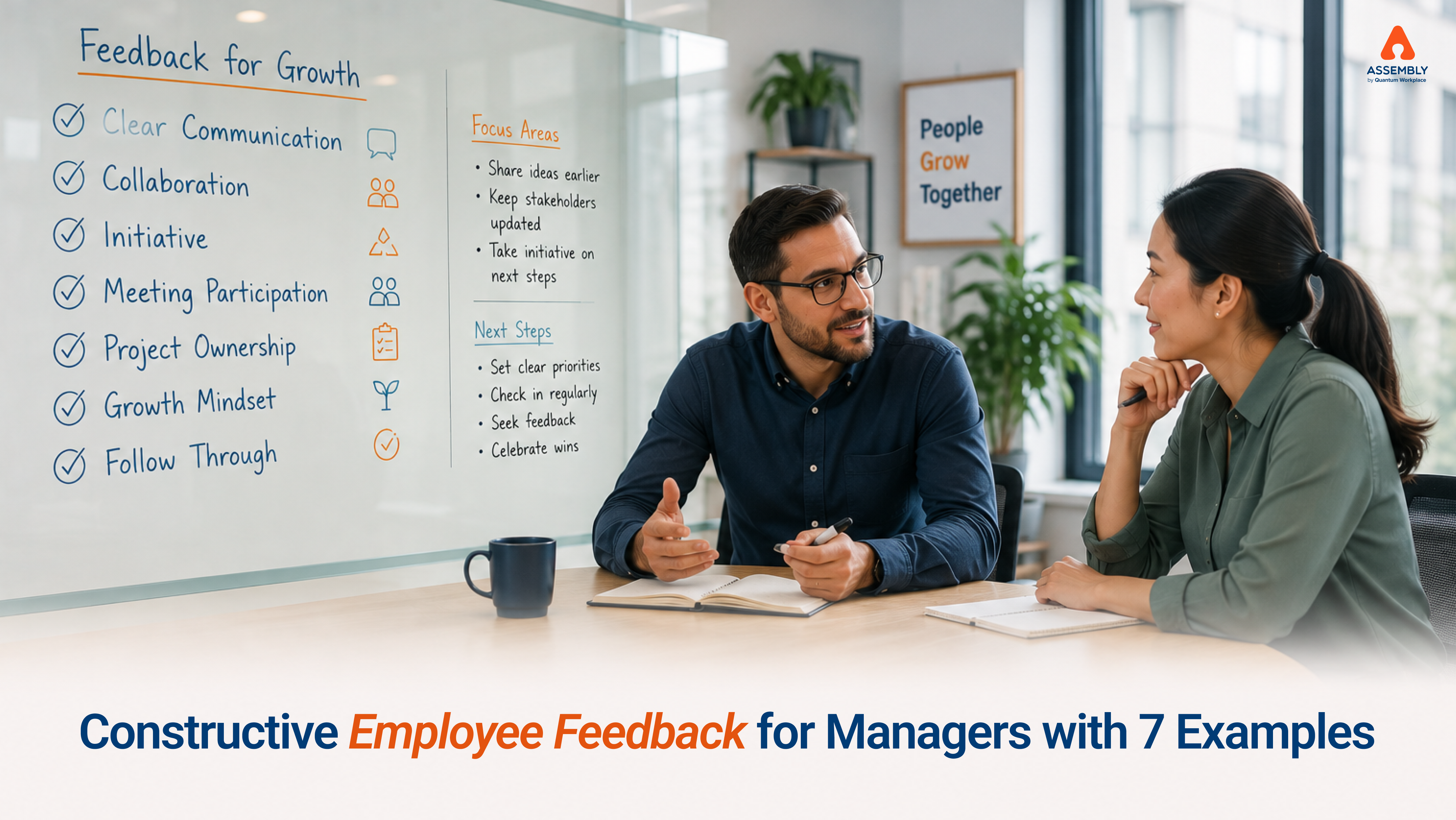
A manager's ability to give constructive feedback shapes everything downstream from employee performance, trust, retention to how safe people feel raising problems before they become bigger ones.
Most managers know feedback matters. Far fewer feel confident delivering it well. Vague praise does not help anyone improve. Criticism without specifics feels personal rather than actionable. The gap between knowing feedback matters and actually giving it effectively is where most managers get stuck.
This guide covers what constructive feedback is, why it matters, manager feedback examples organised by real workplace scenarios, how to give feedback effectively, and how employees can give constructive feedback to their managers in return.
What Is Constructive Feedback?
Constructive feedback is guidance focused on specific behaviours or outcomes, not personality. It gives the recipient a clear path to improvement. It differs from criticism in one key way. Criticism points out what went wrong. Constructive feedback explains what happened, why it mattered, and what to do differently.
Constructive feedback in the workplace can be positive or developmental. Positive feedback reinforces behaviour worth repeating whereas developmental feedback addresses a gap between current performance and what is expected. Both types follow the same structure. They are specific, behaviour based, and forward looking.
Importance of Constructive Feedback
According to Gallup, employees who received meaningful feedback in the past week are significantly more likely to be fully engaged at work than those who went without it. A 2025 study published in the Journal of Applied Psychology found that when managers framed feedback in a performance-oriented, helping-focused way, recipients were more likely to act on it and both parties reported more positive emotions during the exchange.
Benefits of Constructive Feedback for Managers
Constructive feedback is more than occasional correction. The benefits of employee feedback extend well beyond the individual conversation, they shape team-wide trust and performance over time.
Improved performance: Constructive feedback helps employees understand their strengths and close specific gaps, leading to measurably better output over time.
Stronger engagement: Employees who receive regular, specific feedback feel more valued and connected to their work than those left guessing where they stand. Giving constructive feedback is one of the top strategies to make employee engagement stronger.
Better decision-making: Two-way feedback gives managers visibility into what is actually working on the ground, an insight that informal check-ins alone rarely surface.
Stronger relationships: Open, constructive feedback builds the kind of trust that makes difficult conversations easier the next time, not harder. This is also why effective feedback starts with recognition, the two reinforce each other.
When avoided or delivered poorly, the opposite happens. Small issues compound, communication gaps widen, performance drifts, and employees disengage quietly long before they raise their hand.
Manager Feedback Examples for Improving Employee Performance
Generic feedback templates rarely help because real workplace situations are specific. The examples below pair common scenarios managers actually face with feedback language that addresses them directly.
Scenario 1: An employee dominates meetings and talks over others
"It's clear you're invested in getting this right, and that energy matters. I noticed in yesterday's planning call you spoke over Priya twice before she finished her point. Leaving a bit more space for others to weigh in would help us get the full picture, not just the loudest one."
Scenario 2: An employee has missed several recent deadlines
"Your work on the client report was strong once it landed, but it came in two days late, and that is the third deliverable in a row that has slipped. Let's look at how you are prioritising tasks and see whether something in your workload needs to shift."
Scenario 3: An employee is highly skilled but reluctant to take initiative
"You consistently produce excellent work once you are given direction. I would like to see you trust your own judgement more and act before waiting for instruction, you have earned that latitude."
Scenario 4: An employee's work has small but recurring errors
"The structure of your last few reports has been genuinely strong. What I am noticing is small errors creeping in like a few numbers, a couple of typos, that a second pass would likely catch. Building in a short review step before sending could make a real difference."
Scenario 5: An employee is excelling and deserves specific recognition
"Your turnaround on the client report this week was excellent. Moments like this do more for job satisfaction than any policy change could. You anticipated three questions before they were even asked, which saved the whole team time. That is exactly the kind of foresight that makes a real difference."
Scenario 6: An employee seems disengaged in team discussions
"I have noticed you have been quieter in our last few team meetings than usual. I want to check in - is there something getting in the way of contributing, or is now just not the right format for you to share ideas?"
Scenario 7: An employee struggles to collaborate across teams
"You have been the person other teams come to when they need something done quickly, and that reputation matters. I have also heard from two teammates that they feel a bit out of the loop on your project status, looping them in earlier would help everyone stay aligned."
Scenario 8: An employee needs to improve the clarity of their communication
"When you explained the project changes in yesterday's meeting, it was easy for everyone to follow, even people who joined the project late. That clarity is a real strength. I would like to see you bring that same clarity to written updates too."
Constructive Feedback Examples Employees Can Give Their Managers
Feedback should not only flow downward. Understanding the types of employee feedback helps managers invite it well.
Managers who actively invite upward feedback build stronger trust with their teams and often learn things they would otherwise miss entirely. Here are seven constructive feedback examples employees can use with their own managers.
1. Encouraging Open Communication
Example: "I appreciate how you always make time for our team meetings and encourage open dialogue. It would help if we had more one-on-one sessions to discuss individual progress and challenges." Why it works: This invites more personalised manager attention without sounding like a complaint.
2. Recognising Achievements and Efforts
Example: "Your recognition of the team's work during the last project was motivating. It would be even more impactful if we could celebrate smaller milestones along the way too." Why it works: Suggesting more frequent recognition helps managers build a more consistently positive environment.
3. Requesting Clearer Feedback
Example: "I value the feedback you gave on my recent presentation. It would help if you could include more specific examples of what worked well and what to improve next time." Why it works: This pushes for more actionable detail without sounding critical.
4. Supporting Professional Development
Example: "I appreciate your support in my career development so far. It would help if we could discuss training opportunities or projects that align more closely with my goals." Why it works: This invites the manager into a concrete development conversation.
5. Fostering a Positive Work Environment
Example: "I enjoy the atmosphere on our team. It would be great if we could build in more team-building moments to strengthen how we collaborate." Why it works: This frames a suggestion as a way to build on something already going well.
6. Encouraging Innovation
Example: "I appreciate how open you are to new ideas. It would be exciting to have dedicated brainstorming sessions to explore solutions for some of our bigger challenges." Why it works: This invites managers to create more structured space for creativity.
7. Raising Workload Concerns
Example: "I understand the pressure on our current projects. It would help if we could talk through how to balance the workload so the team avoids burnout." Why it works: This surfaces a real concern constructively, giving the manager room to act on it.
How to Give Constructive Feedback as a Manager
The way feedback is delivered matters as much as what is said. These principles apply whether the conversation is about a missed deadline or genuine praise.
Be specific and behaviour-based: Focus on what someone did, not who they are. "You missed two deadlines this month" is actionable. "You are disorganised" is not.
Use the SBI model: Describe the Situation, the Behaviour you observed, and the Impact it had. This structure keeps feedback grounded in fact rather than judgement.
Choose the right time and place: A private, unhurried conversation almost always outperforms feedback delivered in passing or in front of others.
Lead with what is working before what is not: This is not about softening hard truths. It gives the full picture so the feedback feels accurate rather than one-sided.
Focus on one thing at a time: Stacking multiple criticisms into a single conversation overwhelms the recipient. Pick the highest-impact item and start there.
Focus on solutions: Pointing out a problem without a path forward leaves the employee stuck. The most useful feedback always includes a next step.
Create a safe environment: Feedback only flows honestly when people trust that sharing it will not be held against them.
Listen actively after delivering it:Giving feedback as a manager is only half the conversation. How you respond when the employee reacts matters just as much for building trust.
Follow up: Feedback that is never revisited rarely leads to real change. Closing the feedback loop with a brief check-in a few weeks later shows the conversation mattered.
Most feedback breaks down not because managers do not care, but because there is no consistent system for capturing and acting on it. Building a true feedback culture takes consistency more than any single tool but the right tools make that consistency far easier to sustain.
Assembly's manager development tools give managers a dashboard for tracking 1:1s, giving feedback, and viewing team engagement insights, so feedback happens consistently rather than only during formal reviews. People analytics help HR teams turn feedback data into action, surfacing patterns and engagement gaps that individual conversations might miss. And peer-to-peer recognition reinforces the positive side of feedback making it easy for managers and teammates to acknowledge what is working in real time, not just flag what needs to improve.
On the Quantum Workplace side, one-on-one meeting software gives managers curated templates, automated cycles, and shared agendas to make every check-in more effective. Its performance management software supports 360-degree feedback, peer feedback, and upward feedback with an AI-powered writing assistant that helps managers share more constructive, impactful feedback quickly and confidently.
Book a demo to see how Assembly and Quantum Workplace help managers build feedback into the everyday rhythm of work.
Final words
Constructive feedback is not a single conversation. It is a habit built over consistent, specific, well-timed moments. Start with one scenario from this guide, deliver it with the SBI model, and follow up. The managers who do this consistently are the ones whose teams stay engaged, improve faster, and trust them more.
FAQs
What is constructive feedback?
Constructive feedback is feedback focused on specific behaviours or outcomes, not personality. It gives the recipient a clear path to improvement. It can be positive, reinforcing what is working well, or developmental, addressing a specific gap. The goal is always growth, not judgement.
How can managers give constructive feedback effectively?
Be specific and behaviour-based. Use a structure like the SBI model: Situation, Behaviour, Impact. Choose a private setting. Always pair the feedback with a concrete next step. Feedback that names a real moment and offers a clear path forward is far more likely to be acted on than vague or generic comments.
What are some constructive feedback examples for employees?
Good examples acknowledge a specific strength tied to a real moment, such as "Your turnaround time this week was excellent." They also pair developmental feedback with a clear next step, such as "Let's look at how you are prioritising tasks so deadlines feel less tight." The most useful examples are specific to the actual situation, not generic templates.
How can feedback improve employee performance?
Feedback closes the gap between what an employee is doing and what is expected. It gives them a clear sense of direction. According to Gallup, employees who receive regular, meaningful feedback are significantly more engaged than those who go without it. Engaged employees consistently outperform disengaged ones across nearly every measurable metric.
Can employees give constructive feedback to their managers?
Yes. Managers who actively invite it tend to build stronger, more trusting teams. Upward feedback works best when it is framed constructively, focuses on a specific situation, and offers a suggestion rather than just a complaint. Managers who respond well to this feedback signal that the team's input genuinely matters.
What is the difference between constructive and negative feedback?
Constructive feedback is specific, behaviour-focused, and paired with a path forward. Negative feedback often focuses on what went wrong without offering direction. This leaves the recipient feeling criticised rather than supported. The intent and structure, not just the tone, are what separate the two.
class SampleComponent extends React.Component {
  // using the experimental public class field syntax below. We can also attach
  // the contextType to the current class
  static contextType = ColorContext;
  render() {
    return <Button color={this.color} />
  }
}
A manager's ability to give constructive feedback shapes everything downstream from employee performance, trust, retention to how safe people feel raising problems before they become bigger ones.
Most managers know feedback matters. Far fewer feel confident delivering it well. Vague praise does not help anyone improve. Criticism without specifics feels personal rather than actionable. The gap between knowing feedback matters and actually giving it effectively is where most managers get stuck.
This guide covers what constructive feedback is, why it matters, manager feedback examples organised by real workplace scenarios, how to give feedback effectively, and how employees can give constructive feedback to their managers in return.
What Is Constructive Feedback?
Constructive feedback is guidance focused on specific behaviours or outcomes, not personality. It gives the recipient a clear path to improvement. It differs from criticism in one key way. Criticism points out what went wrong. Constructive feedback explains what happened, why it mattered, and what to do differently.
Constructive feedback in the workplace can be positive or developmental. Positive feedback reinforces behaviour worth repeating whereas developmental feedback addresses a gap between current performance and what is expected. Both types follow the same structure. They are specific, behaviour based, and forward looking.
Importance of Constructive Feedback
According to Gallup, employees who received meaningful feedback in the past week are significantly more likely to be fully engaged at work than those who went without it. A 2025 study published in the Journal of Applied Psychology found that when managers framed feedback in a performance-oriented, helping-focused way, recipients were more likely to act on it and both parties reported more positive emotions during the exchange.
Benefits of Constructive Feedback for Managers
Constructive feedback is more than occasional correction. The benefits of employee feedback extend well beyond the individual conversation, they shape team-wide trust and performance over time.
Improved performance: Constructive feedback helps employees understand their strengths and close specific gaps, leading to measurably better output over time.
Stronger engagement: Employees who receive regular, specific feedback feel more valued and connected to their work than those left guessing where they stand. Giving constructive feedback is one of the top strategies to make employee engagement stronger.
Better decision-making: Two-way feedback gives managers visibility into what is actually working on the ground, an insight that informal check-ins alone rarely surface.
Stronger relationships: Open, constructive feedback builds the kind of trust that makes difficult conversations easier the next time, not harder. This is also why effective feedback starts with recognition, the two reinforce each other.
When avoided or delivered poorly, the opposite happens. Small issues compound, communication gaps widen, performance drifts, and employees disengage quietly long before they raise their hand.
Manager Feedback Examples for Improving Employee Performance
Generic feedback templates rarely help because real workplace situations are specific. The examples below pair common scenarios managers actually face with feedback language that addresses them directly.
Scenario 1: An employee dominates meetings and talks over others
"It's clear you're invested in getting this right, and that energy matters. I noticed in yesterday's planning call you spoke over Priya twice before she finished her point. Leaving a bit more space for others to weigh in would help us get the full picture, not just the loudest one."
Scenario 2: An employee has missed several recent deadlines
"Your work on the client report was strong once it landed, but it came in two days late, and that is the third deliverable in a row that has slipped. Let's look at how you are prioritising tasks and see whether something in your workload needs to shift."
Scenario 3: An employee is highly skilled but reluctant to take initiative
"You consistently produce excellent work once you are given direction. I would like to see you trust your own judgement more and act before waiting for instruction, you have earned that latitude."
Scenario 4: An employee's work has small but recurring errors
"The structure of your last few reports has been genuinely strong. What I am noticing is small errors creeping in like a few numbers, a couple of typos, that a second pass would likely catch. Building in a short review step before sending could make a real difference."
Scenario 5: An employee is excelling and deserves specific recognition
"Your turnaround on the client report this week was excellent. Moments like this do more for job satisfaction than any policy change could. You anticipated three questions before they were even asked, which saved the whole team time. That is exactly the kind of foresight that makes a real difference."
Scenario 6: An employee seems disengaged in team discussions
"I have noticed you have been quieter in our last few team meetings than usual. I want to check in - is there something getting in the way of contributing, or is now just not the right format for you to share ideas?"
Scenario 7: An employee struggles to collaborate across teams
"You have been the person other teams come to when they need something done quickly, and that reputation matters. I have also heard from two teammates that they feel a bit out of the loop on your project status, looping them in earlier would help everyone stay aligned."
Scenario 8: An employee needs to improve the clarity of their communication
"When you explained the project changes in yesterday's meeting, it was easy for everyone to follow, even people who joined the project late. That clarity is a real strength. I would like to see you bring that same clarity to written updates too."
Constructive Feedback Examples Employees Can Give Their Managers
Feedback should not only flow downward. Understanding the types of employee feedback helps managers invite it well.
Managers who actively invite upward feedback build stronger trust with their teams and often learn things they would otherwise miss entirely. Here are seven constructive feedback examples employees can use with their own managers.
1. Encouraging Open Communication
Example: "I appreciate how you always make time for our team meetings and encourage open dialogue. It would help if we had more one-on-one sessions to discuss individual progress and challenges." Why it works: This invites more personalised manager attention without sounding like a complaint.
2. Recognising Achievements and Efforts
Example: "Your recognition of the team's work during the last project was motivating. It would be even more impactful if we could celebrate smaller milestones along the way too." Why it works: Suggesting more frequent recognition helps managers build a more consistently positive environment.
3. Requesting Clearer Feedback
Example: "I value the feedback you gave on my recent presentation. It would help if you could include more specific examples of what worked well and what to improve next time." Why it works: This pushes for more actionable detail without sounding critical.
4. Supporting Professional Development
Example: "I appreciate your support in my career development so far. It would help if we could discuss training opportunities or projects that align more closely with my goals." Why it works: This invites the manager into a concrete development conversation.
5. Fostering a Positive Work Environment
Example: "I enjoy the atmosphere on our team. It would be great if we could build in more team-building moments to strengthen how we collaborate." Why it works: This frames a suggestion as a way to build on something already going well.
6. Encouraging Innovation
Example: "I appreciate how open you are to new ideas. It would be exciting to have dedicated brainstorming sessions to explore solutions for some of our bigger challenges." Why it works: This invites managers to create more structured space for creativity.
7. Raising Workload Concerns
Example: "I understand the pressure on our current projects. It would help if we could talk through how to balance the workload so the team avoids burnout." Why it works: This surfaces a real concern constructively, giving the manager room to act on it.
How to Give Constructive Feedback as a Manager
The way feedback is delivered matters as much as what is said. These principles apply whether the conversation is about a missed deadline or genuine praise.
Be specific and behaviour-based: Focus on what someone did, not who they are. "You missed two deadlines this month" is actionable. "You are disorganised" is not.
Use the SBI model: Describe the Situation, the Behaviour you observed, and the Impact it had. This structure keeps feedback grounded in fact rather than judgement.
Choose the right time and place: A private, unhurried conversation almost always outperforms feedback delivered in passing or in front of others.
Lead with what is working before what is not: This is not about softening hard truths. It gives the full picture so the feedback feels accurate rather than one-sided.
Focus on one thing at a time: Stacking multiple criticisms into a single conversation overwhelms the recipient. Pick the highest-impact item and start there.
Focus on solutions: Pointing out a problem without a path forward leaves the employee stuck. The most useful feedback always includes a next step.
Create a safe environment: Feedback only flows honestly when people trust that sharing it will not be held against them.
Listen actively after delivering it:Giving feedback as a manager is only half the conversation. How you respond when the employee reacts matters just as much for building trust.
Follow up: Feedback that is never revisited rarely leads to real change. Closing the feedback loop with a brief check-in a few weeks later shows the conversation mattered.
Most feedback breaks down not because managers do not care, but because there is no consistent system for capturing and acting on it. Building a true feedback culture takes consistency more than any single tool but the right tools make that consistency far easier to sustain.
Assembly's manager development tools give managers a dashboard for tracking 1:1s, giving feedback, and viewing team engagement insights, so feedback happens consistently rather than only during formal reviews. People analytics help HR teams turn feedback data into action, surfacing patterns and engagement gaps that individual conversations might miss. And peer-to-peer recognition reinforces the positive side of feedback making it easy for managers and teammates to acknowledge what is working in real time, not just flag what needs to improve.
On the Quantum Workplace side, one-on-one meeting software gives managers curated templates, automated cycles, and shared agendas to make every check-in more effective. Its performance management software supports 360-degree feedback, peer feedback, and upward feedback with an AI-powered writing assistant that helps managers share more constructive, impactful feedback quickly and confidently.
Book a demo to see how Assembly and Quantum Workplace help managers build feedback into the everyday rhythm of work.
Final words
Constructive feedback is not a single conversation. It is a habit built over consistent, specific, well-timed moments. Start with one scenario from this guide, deliver it with the SBI model, and follow up. The managers who do this consistently are the ones whose teams stay engaged, improve faster, and trust them more.
FAQs
What is constructive feedback?
Constructive feedback is feedback focused on specific behaviours or outcomes, not personality. It gives the recipient a clear path to improvement. It can be positive, reinforcing what is working well, or developmental, addressing a specific gap. The goal is always growth, not judgement.
How can managers give constructive feedback effectively?
Be specific and behaviour-based. Use a structure like the SBI model: Situation, Behaviour, Impact. Choose a private setting. Always pair the feedback with a concrete next step. Feedback that names a real moment and offers a clear path forward is far more likely to be acted on than vague or generic comments.
What are some constructive feedback examples for employees?
Good examples acknowledge a specific strength tied to a real moment, such as "Your turnaround time this week was excellent." They also pair developmental feedback with a clear next step, such as "Let's look at how you are prioritising tasks so deadlines feel less tight." The most useful examples are specific to the actual situation, not generic templates.
How can feedback improve employee performance?
Feedback closes the gap between what an employee is doing and what is expected. It gives them a clear sense of direction. According to Gallup, employees who receive regular, meaningful feedback are significantly more engaged than those who go without it. Engaged employees consistently outperform disengaged ones across nearly every measurable metric.
Can employees give constructive feedback to their managers?
Yes. Managers who actively invite it tend to build stronger, more trusting teams. Upward feedback works best when it is framed constructively, focuses on a specific situation, and offers a suggestion rather than just a complaint. Managers who respond well to this feedback signal that the team's input genuinely matters.
What is the difference between constructive and negative feedback?
Constructive feedback is specific, behaviour-focused, and paired with a path forward. Negative feedback often focuses on what went wrong without offering direction. This leaves the recipient feeling criticised rather than supported. The intent and structure, not just the tone, are what separate the two.
Browse our Free Employee Recognition Guide
Get the foundational knowledge on creating an employee recognition program that boosts employee engagement and helps them feel valued.






.png)