Your best people want regular feedback, clear goals, and a sense that someone is paying attention to their growth. Performance review phrases are a good starting point but the right employee performance management software helps you deliver on all of that. And it does it without burying your HR team in manual work."
But with dozens of platforms on the market, choosing the right one can feel overwhelming. Some are built for enterprise complexity. Others are designed for speed and simplicity. A few try to do everything at once.
This guide compares the top performance management tools for 2026, highlighting their strengths, limitations, and pricing so you can choose the right fit for your team.
Key Features of Performance Management Software You Should Look For
Not all performance management platforms are built the same. Before you evaluate any tool, check whether it covers these six capabilities.
Goal setting and alignment: Can you set goals at the individual, team, and company level? Does the platform visually map how they connect so employees can see where their work fits into the bigger picture?
Continuous feedback and check-ins: Does the platform let managers and employees exchange feedback in real time through Slack, Teams, or email? Continuous feedback is now the baseline expectation for any modern performance management system.
Performance reviews: Can you customize review cycles to support self-assessments, peer reviews, manager evaluations, and 360-degree feedback? Does the platform handle scheduling, reminders, and tracking automatically?
1:1 meeting tools: Does the platform give managers and direct reports a shared space with agendas, action item tracking, and searchable meeting history? Or are you still relying on separate docs and calendar notes?
Recognition and rewards: Is peer-to-peer recognition built into the platform with a public feed tied to company values? Can employees earn and redeem rewards directly, or is recognition treated as a separate system?
Analytics and integrations: Can you see review completion rates, engagement trends, and recognition patterns in one dashboard? Does the platform connect with your existing HRIS, Slack, Teams, and calendar tools without custom setup?
AI and automation: Does the platform use AI to summarize reviews, suggest feedback language, flag engagement risks, or generate goal recommendations? In 2026, AI-powered performance management tools are separating platforms that save manager time from those that only add admin work.
Comparison: Top Performance Management Software
Key Differences
Platform
Best For
Starting Price
G2 Rating
Key Strength
Quantum Workplace
Enterprise performance + engagement
Custom pricing
4.3/5
Unified engagement, performance, and development with deep analytics
Assembly
Recognition-driven performance culture
From $2/user/mo
4.8/5
Peer recognition, rewards, and automated celebrations with AI insights
Lattice
Mid-market to enterprise
From $11/seat/mo
4.7/5
All-in-one performance, goals, engagement, and compensation
15Five
Manager development + feedback
From $4/user/mo
4.6/5
Weekly check-ins and structured coaching for managers
PerformYard
Customizable review cycles
From $5/user/mo
4.7/5
Flexible review process builder with dedicated support
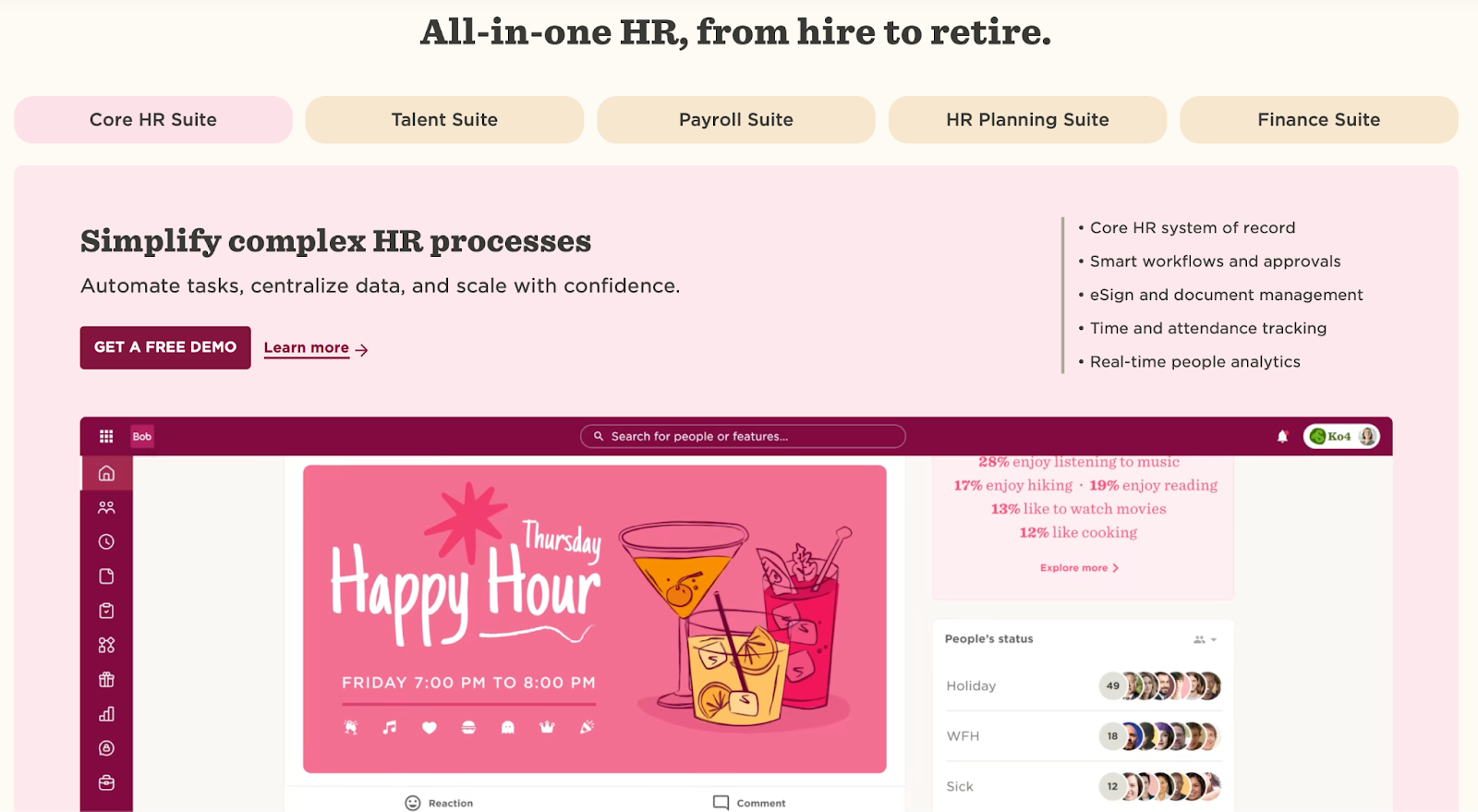
BambooHR
SMBs needing HRIS + basic PM
From $10/user/mo
4.4/5
Integrated HR platform with performance reviews built in
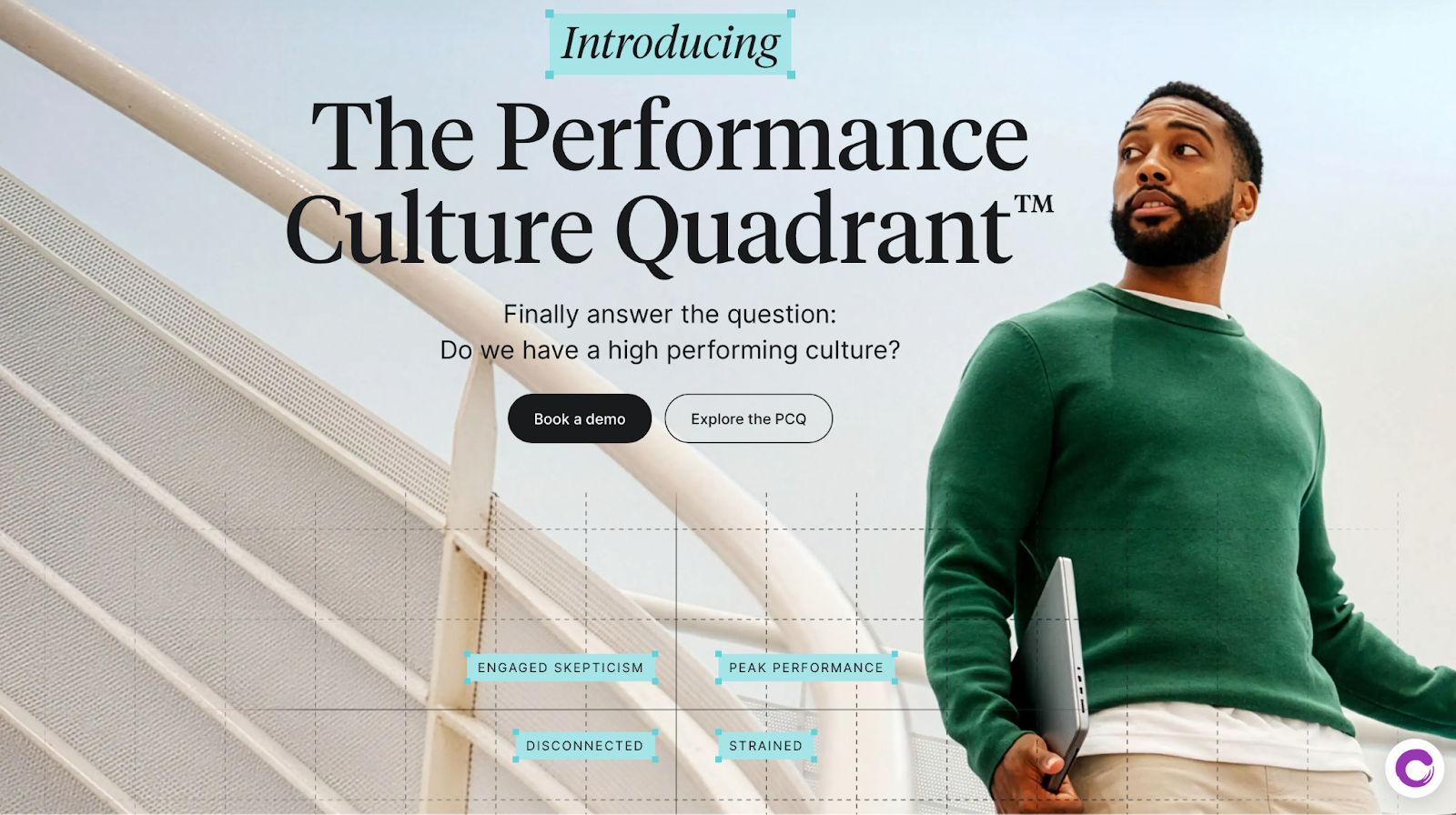
Culture Amp
Data-driven engagement + performance
Custom pricing
4.5/5
Research-backed engagement surveys with performance tools
Betterworks
Enterprise OKR alignment
Custom pricing
4.3/5
Cascading goal alignment and calibration for large orgs
Leapsome
All-in-one people management
Custom pricing
4.8/5
Performance, engagement, learning, and HRIS in one platform
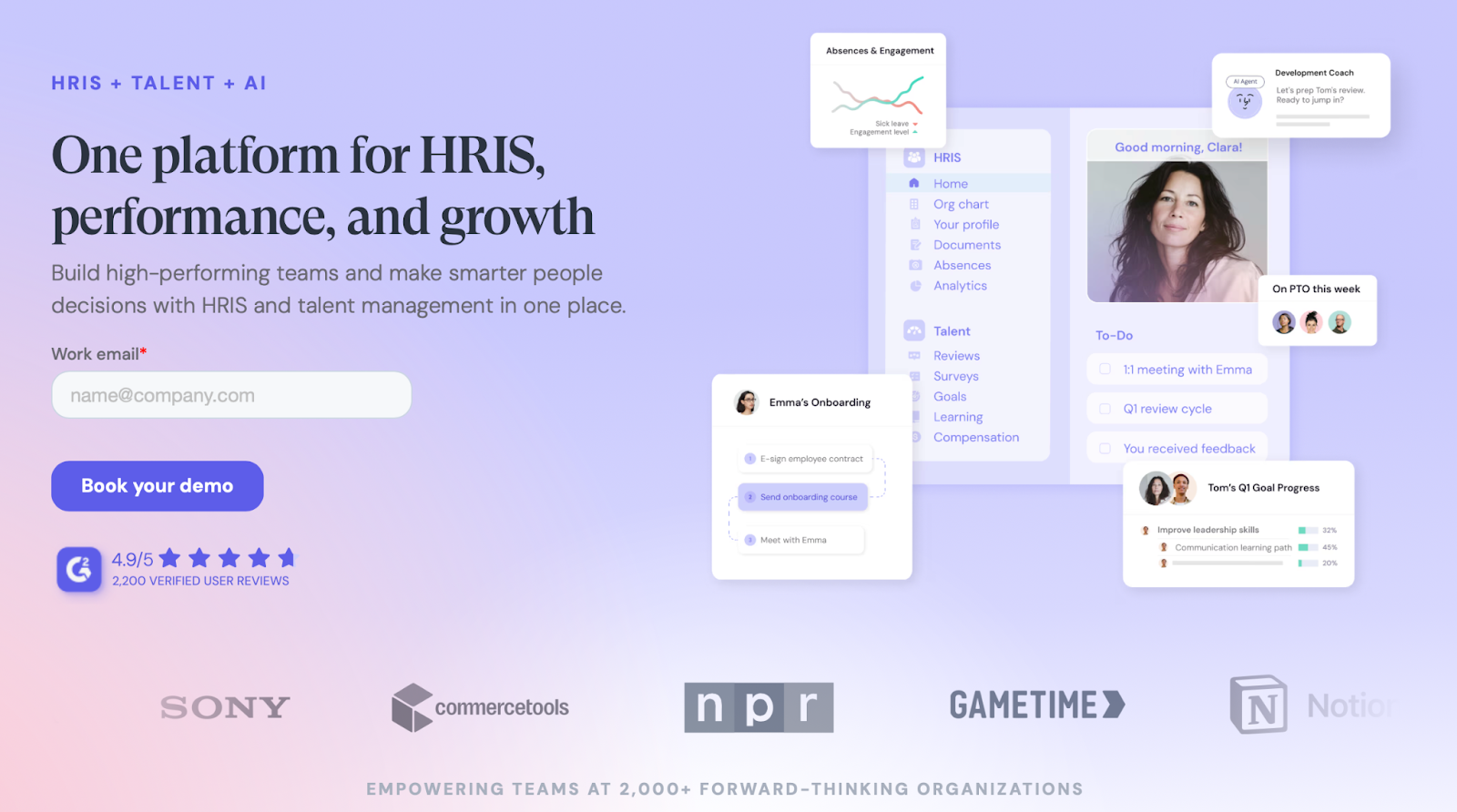
HiBob
Modern HRIS + performance
Custom pricing
4.5/5
Employee-centric HR platform with culture tools
10 Best Performance Management Software in 2026
Now let us take a closer look at each platform, covering what they do best, where they fall short, and what they cost.
1. Quantum Workplace
Best For:
Mid-size to enterprise teams that want engagement and performance in one place instead of two separate systems that never talk to each other.
Why It Stands Out
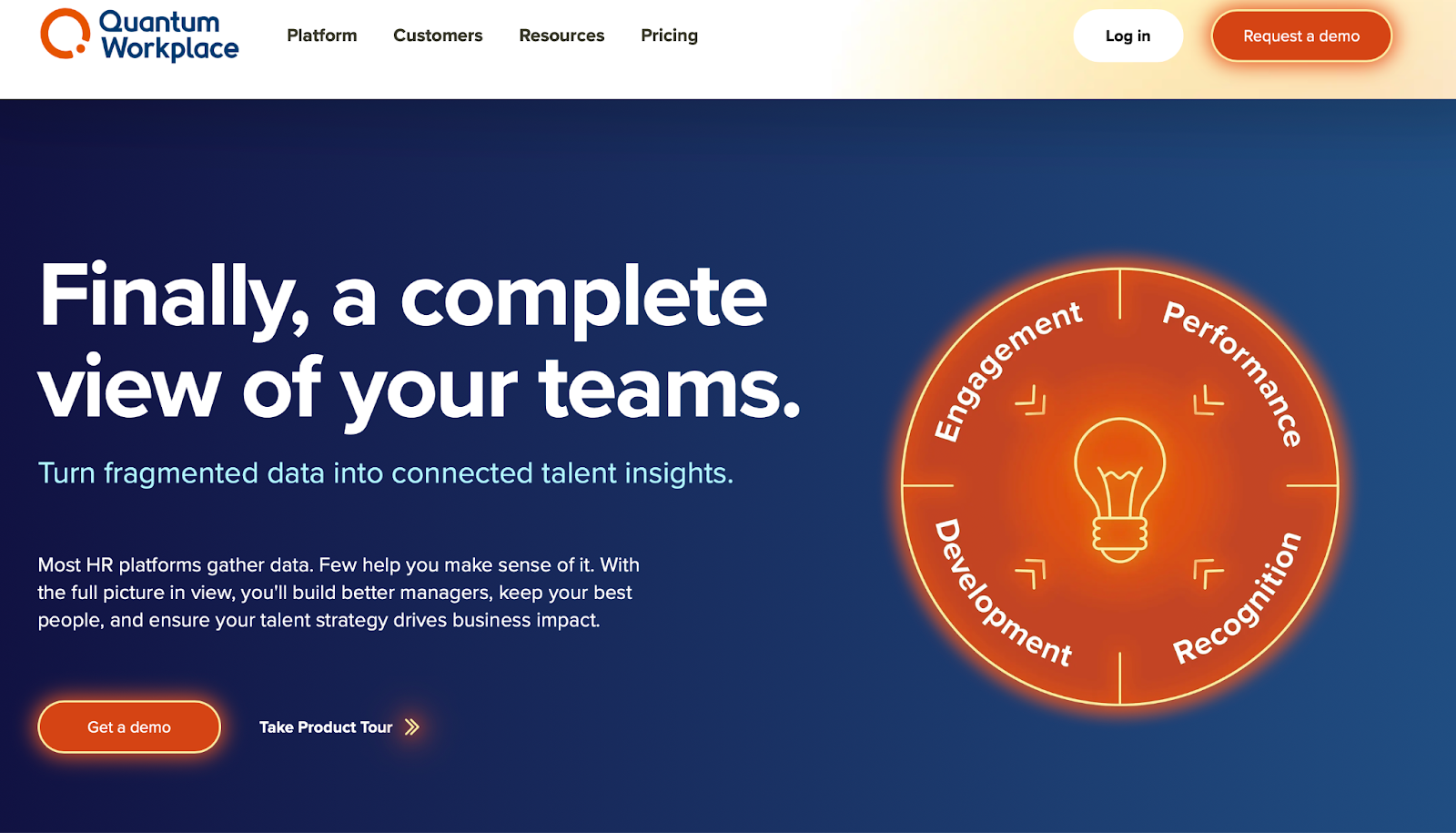
Quantum Workplace brings engagement surveys, performance reviews, and talent analytics into one platform, so everything works together. Built in AI tools like Smart Summary and Goal Generator helps managers by reducing their manual work.
With its Assembly acquisition, recognition and rewards are also included, so you don’t have to switch between tools.
Strengths
Engagement and performance data actually connected, not siloed in separate dashboards
AI tools that save your managers and HR team real time
Flexible review templates with automated cycles and real-time tracking
Strong customer support with dedicated implementation specialists
Limitations
Lots of features, which can feel like a lot to learn at first
You need to contact sales for pricing
Pricing: Custom pricing based on your team size and the products you need. Multi-product bundles come with discounts.
2. Assembly
Best For:
Teams of any size that want recognition at the center of their performance culture, with a platform people actually enjoy using from day one.
Why It Stands Out
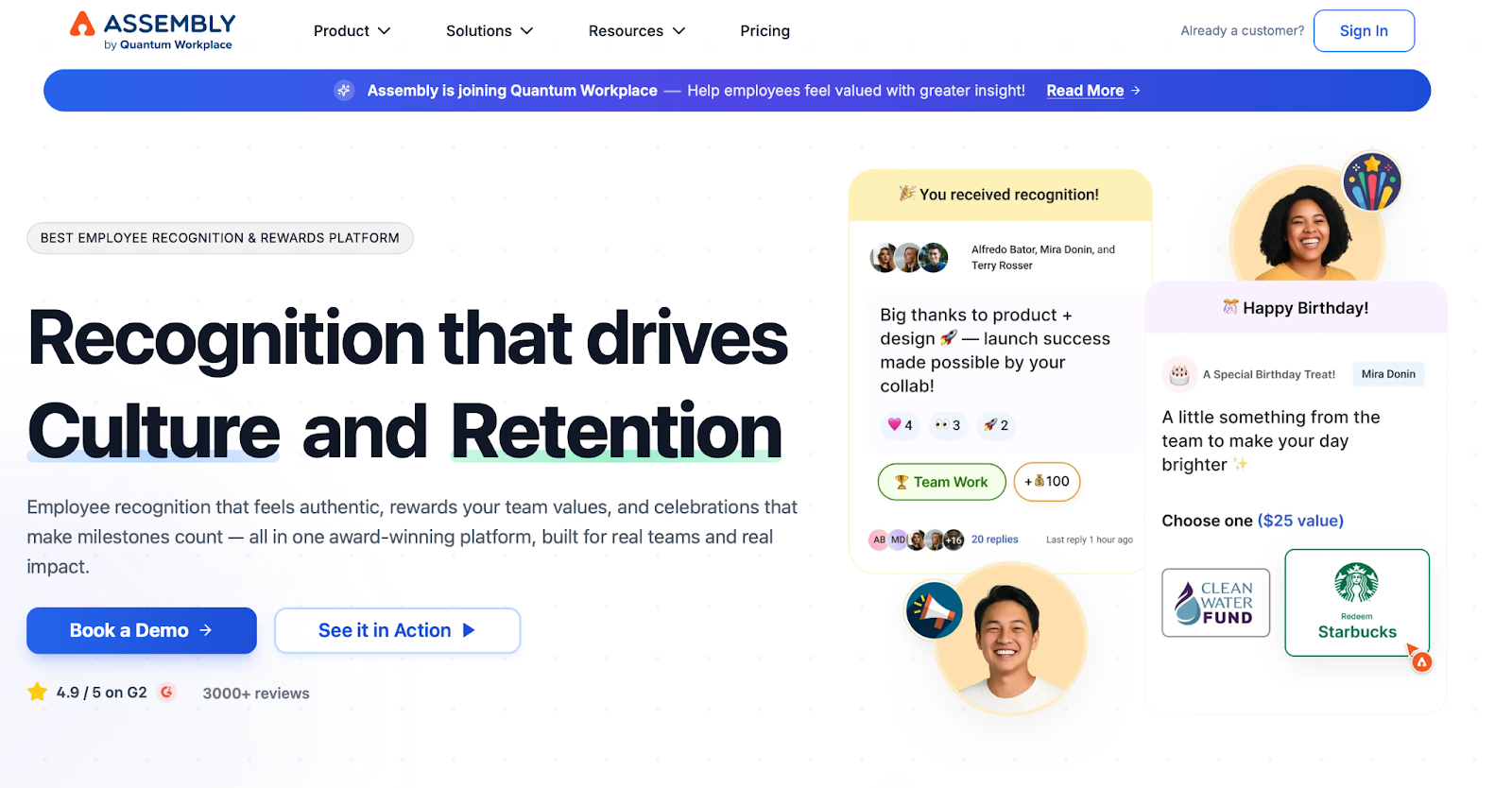
Most performance tools treat recognition as a bonus feature. Assembly puts it at the center. It enables peer-to-peer recognition through Slack, Teams, or your HR system, so contributions are captured in real time, not just during reviews. All that data becomes useful proof during promotion discussions. Its built-in Dora AI also flags employees who might be getting overlooked. Assembly's recognition analytics turn that visibility into action HR leaders can take immediately.
Strengths
90%+ participation rates and you can be up and running in hours
Rewards catalog with gift cards, donations, swag, and Amazon integration
DoraAI surfaces engagement trends and flags overlooked contributors
Works with Slack, Teams, and 50+ HRIS platforms out of the box
Limitations
Built around recognition and engagement, not full-cycle performance reviews
Works best when paired with Quantum Workplace for complete performance management
Pricing: Plans start at $2/employee/month. Free onboarding and unlimited training.
3. Lattice
Best For:
Mid-market to enterprise teams that want one platform for performance, goals, engagement, and compensation instead of juggling multiple tools.
Why It Stands Out
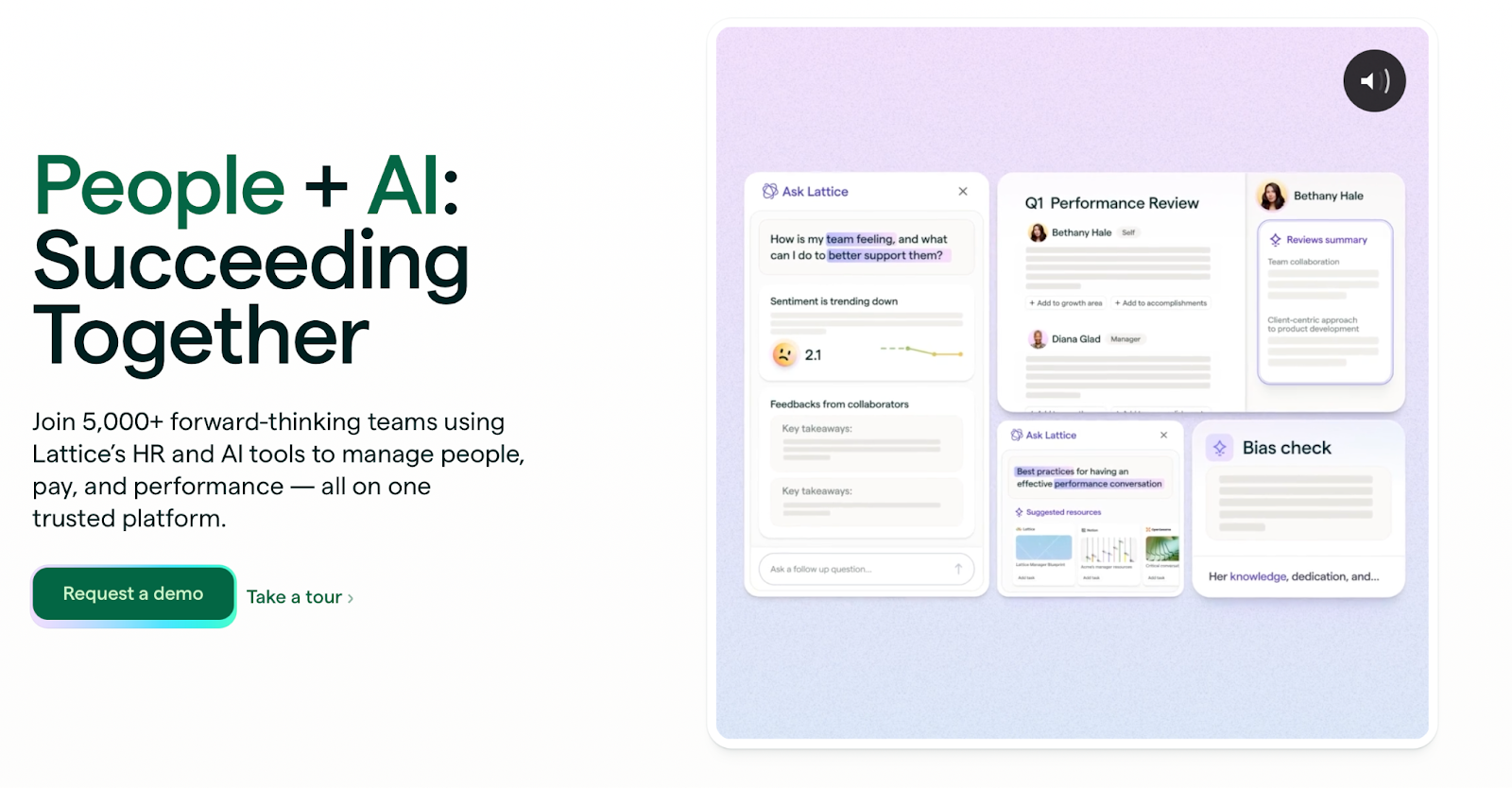
Lattice brings performance reviews, OKRs, engagement surveys, career growth, and compensation into one platform. You can start with one feature and add more as you grow. Its key strength is analytics that connect performance with engagement. The AI agent helps managers write reviews and offers coaching tips. It’s used by 5,000+ organizations.
Strengths
Everything in one place: performance, goals, engagement, and compensation
AI Agent that handles HR questions, helps write reviews, and coaches managers
50+ integrations with HRIS, Slack, Teams, and Jira
Limitations
Costs go up fast as you add modules
$4,000/year minimum commitment, which is a lot for smaller teams
Pricing: Performance + OKRs plans start at $11/seat/month. $4,000/year minimum.
4. 15Five
Best For:
Mid-sized companies (50 to 500 employees) that want performance to be driven by strong manager-employee conversations happening every week, not just during review season.
Why It Stands Out
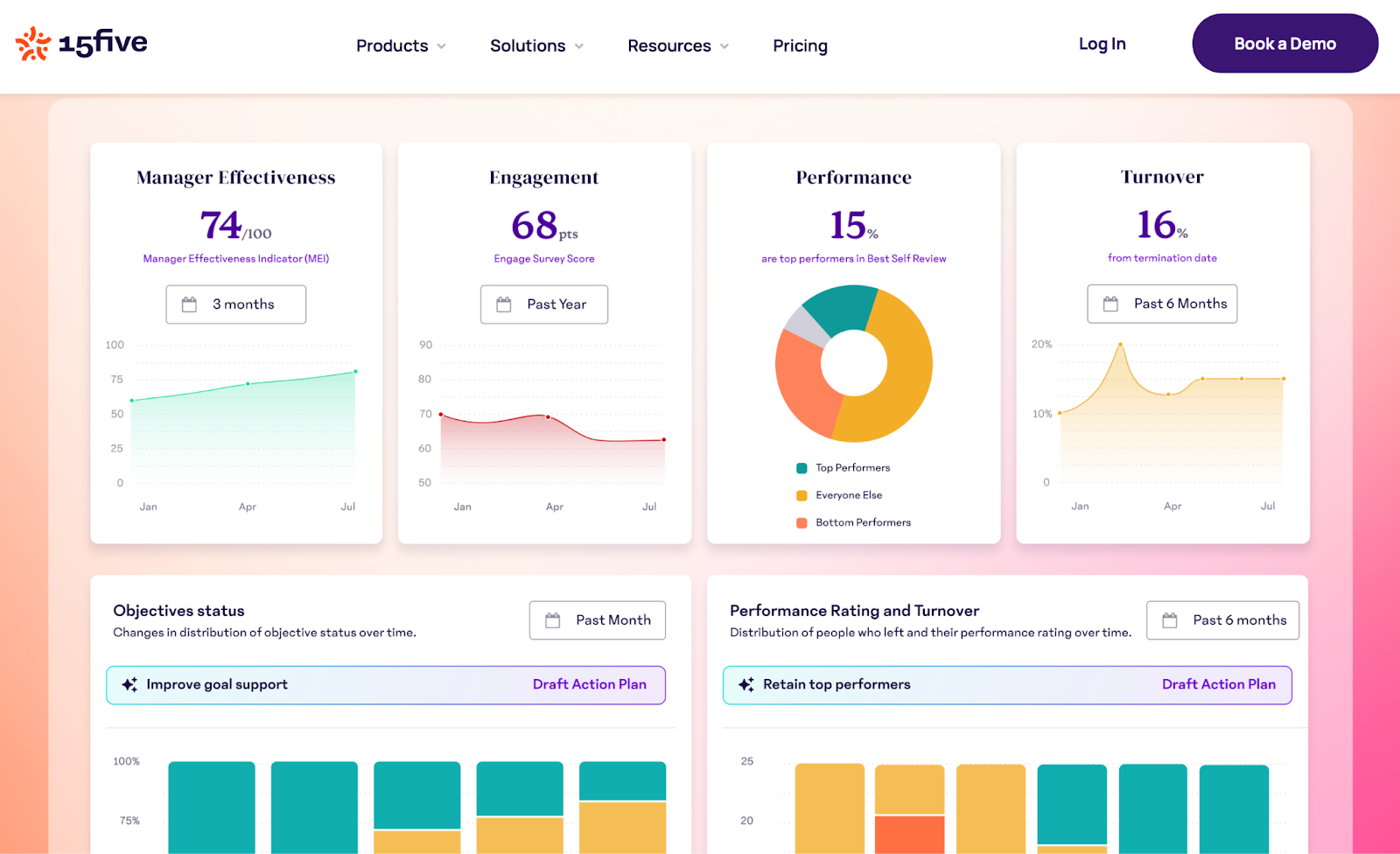
15Five is built around a simple idea: performance improves with regular conversations. It focuses on weekly check-ins where employees share updates, flag issues, and reflect. It also includes manager coaching, which many tools don’t offer.
Its AI agent, AMAYA, helps spot retention risks before employees actually leave. Over 3,000 companies use it. Strengths
Weekly check-ins that keep feedback flowing consistently
Manager coaching and development tools (Transform) that most competitors skip
AMAYA AI agent that catches engagement risks before they turn into resignations
Limitations
Can feel too lightweight for bigger companies with complex review needs
Engagement surveys are still catching up to dedicated survey platforms
Pricing: Starts at $4/user/month
5. PerformYard
Best For:
HR teams that want full control over how their review process works and need a platform that bends to their workflow and not the other way around.
Why It Stands Out
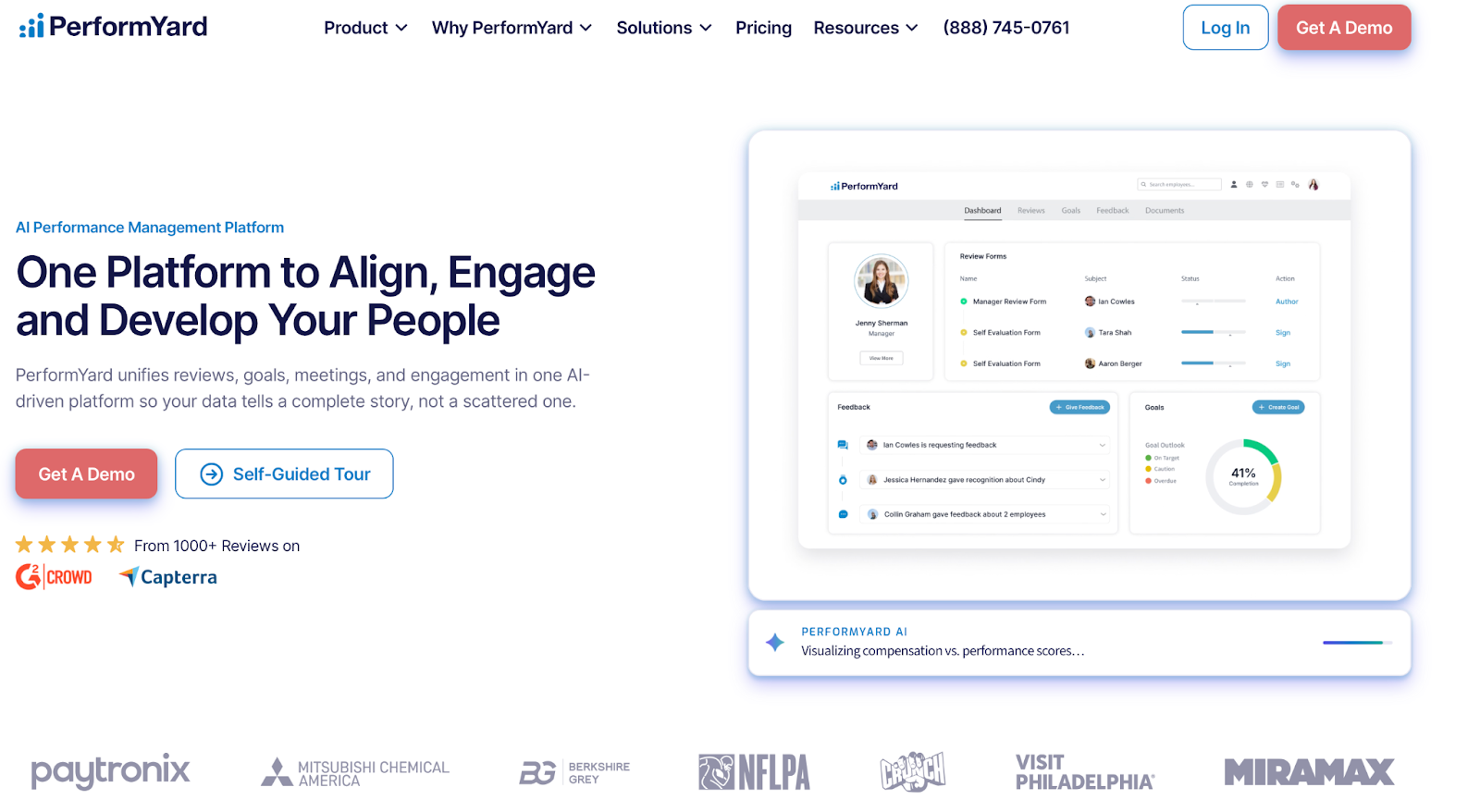
PerformYard gives HR teams full control over how performance reviews are set up. You can create custom frameworks, multi-step approvals, and evaluation formats that match your process instead of forcing you into a template. It also uses AI to summarize feedback and identify performance trends. Another plus is that, every plan includes live training and a dedicated success manager.
Strengths
Review cycles that you can customize to match exactly how you work
AI that summarizes reviews, improves feedback, and spots performance patterns
Dedicated success manager and live training included with every contract
Limitations
No built-in recognition, rewards, or compensation management tools
Focused specifically on performance management, so you may need additional platforms for other HR requirements.
Pricing: Starts at $5/user/month.
6. BambooHR
Best For:
Small businesses already on BambooHR who want to add basic performance reviews without bringing in another platform or another bill.
Why It Stands Out
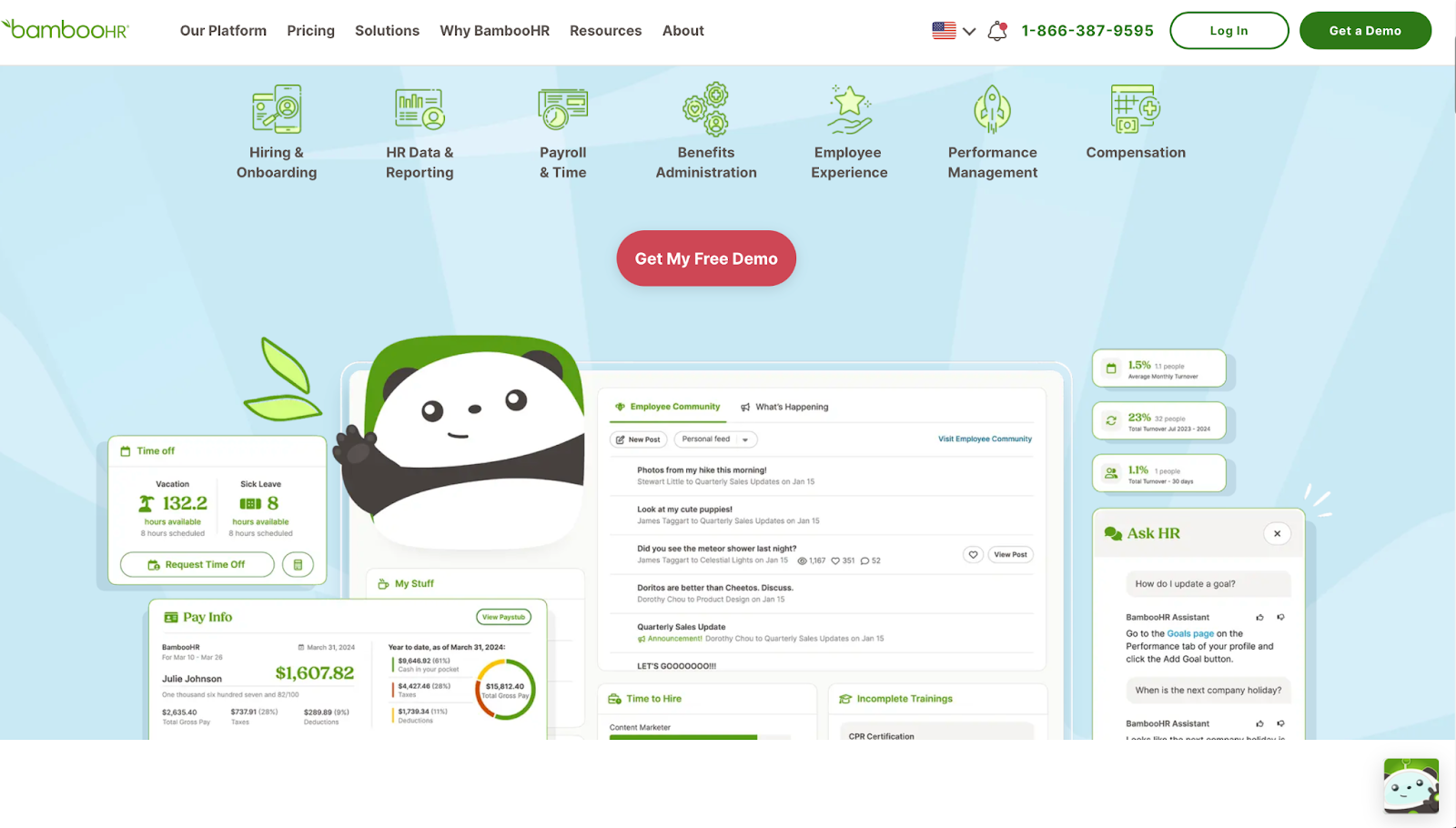
BambooHR is primarily an HR platform, with performance management as an add-on. If you already use it for employee records, time-off, payroll, and onboarding, you can easily manage performance reviews without adding another tool. It’s not as feature-rich as dedicated performance platforms, but for small teams that just need the basics to work well, it’s a great fit.
Strengths
HR, performance, payroll, and onboarding all in one platform
Simple interface that anyone can pick up without training
Solid for small teams that want simplicity, not feature overload
Limitations
Performance features are basic next to dedicated tools
Not a strong standalone option for mid-size or larger teams
Pricing: From $10/user/month. Pricing depends on team size and features.
7. Culture Amp
Best For:
Organizations that want engagement data to drive their performance strategy, especially teams that value research-backed, data-heavy approaches.
Why It Stands Out
Culture Amp started as an employee survey tool and later added performance management. Its surveys are designed by experts, with strong benchmarking and sentiment analysis that most tools don’t match. It also has an AI Coach that helps managers write clear, balanced reviews.
If you want performance decisions based on real employee feedback, it’s a solid choice.
Strengths
Engagement surveys that are genuinely best-in-class, backed by research and benchmarking
Analytics that tie employee sentiment directly to performance and retention
Strong DEIB tools built right into the platform
Limitations
Performance features are solid but not as deep as other platforms.
Setup and implementation can take longer than lighter-weight platforms
Pricing: Customised.
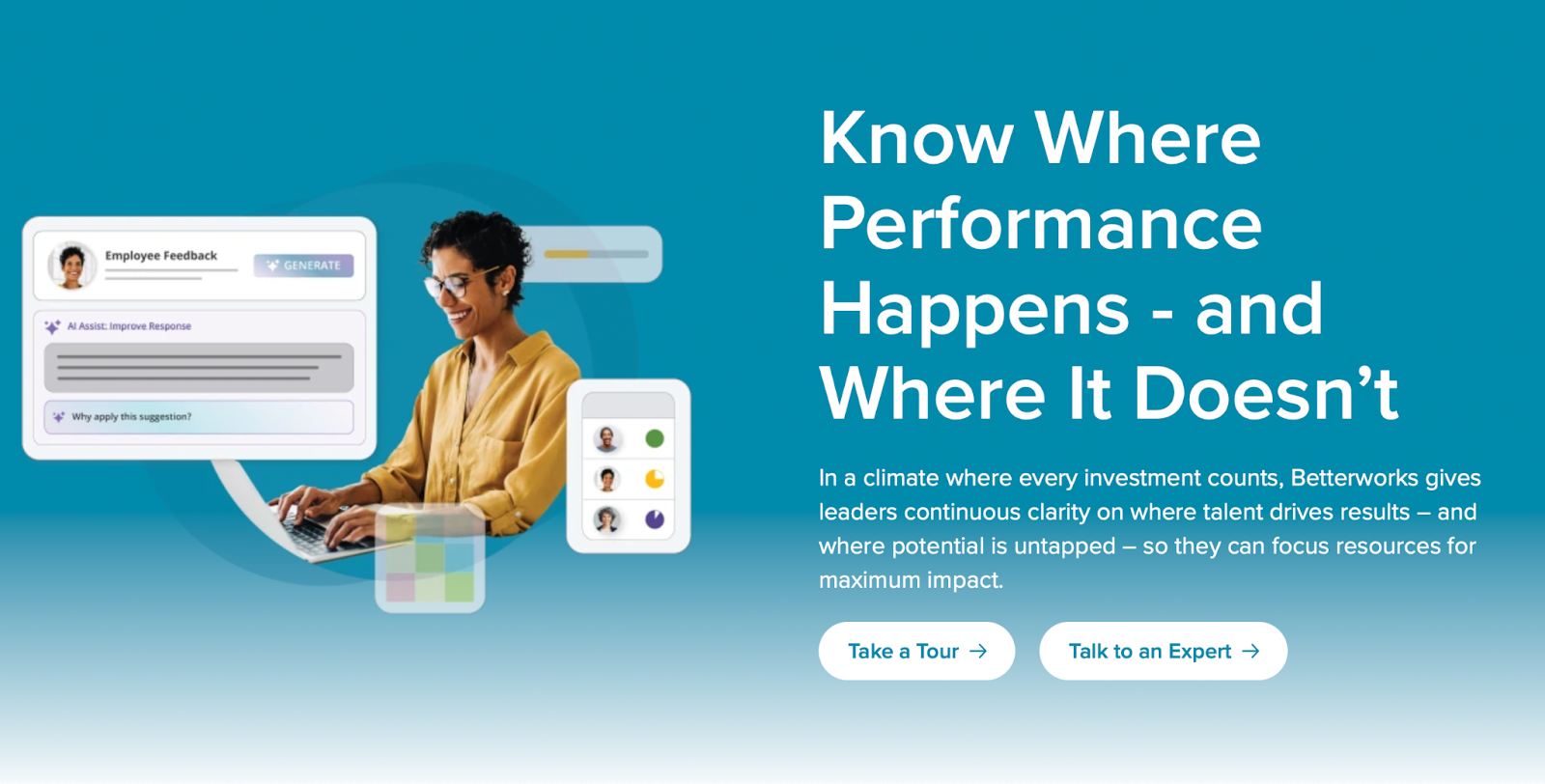
8. Betterworks
Best For:
Large enterprises that need cascading OKRs, serious calibration tools, and tight integration with enterprise HR systems like Workday.
Why It Stands Out
Betterworks is strong at keeping goals aligned from leadership down to individual contributors, especially at scale. It handles complex OKR setups and tracking at scale. AI Assist helps managers write better feedback, and calibration keeps ratings consistent across teams.
It also offers deep Workday integration. Companies like Colgate-Palmolive and Intuit use it.
Strengths
Reliable OKR cascading across large organizations
AI-assisted feedback and automated calibration that help make reviews more consistent
Strong integration with Workday and other enterprise HR systems
Limitations
Takes more time and effort to implement than mid-market tools
Pricing is built for enterprise budgets, not smaller teams
Pricing: Custom enterprise pricing.
9. Leapsome
Best For:
Companies that want to consolidate their HR stack and run performance, engagement, learning, and core HR from one platform instead of five.
Why It Stands Out
Leapsome brings performance reviews, OKRs, engagement surveys, 360 feedback, learning, compensation, and HRIS into one platform. It covers a lot without becoming hard to use. AI agents handle repetitive tasks and surface insights from your people's data.
It also supports multiple languages, making it great for global teams. Used by 2,000+ organizations, and also has an excellent rate of 4.8/5 on G2.
Strengths
Covers more ground than almost any competitor: performance, engagement, learning, compensation, and HRIS
AI Agents that cut admin time and speed up reporting
Analytics that connect engagement, performance, and development data in one view
Limitations
So many modules that setup can feel overwhelming at first
Costs grow as you turn on more features
Pricing: Starts around $8/user/month with modular pricing. Free trial available.
10. HiBob
Best For:
Fast-growing, modern companies that care about user experience as much as functionality, especially global teams that need multi-country support.
Why It Stands Out
HiBob combines HRIS, performance reviews, compensation, payroll, and culture tools in one platform for global teams. Its performance module includes review cycles, calibration, continuous feedback, peer recognition, and OKRs. The Bob AI Companion summarizes reviews, drafts feedback, and helps managers find what they need quickly.
Used by 5,000+ companies worldwide.
Strengths
Has a modern interface your team will actually enjoy using, which drives real adoption
Bob AI Companion that helps managers with reviews, feedback, and navigation
HRIS, performance, compensation, payroll, and culture tools all in one place
Limitations
Performance features are not as deep as dedicated tools (no weighted goals or advanced calibration)
Can be tricky to set up if you have very customized processes
Pricing: Custom pricing.
How To Choose the Best Performance Management Software
1. Start With the Problem You Are Solving
Are you trying to replace outdated annual reviews? Build a feedback culture? Get better visibility into who is actually contributing? The answer shapes everything. Do not start with features. Start with the gap. If your biggest issue is that great work goes unnoticed, look for platforms where employee recognition data is built in, like Assembly's peer-to-peer recognition that creates a running record your managers can actually reference during reviews.
2. Think About What Your Managers Actually Need
Your managers are the ones using this tool every week. If they do not find it helpful, adoption dies. Look for platforms that give managers structure without creating busywork. Quantum Workplace's 1:1 software, for example, gives managers shared agendas, action tracking, and conversation history so check-ins stay productive and nothing falls through the cracks.
3. Match the Tool to Your Team Size and Stage
A 50-person startup and a 5,000-person enterprise need very different things. The best performance management software for small business prioritizes fast setup, simple interfaces, and affordable pricing. Assembly gets teams running in hours, not weeks. Mid-market companies often need more depth like what Lattice or Leapsome offer. Enterprise organizations with complex structures need the configurability of Quantum Workplace or Betterworks.
4. Prioritize Adoption Over Feature Count
The most powerful platform in the world is useless if your people do not use it. Look at real adoption numbers, not just feature lists. Assembly's 90%+ participation rate tells you something about how natural it feels in daily work. During your evaluation, run a pilot with real managers and employees. Watch whether they use it without being reminded.
5. Make Sure Your Data Is Not Siloed
Performance data in one tool, engagement data in another, recognition somewhere else. That is how most companies end up flying blind. Look for platforms where these data points connect. Quantum Workplace's analytics tie engagement survey results to performance trends, so you can see patterns instead of guessing. When your tools talk to each other, your decisions get sharper.
How Assembly Helps You Turn Performance Into Action
Most companies use separate tools for performance, recognition, and engagement.
This creates a scattered view, where no single platform shows what’s really happening with your people.
That is the problem Assembly and Quantum Workplace solve together. Since Quantum Workplace acquired Assembly, organizations can now run the full cycle from one connected ecosystem: set goals, run reviews, collect engagement feedback, recognize contributions, and reward great work, all without switching platforms or stitching data together manually.
For HR leaders, this means fewer tools to manage and one place where everything connects. Use Quantum Workplace's performance reviews to run structured, fair evaluation cycles. Track goals and alignment with Quantum Workplace's goal management tools. Run engagement and pulse surveys to understand how your people are really feeling. Then layer in Assembly's peer-to-peer recognition so contributions are visible every day, not just during reviews. Celebrate milestones automatically with Assembly's milestone and celebration workflows. And use Assembly's rewards catalog to turn appreciation into something tangible with gift cards, donations, swag, and experiences.
For managers, the recognition their team gives each other throughout the year automatically builds a track record they can pull into review conversations. For employees, their contributions are visible every day, not just when someone remembers to mention them during an annual review.
The companies seeing the best results from performance management are not the ones with the most sophisticated tools. They are the ones where feedback, recognition, and growth conversations are all part of the same daily experience. That is what this ecosystem is built to do.
Final Words
Choosing performance management software is not about finding the platform with the most advanced features. It is about finding the one that fits how your team works, helps managers lead better, and makes employees feel seen.
Start with the problem you want to solve and choose a tool your team will actually use. Performance management works best when it is part of everyday work, not a separate process.
Take time to run a pilot with your actual managers and employees before committing. The right platform is the one your team uses consistently and confidently.
Ready to see how performance and recognition work better together? Book a demo with Assembly and see how it all comes together.
FAQ
What is a performance management system?
Performance management system helps organizations track and improve employee performance through goal setting, feedback, reviews, and analytics. It replaces manual processes with structured, ongoing conversations that keep employees aligned with organizational goals.
How much does performance management software cost?
Pricing ranges from $2/user/month for recognition-focused platforms like Assembly to $11+/user/month for comprehensive tools like Lattice. Enterprise platforms like Betterworks and Quantum Workplace use custom pricing. Most offer annual billing with volume discounts.
Can small businesses use performance management software?
Yes. Assembly, 15Five, and BambooHR work well for smaller teams. Look for quick setup, intuitive interfaces, and affordable per-user pricing
What is the difference between performance management and employee engagement software?
Performance management focuses on goals, reviews, and feedback. Engagement software measures how connected and motivated employees feel. The best platforms, like Quantum Workplace, combine both so engagement levels directly inform performance outcomes.
How do I get my team to actually use performance management software?
Integrate with Slack or Teams so feedback happens where people already work. Keep review processes simple. Pair the platform with peer recognition like Assembly so employees associate it with positive experiences, not just evaluations
Should I choose a standalone performance tool or an all-in-one platform?
It depends on your existing tech stack. If you have a strong HRIS, a standalone tool like PerformYard or 15Five can focus on what it does best. If you want fewer tools and connected data, platforms like Quantum Workplace, Lattice, or Leapsome offer broader functionality.
class SampleComponent extends React.Component {
  // using the experimental public class field syntax below. We can also attach
  // the contextType to the current class
  static contextType = ColorContext;
  render() {
    return <Button color={this.color} />
  }
}
Your best people want regular feedback, clear goals, and a sense that someone is paying attention to their growth. Performance review phrases are a good starting point but the right employee performance management software helps you deliver on all of that. And it does it without burying your HR team in manual work."
But with dozens of platforms on the market, choosing the right one can feel overwhelming. Some are built for enterprise complexity. Others are designed for speed and simplicity. A few try to do everything at once.
This guide compares the top performance management tools for 2026, highlighting their strengths, limitations, and pricing so you can choose the right fit for your team.
Key Features of Performance Management Software You Should Look For
Not all performance management platforms are built the same. Before you evaluate any tool, check whether it covers these six capabilities.
Goal setting and alignment: Can you set goals at the individual, team, and company level? Does the platform visually map how they connect so employees can see where their work fits into the bigger picture?
Continuous feedback and check-ins: Does the platform let managers and employees exchange feedback in real time through Slack, Teams, or email? Continuous feedback is now the baseline expectation for any modern performance management system.
Performance reviews: Can you customize review cycles to support self-assessments, peer reviews, manager evaluations, and 360-degree feedback? Does the platform handle scheduling, reminders, and tracking automatically?
1:1 meeting tools: Does the platform give managers and direct reports a shared space with agendas, action item tracking, and searchable meeting history? Or are you still relying on separate docs and calendar notes?
Recognition and rewards: Is peer-to-peer recognition built into the platform with a public feed tied to company values? Can employees earn and redeem rewards directly, or is recognition treated as a separate system?
Analytics and integrations: Can you see review completion rates, engagement trends, and recognition patterns in one dashboard? Does the platform connect with your existing HRIS, Slack, Teams, and calendar tools without custom setup?
AI and automation: Does the platform use AI to summarize reviews, suggest feedback language, flag engagement risks, or generate goal recommendations? In 2026, AI-powered performance management tools are separating platforms that save manager time from those that only add admin work.
Comparison: Top Performance Management Software
Key Differences
Platform
Best For
Starting Price
G2 Rating
Key Strength
Quantum Workplace
Enterprise performance + engagement
Custom pricing
4.3/5
Unified engagement, performance, and development with deep analytics
Assembly
Recognition-driven performance culture
From $2/user/mo
4.8/5
Peer recognition, rewards, and automated celebrations with AI insights
Lattice
Mid-market to enterprise
From $11/seat/mo
4.7/5
All-in-one performance, goals, engagement, and compensation
15Five
Manager development + feedback
From $4/user/mo
4.6/5
Weekly check-ins and structured coaching for managers
PerformYard
Customizable review cycles
From $5/user/mo
4.7/5
Flexible review process builder with dedicated support
BambooHR
SMBs needing HRIS + basic PM
From $10/user/mo
4.4/5
Integrated HR platform with performance reviews built in
Culture Amp
Data-driven engagement + performance
Custom pricing
4.5/5
Research-backed engagement surveys with performance tools
Betterworks
Enterprise OKR alignment
Custom pricing
4.3/5
Cascading goal alignment and calibration for large orgs
Leapsome
All-in-one people management
Custom pricing
4.8/5
Performance, engagement, learning, and HRIS in one platform
HiBob
Modern HRIS + performance
Custom pricing
4.5/5
Employee-centric HR platform with culture tools
10 Best Performance Management Software in 2026
Now let us take a closer look at each platform, covering what they do best, where they fall short, and what they cost.
1. Quantum Workplace
Best For:
Mid-size to enterprise teams that want engagement and performance in one place instead of two separate systems that never talk to each other.
Why It Stands Out
Quantum Workplace brings engagement surveys, performance reviews, and talent analytics into one platform, so everything works together. Built in AI tools like Smart Summary and Goal Generator helps managers by reducing their manual work.
With its Assembly acquisition, recognition and rewards are also included, so you don’t have to switch between tools.
Strengths
Engagement and performance data actually connected, not siloed in separate dashboards
AI tools that save your managers and HR team real time
Flexible review templates with automated cycles and real-time tracking
Strong customer support with dedicated implementation specialists
Limitations
Lots of features, which can feel like a lot to learn at first
You need to contact sales for pricing
Pricing: Custom pricing based on your team size and the products you need. Multi-product bundles come with discounts.
2. Assembly
Best For:
Teams of any size that want recognition at the center of their performance culture, with a platform people actually enjoy using from day one.
Why It Stands Out
Most performance tools treat recognition as a bonus feature. Assembly puts it at the center. It enables peer-to-peer recognition through Slack, Teams, or your HR system, so contributions are captured in real time, not just during reviews. All that data becomes useful proof during promotion discussions. Its built-in Dora AI also flags employees who might be getting overlooked. Assembly's recognition analytics turn that visibility into action HR leaders can take immediately.
Strengths
90%+ participation rates and you can be up and running in hours
Rewards catalog with gift cards, donations, swag, and Amazon integration
DoraAI surfaces engagement trends and flags overlooked contributors
Works with Slack, Teams, and 50+ HRIS platforms out of the box
Limitations
Built around recognition and engagement, not full-cycle performance reviews
Works best when paired with Quantum Workplace for complete performance management
Pricing: Plans start at $2/employee/month. Free onboarding and unlimited training.
3. Lattice
Best For:
Mid-market to enterprise teams that want one platform for performance, goals, engagement, and compensation instead of juggling multiple tools.
Why It Stands Out
Lattice brings performance reviews, OKRs, engagement surveys, career growth, and compensation into one platform. You can start with one feature and add more as you grow. Its key strength is analytics that connect performance with engagement. The AI agent helps managers write reviews and offers coaching tips. It’s used by 5,000+ organizations.
Strengths
Everything in one place: performance, goals, engagement, and compensation
AI Agent that handles HR questions, helps write reviews, and coaches managers
50+ integrations with HRIS, Slack, Teams, and Jira
Limitations
Costs go up fast as you add modules
$4,000/year minimum commitment, which is a lot for smaller teams
Pricing: Performance + OKRs plans start at $11/seat/month. $4,000/year minimum.
4. 15Five
Best For:
Mid-sized companies (50 to 500 employees) that want performance to be driven by strong manager-employee conversations happening every week, not just during review season.
Why It Stands Out
15Five is built around a simple idea: performance improves with regular conversations. It focuses on weekly check-ins where employees share updates, flag issues, and reflect. It also includes manager coaching, which many tools don’t offer.
Its AI agent, AMAYA, helps spot retention risks before employees actually leave. Over 3,000 companies use it. Strengths
Weekly check-ins that keep feedback flowing consistently
Manager coaching and development tools (Transform) that most competitors skip
AMAYA AI agent that catches engagement risks before they turn into resignations
Limitations
Can feel too lightweight for bigger companies with complex review needs
Engagement surveys are still catching up to dedicated survey platforms
Pricing: Starts at $4/user/month
5. PerformYard
Best For:
HR teams that want full control over how their review process works and need a platform that bends to their workflow and not the other way around.
Why It Stands Out
PerformYard gives HR teams full control over how performance reviews are set up. You can create custom frameworks, multi-step approvals, and evaluation formats that match your process instead of forcing you into a template. It also uses AI to summarize feedback and identify performance trends. Another plus is that, every plan includes live training and a dedicated success manager.
Strengths
Review cycles that you can customize to match exactly how you work
AI that summarizes reviews, improves feedback, and spots performance patterns
Dedicated success manager and live training included with every contract
Limitations
No built-in recognition, rewards, or compensation management tools
Focused specifically on performance management, so you may need additional platforms for other HR requirements.
Pricing: Starts at $5/user/month.
6. BambooHR
Best For:
Small businesses already on BambooHR who want to add basic performance reviews without bringing in another platform or another bill.
Why It Stands Out
BambooHR is primarily an HR platform, with performance management as an add-on. If you already use it for employee records, time-off, payroll, and onboarding, you can easily manage performance reviews without adding another tool. It’s not as feature-rich as dedicated performance platforms, but for small teams that just need the basics to work well, it’s a great fit.
Strengths
HR, performance, payroll, and onboarding all in one platform
Simple interface that anyone can pick up without training
Solid for small teams that want simplicity, not feature overload
Limitations
Performance features are basic next to dedicated tools
Not a strong standalone option for mid-size or larger teams
Pricing: From $10/user/month. Pricing depends on team size and features.
7. Culture Amp
Best For:
Organizations that want engagement data to drive their performance strategy, especially teams that value research-backed, data-heavy approaches.
Why It Stands Out
Culture Amp started as an employee survey tool and later added performance management. Its surveys are designed by experts, with strong benchmarking and sentiment analysis that most tools don’t match. It also has an AI Coach that helps managers write clear, balanced reviews.
If you want performance decisions based on real employee feedback, it’s a solid choice.
Strengths
Engagement surveys that are genuinely best-in-class, backed by research and benchmarking
Analytics that tie employee sentiment directly to performance and retention
Strong DEIB tools built right into the platform
Limitations
Performance features are solid but not as deep as other platforms.
Setup and implementation can take longer than lighter-weight platforms
Pricing: Customised.
8. Betterworks
Best For:
Large enterprises that need cascading OKRs, serious calibration tools, and tight integration with enterprise HR systems like Workday.
Why It Stands Out
Betterworks is strong at keeping goals aligned from leadership down to individual contributors, especially at scale. It handles complex OKR setups and tracking at scale. AI Assist helps managers write better feedback, and calibration keeps ratings consistent across teams.
It also offers deep Workday integration. Companies like Colgate-Palmolive and Intuit use it.
Strengths
Reliable OKR cascading across large organizations
AI-assisted feedback and automated calibration that help make reviews more consistent
Strong integration with Workday and other enterprise HR systems
Limitations
Takes more time and effort to implement than mid-market tools
Pricing is built for enterprise budgets, not smaller teams
Pricing: Custom enterprise pricing.
9. Leapsome
Best For:
Companies that want to consolidate their HR stack and run performance, engagement, learning, and core HR from one platform instead of five.
Why It Stands Out
Leapsome brings performance reviews, OKRs, engagement surveys, 360 feedback, learning, compensation, and HRIS into one platform. It covers a lot without becoming hard to use. AI agents handle repetitive tasks and surface insights from your people's data.
It also supports multiple languages, making it great for global teams. Used by 2,000+ organizations, and also has an excellent rate of 4.8/5 on G2.
Strengths
Covers more ground than almost any competitor: performance, engagement, learning, compensation, and HRIS
AI Agents that cut admin time and speed up reporting
Analytics that connect engagement, performance, and development data in one view
Limitations
So many modules that setup can feel overwhelming at first
Costs grow as you turn on more features
Pricing: Starts around $8/user/month with modular pricing. Free trial available.
10. HiBob
Best For:
Fast-growing, modern companies that care about user experience as much as functionality, especially global teams that need multi-country support.
Why It Stands Out
HiBob combines HRIS, performance reviews, compensation, payroll, and culture tools in one platform for global teams. Its performance module includes review cycles, calibration, continuous feedback, peer recognition, and OKRs. The Bob AI Companion summarizes reviews, drafts feedback, and helps managers find what they need quickly.
Used by 5,000+ companies worldwide.
Strengths
Has a modern interface your team will actually enjoy using, which drives real adoption
Bob AI Companion that helps managers with reviews, feedback, and navigation
HRIS, performance, compensation, payroll, and culture tools all in one place
Limitations
Performance features are not as deep as dedicated tools (no weighted goals or advanced calibration)
Can be tricky to set up if you have very customized processes
Pricing: Custom pricing.
How To Choose the Best Performance Management Software
1. Start With the Problem You Are Solving
Are you trying to replace outdated annual reviews? Build a feedback culture? Get better visibility into who is actually contributing? The answer shapes everything. Do not start with features. Start with the gap. If your biggest issue is that great work goes unnoticed, look for platforms where employee recognition data is built in, like Assembly's peer-to-peer recognition that creates a running record your managers can actually reference during reviews.
2. Think About What Your Managers Actually Need
Your managers are the ones using this tool every week. If they do not find it helpful, adoption dies. Look for platforms that give managers structure without creating busywork. Quantum Workplace's 1:1 software, for example, gives managers shared agendas, action tracking, and conversation history so check-ins stay productive and nothing falls through the cracks.
3. Match the Tool to Your Team Size and Stage
A 50-person startup and a 5,000-person enterprise need very different things. The best performance management software for small business prioritizes fast setup, simple interfaces, and affordable pricing. Assembly gets teams running in hours, not weeks. Mid-market companies often need more depth like what Lattice or Leapsome offer. Enterprise organizations with complex structures need the configurability of Quantum Workplace or Betterworks.
4. Prioritize Adoption Over Feature Count
The most powerful platform in the world is useless if your people do not use it. Look at real adoption numbers, not just feature lists. Assembly's 90%+ participation rate tells you something about how natural it feels in daily work. During your evaluation, run a pilot with real managers and employees. Watch whether they use it without being reminded.
5. Make Sure Your Data Is Not Siloed
Performance data in one tool, engagement data in another, recognition somewhere else. That is how most companies end up flying blind. Look for platforms where these data points connect. Quantum Workplace's analytics tie engagement survey results to performance trends, so you can see patterns instead of guessing. When your tools talk to each other, your decisions get sharper.
How Assembly Helps You Turn Performance Into Action
Most companies use separate tools for performance, recognition, and engagement.
This creates a scattered view, where no single platform shows what’s really happening with your people.
That is the problem Assembly and Quantum Workplace solve together. Since Quantum Workplace acquired Assembly, organizations can now run the full cycle from one connected ecosystem: set goals, run reviews, collect engagement feedback, recognize contributions, and reward great work, all without switching platforms or stitching data together manually.
For HR leaders, this means fewer tools to manage and one place where everything connects. Use Quantum Workplace's performance reviews to run structured, fair evaluation cycles. Track goals and alignment with Quantum Workplace's goal management tools. Run engagement and pulse surveys to understand how your people are really feeling. Then layer in Assembly's peer-to-peer recognition so contributions are visible every day, not just during reviews. Celebrate milestones automatically with Assembly's milestone and celebration workflows. And use Assembly's rewards catalog to turn appreciation into something tangible with gift cards, donations, swag, and experiences.
For managers, the recognition their team gives each other throughout the year automatically builds a track record they can pull into review conversations. For employees, their contributions are visible every day, not just when someone remembers to mention them during an annual review.
The companies seeing the best results from performance management are not the ones with the most sophisticated tools. They are the ones where feedback, recognition, and growth conversations are all part of the same daily experience. That is what this ecosystem is built to do.
Final Words
Choosing performance management software is not about finding the platform with the most advanced features. It is about finding the one that fits how your team works, helps managers lead better, and makes employees feel seen.
Start with the problem you want to solve and choose a tool your team will actually use. Performance management works best when it is part of everyday work, not a separate process.
Take time to run a pilot with your actual managers and employees before committing. The right platform is the one your team uses consistently and confidently.
Ready to see how performance and recognition work better together? Book a demo with Assembly and see how it all comes together.
FAQ
What is a performance management system?
Performance management system helps organizations track and improve employee performance through goal setting, feedback, reviews, and analytics. It replaces manual processes with structured, ongoing conversations that keep employees aligned with organizational goals.
How much does performance management software cost?
Pricing ranges from $2/user/month for recognition-focused platforms like Assembly to $11+/user/month for comprehensive tools like Lattice. Enterprise platforms like Betterworks and Quantum Workplace use custom pricing. Most offer annual billing with volume discounts.
Can small businesses use performance management software?
Yes. Assembly, 15Five, and BambooHR work well for smaller teams. Look for quick setup, intuitive interfaces, and affordable per-user pricing
What is the difference between performance management and employee engagement software?
Performance management focuses on goals, reviews, and feedback. Engagement software measures how connected and motivated employees feel. The best platforms, like Quantum Workplace, combine both so engagement levels directly inform performance outcomes.
How do I get my team to actually use performance management software?
Integrate with Slack or Teams so feedback happens where people already work. Keep review processes simple. Pair the platform with peer recognition like Assembly so employees associate it with positive experiences, not just evaluations
Should I choose a standalone performance tool or an all-in-one platform?
It depends on your existing tech stack. If you have a strong HRIS, a standalone tool like PerformYard or 15Five can focus on what it does best. If you want fewer tools and connected data, platforms like Quantum Workplace, Lattice, or Leapsome offer broader functionality.
Browse our Free Employee Recognition Guide
Get the foundational knowledge on creating an employee recognition program that boosts employee engagement and helps them feel valued.





.png)