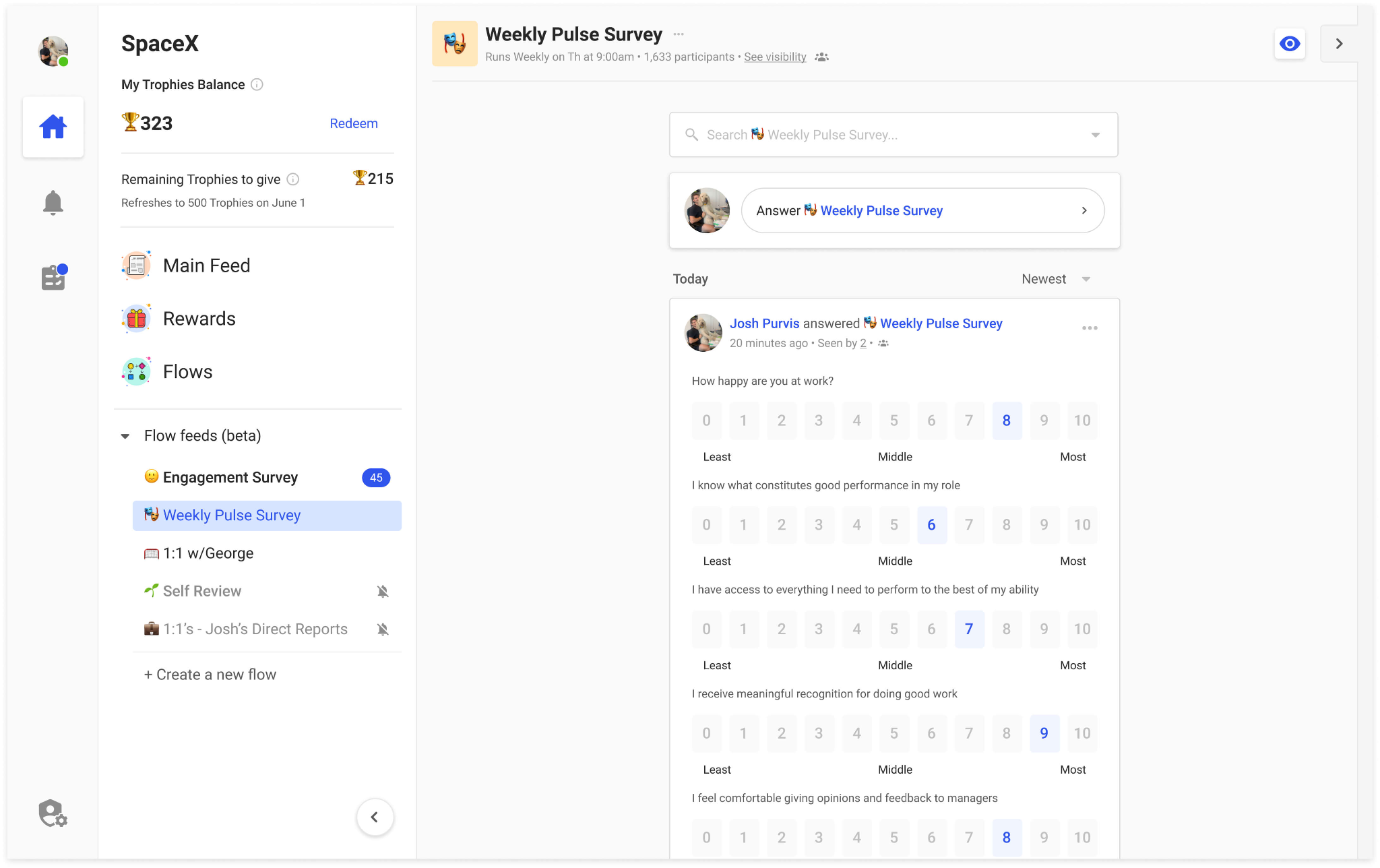
Great leaders know that strong workplace culture does not happen by accident. It comes from regular, honest conversations with employees.
But understanding how your team really feels can be hard. If you only run one big engagement survey every year, you may spot problems too late. A lot can change in 12 months. Employees may feel frustrated, great ideas may go unheard, and top talent may leave even before you notice the warning signs.
Employee pulse surveys help you stay connected more often. Instead of waiting for an annual survey, you can check in regularly and understand what employees need in the moment.
Research by Qualtrics found that 77% of employees want to give feedback more than once a year. But collecting feedback is only the first step. Another report found that while 95% of organizations collect employee feedback, only 15% consistently follow up by sharing what actions they have taken. That gap is where you as a leader can make a real difference.
In this guide, we will explain what employee pulse surveys are, why they matter, and how to use them well. You will also find 25 ready-to-use pulse survey questions and practical tips to turn feedback into real action.
What is an Employee Pulse Survey?
An employee pulse survey is a short, focused survey sent to employees on a regular schedule, such as weekly, biweekly, or monthly. Most pulse surveys include 5 to 15 questions and take less than five minutes to complete.
Instead of waiting for an annual engagement survey to understand how your team is feeling, pulse surveys help you check in more often. This makes it easier to spot changes in employee sentiment early and respond before small issues become bigger problems.
Think of pulse surveys as regular health checks for your organization. An annual survey is like a full physical checkup once a year. A pulse survey is like checking your vitals regularly, so you can catch warning signs early.
Pulse surveys do not replace annual engagement surveys. They complement them. Annual surveys give you the big picture, while pulse surveys help you understand what is changing between those larger check-ins.
They also help you see whether the actions you have taken are actually working. Over time, regular feedback gives employees more chances to share what is on their minds, which builds trust and helps them feel more connected to the process.
If you want a ready-made starting point, our employee pulse survey template gives you a simple, customizable check-in you can launch right away.
How Employee Pulse Surveys Turn Guesswork into Real Insight
Most HR teams know when something feels off. You may notice a team seems quieter than usual, a manager is struggling, or employees seem less motivated.
The hard part is turning that feeling into something clear enough to act on.
Employee pulse check surveys help by giving you regular, timely feedback. Instead of relying on guesses or waiting for someone to speak up, you get real data about how employees are feeling.
You Catch Problems Before They Become Resignations
By the time a problem appears in an annual survey, it may already be too late. An employee may have felt disengaged for months, or a manager relationship may already be strained.
Monthly pulse surveys help you catch these signs earlier. If scores drop on a question like “I feel supported by my manager,” HR can respond within weeks instead of waiting until the end of the year. That early signal gives you a chance to have a conversation or adjust workloads before the issue turns into an exit interview.
You Get Honest Feedback More Consistently
A short pulse survey feels easier to complete than a long annual survey. When a survey has only five questions and takes a few minutes, employees are more likely to respond. The key is following up. When employees see that their feedback leads to visible changes, they are more likely to keep participating and trust the process. Short, frequent surveys also reduce survey fatigue, which is one of the biggest reasons annual survey participation declines year over year.
But how do you know if those changes are actually helping?
Pulse surveys help you measure whether those changes are working. You can ask the same question before and after a change, then use the results to show progress with real data. For example, you can ask employees how supported they feel before changing your one-on-one meeting structure, then ask the same question again a few weeks later.
This gives HR teams a clearer way to show impact. Instead of saying, “We think this helped,” you can point to data that shows whether employee sentiment improved.
You Spot Patterns Across Teams
Company-wide averages can hide important problems.
Your overall engagement score might look healthy, but one department may be struggling. One location may feel disconnected. One team may be dealing with workload issues that are not showing up elsewhere.
Pulse surveys let you break results down by team, department, or location. This helps HR understand where support is needed most, especially in remote and hybrid teams.
If you are seeing signs of overwork in specific teams, our guide on how to prevent employee burnout pairs well with pulse survey findings.
You Build a Culture Where People Feel Heard
Running pulse surveys consistently sends a message: we care about how you experience work here, and we want to know regularly.
But asking for feedback is only the first step. Share what you learned, explain what you are acting on, and be honest about what cannot change right away. When employees see their feedback leading to real decisions, they stay more engaged and more willing to speak up next time. That transparency is what drives lasting employee engagement.
25 Employee Pulse Survey Questions
The right questions can turn employee feedback into clear, useful insight. Here are 25 employee pulse survey questions organized by theme. You can use them as employee pulse survey examples or customize them for your team.
Employee Engagement Pulse Survey Questions
How motivated do you feel about your work right now?
Do you feel connected to what our company is trying to achieve?
Would you recommend this company as a great place to work?
Do you feel excited about the work you are doing this month?
On a scale of 1 to 10, how engaged do you feel at work right now?
Manager Effectiveness Pulse Survey Questions
Does your manager check in with you regularly?
Do you feel comfortable giving honest feedback to your manager?
Does your manager recognize your contributions in a timely way?
How supported do you feel by your manager when facing challenges?
Does your manager help you understand how your work connects to team goals?
Wellbeing and Workload Pulse Survey Questions
Is your current workload sustainable?
Do you feel you can take time off without guilt or worry?
How would you rate your overall wellbeing at work right now?
Do you have enough uninterrupted time for your most important work?
Have you experienced signs of burnout in the past month?
Recognition and Culture Pulse Survey Questions
Do you feel recognized for the work you do?
When was the last time someone acknowledged something you did well?
Do you feel a sense of belonging on your team?
Does our company culture reflect the values we talk about?
Do you see your colleagues being appreciated for their contributions?
Retention and Growth Pulse Survey Questions
Do you see a clear path for growth in your current role?
Have you had a meaningful career development conversation in the last three months?
Do you feel your skills are being used well?
Have you considered looking for a new job in the past month?
What is one thing that would most improve your experience at work right now?
How Pulse Surveys Improve Employee Retention and Reduce Turnover
Retention is rarely about one big moment. It often starts with small things: feeling overlooked, not getting a response after raising a concern, or sharing feedback that never seems to go anywhere.
These small experiences compound over time. Pulse surveys help HR teams catch these issues before they turn into resignations.
When you ask employees regularly about their manager, workload, growth, and recognition, patterns become easier to see. For example, low scores around manager support may show that a team needs more attention. If an employee says they have considered looking for a new job, that is a clear signal to act now, not months later.
A 2025 retention study based on over 120,000 exit interviews found that more than 76% of voluntary departures were driven by preventable factors. Often, employees leave over issues that could have been addressed sooner, from workload pressure to poor manager support or lack of growth.
Pulse surveys give HR teams that early warning system. Instead of relying on one annual snapshot, you get a steady rhythm of feedback throughout the year.
The best organizations use pulse surveys as part of their retention strategy, not just as a measurement tool. They use the data to guide manager coaching, adjust workloads, improve recognition, and understand where employees need more support.
Most importantly, they close the loop. They tell employees what changed because of their feedback. That follow-through is what turns a survey from a checkbox into a trust-building tool. If you are exploring tools to support your retention efforts, our guide on employee retention software covers the best options for 2026.
How Assembly and Quantum Workplace Turn Pulse Survey Data Into Action
Collecting feedback is the easy part. The real value of employee pulse survey tools comes from what happens next: turning employee feedback into clear actions people can actually see and feel.
Quantum Workplace helps HR teams run pulse surveys quickly. Teams can use ready-made templates for topics like wellbeing, psychological safety, remote work, and change management. Results come in real time, and HR can filter that feedback by team, department, or location to see where support is needed most.
It also helps teams move from insight to action. With Action Planning tools, each priority can have a clear owner, timeline, and next step. That way, feedback does not sit in a report without follow-up. Retention Radar also helps identify employees who may be at risk of leaving by combining engagement and retention signals.
Assembly helps keep engagement visible between surveys. If recognition scores are low, peer-to-peer recognition makes appreciation part of everyday work through Slack, Teams, or your HRIS. If manager support needs improvement, Manager 1:1 tools help teams run better check-ins with shared agendas and action tracking. If belonging scores drop, Community Spaces give employees a simple way to connect beyond project work.
Together, Quantum Workplace helps you understand what employees are feeling, while Assembly helps you act on those insights in the daily flow of work.
Final Words
Pulse surveys work best when they lead to action. Start simple. Choose five questions that matter most to your team right now. Send them out once a month. Share what you learned. Then make one visible change based on the results.
Over time, that consistency builds trust. Employees stop wondering whether anyone is listening and start seeing that their feedback can shape how work gets done.
That is what keeps people engaged, growing, and choosing to stay.
If you want to make pulse surveys part of a larger engagement strategy, book a demo with Assembly to see how recognition, feedback, and connection can come together in one place.
Frequently Asked Questions
How many questions should a quick pulse survey include?
A quick pulse survey should usually include 5 to 15 questions. This keeps it short enough for employees to complete in less than five minutes. For best results, focus each survey on one or two themes, such as workload, manager support, or recognition.
How often should you send pulse surveys to employees?
Monthly is a good starting point for most teams. Some organizations use biweekly or quarterly surveys depending on what they want to track. The most important thing is consistency. Choose a schedule you can keep up with, then stick to it.
What should be the primary goal of a quick pulse survey?
The main goal is to collect specific feedback you can act on quickly. Pulse surveys work best when they focus on a clear topic, such as manager support, workload, wellbeing, recognition, or career growth. They should not try to measure everything at once.
How do you set up employee pulse surveys for remote teams?
Choose employee pulse survey software that works well on mobile and connects with tools like Slack or Microsoft Teams. Keep the survey anonymous, send automatic reminders, and share the results openly. This helps remote employees see that their feedback is being heard and acted on.
Can pulse surveys replace annual engagement surveys?
No. Pulse surveys and annual engagement surveys serve different purposes. Annual surveys give you a broader view of the whole organization. Pulse surveys help you track specific topics more often between those larger surveys. The strongest employee listening strategies usually use both.
What Is the difference between a pulse survey and an engagement survey?
An engagement survey is longer and more detailed. It usually runs once or twice a year and covers many areas of the employee experience. A pulse survey is shorter, more frequent, and focused on specific themes. Engagement surveys give you the big picture. Pulse surveys help you spot changes sooner and respond faster.
class SampleComponent extends React.Component {
  // using the experimental public class field syntax below. We can also attach
  // the contextType to the current class
  static contextType = ColorContext;
  render() {
    return <Button color={this.color} />
  }
}
Great leaders know that strong workplace culture does not happen by accident. It comes from regular, honest conversations with employees.
But understanding how your team really feels can be hard. If you only run one big engagement survey every year, you may spot problems too late. A lot can change in 12 months. Employees may feel frustrated, great ideas may go unheard, and top talent may leave even before you notice the warning signs.
Employee pulse surveys help you stay connected more often. Instead of waiting for an annual survey, you can check in regularly and understand what employees need in the moment.
Research by Qualtrics found that 77% of employees want to give feedback more than once a year. But collecting feedback is only the first step. Another report found that while 95% of organizations collect employee feedback, only 15% consistently follow up by sharing what actions they have taken. That gap is where you as a leader can make a real difference.
In this guide, we will explain what employee pulse surveys are, why they matter, and how to use them well. You will also find 25 ready-to-use pulse survey questions and practical tips to turn feedback into real action.
What is an Employee Pulse Survey?
An employee pulse survey is a short, focused survey sent to employees on a regular schedule, such as weekly, biweekly, or monthly. Most pulse surveys include 5 to 15 questions and take less than five minutes to complete.
Instead of waiting for an annual engagement survey to understand how your team is feeling, pulse surveys help you check in more often. This makes it easier to spot changes in employee sentiment early and respond before small issues become bigger problems.
Think of pulse surveys as regular health checks for your organization. An annual survey is like a full physical checkup once a year. A pulse survey is like checking your vitals regularly, so you can catch warning signs early.
Pulse surveys do not replace annual engagement surveys. They complement them. Annual surveys give you the big picture, while pulse surveys help you understand what is changing between those larger check-ins.
They also help you see whether the actions you have taken are actually working. Over time, regular feedback gives employees more chances to share what is on their minds, which builds trust and helps them feel more connected to the process.
If you want a ready-made starting point, our employee pulse survey template gives you a simple, customizable check-in you can launch right away.
How Employee Pulse Surveys Turn Guesswork into Real Insight
Most HR teams know when something feels off. You may notice a team seems quieter than usual, a manager is struggling, or employees seem less motivated.
The hard part is turning that feeling into something clear enough to act on.
Employee pulse check surveys help by giving you regular, timely feedback. Instead of relying on guesses or waiting for someone to speak up, you get real data about how employees are feeling.
You Catch Problems Before They Become Resignations
By the time a problem appears in an annual survey, it may already be too late. An employee may have felt disengaged for months, or a manager relationship may already be strained.
Monthly pulse surveys help you catch these signs earlier. If scores drop on a question like “I feel supported by my manager,” HR can respond within weeks instead of waiting until the end of the year. That early signal gives you a chance to have a conversation or adjust workloads before the issue turns into an exit interview.
You Get Honest Feedback More Consistently
A short pulse survey feels easier to complete than a long annual survey. When a survey has only five questions and takes a few minutes, employees are more likely to respond. The key is following up. When employees see that their feedback leads to visible changes, they are more likely to keep participating and trust the process. Short, frequent surveys also reduce survey fatigue, which is one of the biggest reasons annual survey participation declines year over year.
But how do you know if those changes are actually helping?
Pulse surveys help you measure whether those changes are working. You can ask the same question before and after a change, then use the results to show progress with real data. For example, you can ask employees how supported they feel before changing your one-on-one meeting structure, then ask the same question again a few weeks later.
This gives HR teams a clearer way to show impact. Instead of saying, “We think this helped,” you can point to data that shows whether employee sentiment improved.
You Spot Patterns Across Teams
Company-wide averages can hide important problems.
Your overall engagement score might look healthy, but one department may be struggling. One location may feel disconnected. One team may be dealing with workload issues that are not showing up elsewhere.
Pulse surveys let you break results down by team, department, or location. This helps HR understand where support is needed most, especially in remote and hybrid teams.
If you are seeing signs of overwork in specific teams, our guide on how to prevent employee burnout pairs well with pulse survey findings.
You Build a Culture Where People Feel Heard
Running pulse surveys consistently sends a message: we care about how you experience work here, and we want to know regularly.
But asking for feedback is only the first step. Share what you learned, explain what you are acting on, and be honest about what cannot change right away. When employees see their feedback leading to real decisions, they stay more engaged and more willing to speak up next time. That transparency is what drives lasting employee engagement.
25 Employee Pulse Survey Questions
The right questions can turn employee feedback into clear, useful insight. Here are 25 employee pulse survey questions organized by theme. You can use them as employee pulse survey examples or customize them for your team.
Employee Engagement Pulse Survey Questions
How motivated do you feel about your work right now?
Do you feel connected to what our company is trying to achieve?
Would you recommend this company as a great place to work?
Do you feel excited about the work you are doing this month?
On a scale of 1 to 10, how engaged do you feel at work right now?
Manager Effectiveness Pulse Survey Questions
Does your manager check in with you regularly?
Do you feel comfortable giving honest feedback to your manager?
Does your manager recognize your contributions in a timely way?
How supported do you feel by your manager when facing challenges?
Does your manager help you understand how your work connects to team goals?
Wellbeing and Workload Pulse Survey Questions
Is your current workload sustainable?
Do you feel you can take time off without guilt or worry?
How would you rate your overall wellbeing at work right now?
Do you have enough uninterrupted time for your most important work?
Have you experienced signs of burnout in the past month?
Recognition and Culture Pulse Survey Questions
Do you feel recognized for the work you do?
When was the last time someone acknowledged something you did well?
Do you feel a sense of belonging on your team?
Does our company culture reflect the values we talk about?
Do you see your colleagues being appreciated for their contributions?
Retention and Growth Pulse Survey Questions
Do you see a clear path for growth in your current role?
Have you had a meaningful career development conversation in the last three months?
Do you feel your skills are being used well?
Have you considered looking for a new job in the past month?
What is one thing that would most improve your experience at work right now?
How Pulse Surveys Improve Employee Retention and Reduce Turnover
Retention is rarely about one big moment. It often starts with small things: feeling overlooked, not getting a response after raising a concern, or sharing feedback that never seems to go anywhere.
These small experiences compound over time. Pulse surveys help HR teams catch these issues before they turn into resignations.
When you ask employees regularly about their manager, workload, growth, and recognition, patterns become easier to see. For example, low scores around manager support may show that a team needs more attention. If an employee says they have considered looking for a new job, that is a clear signal to act now, not months later.
A 2025 retention study based on over 120,000 exit interviews found that more than 76% of voluntary departures were driven by preventable factors. Often, employees leave over issues that could have been addressed sooner, from workload pressure to poor manager support or lack of growth.
Pulse surveys give HR teams that early warning system. Instead of relying on one annual snapshot, you get a steady rhythm of feedback throughout the year.
The best organizations use pulse surveys as part of their retention strategy, not just as a measurement tool. They use the data to guide manager coaching, adjust workloads, improve recognition, and understand where employees need more support.
Most importantly, they close the loop. They tell employees what changed because of their feedback. That follow-through is what turns a survey from a checkbox into a trust-building tool. If you are exploring tools to support your retention efforts, our guide on employee retention software covers the best options for 2026.
How Assembly and Quantum Workplace Turn Pulse Survey Data Into Action
Collecting feedback is the easy part. The real value of employee pulse survey tools comes from what happens next: turning employee feedback into clear actions people can actually see and feel.
Quantum Workplace helps HR teams run pulse surveys quickly. Teams can use ready-made templates for topics like wellbeing, psychological safety, remote work, and change management. Results come in real time, and HR can filter that feedback by team, department, or location to see where support is needed most.
It also helps teams move from insight to action. With Action Planning tools, each priority can have a clear owner, timeline, and next step. That way, feedback does not sit in a report without follow-up. Retention Radar also helps identify employees who may be at risk of leaving by combining engagement and retention signals.
Assembly helps keep engagement visible between surveys. If recognition scores are low, peer-to-peer recognition makes appreciation part of everyday work through Slack, Teams, or your HRIS. If manager support needs improvement, Manager 1:1 tools help teams run better check-ins with shared agendas and action tracking. If belonging scores drop, Community Spaces give employees a simple way to connect beyond project work.
Together, Quantum Workplace helps you understand what employees are feeling, while Assembly helps you act on those insights in the daily flow of work.
Final Words
Pulse surveys work best when they lead to action. Start simple. Choose five questions that matter most to your team right now. Send them out once a month. Share what you learned. Then make one visible change based on the results.
Over time, that consistency builds trust. Employees stop wondering whether anyone is listening and start seeing that their feedback can shape how work gets done.
That is what keeps people engaged, growing, and choosing to stay.
If you want to make pulse surveys part of a larger engagement strategy, book a demo with Assembly to see how recognition, feedback, and connection can come together in one place.
Frequently Asked Questions
How many questions should a quick pulse survey include?
A quick pulse survey should usually include 5 to 15 questions. This keeps it short enough for employees to complete in less than five minutes. For best results, focus each survey on one or two themes, such as workload, manager support, or recognition.
How often should you send pulse surveys to employees?
Monthly is a good starting point for most teams. Some organizations use biweekly or quarterly surveys depending on what they want to track. The most important thing is consistency. Choose a schedule you can keep up with, then stick to it.
What should be the primary goal of a quick pulse survey?
The main goal is to collect specific feedback you can act on quickly. Pulse surveys work best when they focus on a clear topic, such as manager support, workload, wellbeing, recognition, or career growth. They should not try to measure everything at once.
How do you set up employee pulse surveys for remote teams?
Choose employee pulse survey software that works well on mobile and connects with tools like Slack or Microsoft Teams. Keep the survey anonymous, send automatic reminders, and share the results openly. This helps remote employees see that their feedback is being heard and acted on.
Can pulse surveys replace annual engagement surveys?
No. Pulse surveys and annual engagement surveys serve different purposes. Annual surveys give you a broader view of the whole organization. Pulse surveys help you track specific topics more often between those larger surveys. The strongest employee listening strategies usually use both.
What Is the difference between a pulse survey and an engagement survey?
An engagement survey is longer and more detailed. It usually runs once or twice a year and covers many areas of the employee experience. A pulse survey is shorter, more frequent, and focused on specific themes. Engagement surveys give you the big picture. Pulse surveys help you spot changes sooner and respond faster.
Browse our Free Employee Recognition Guide
Get the foundational knowledge on creating an employee recognition program that boosts employee engagement and helps them feel valued.